p.19 抽出テキスト
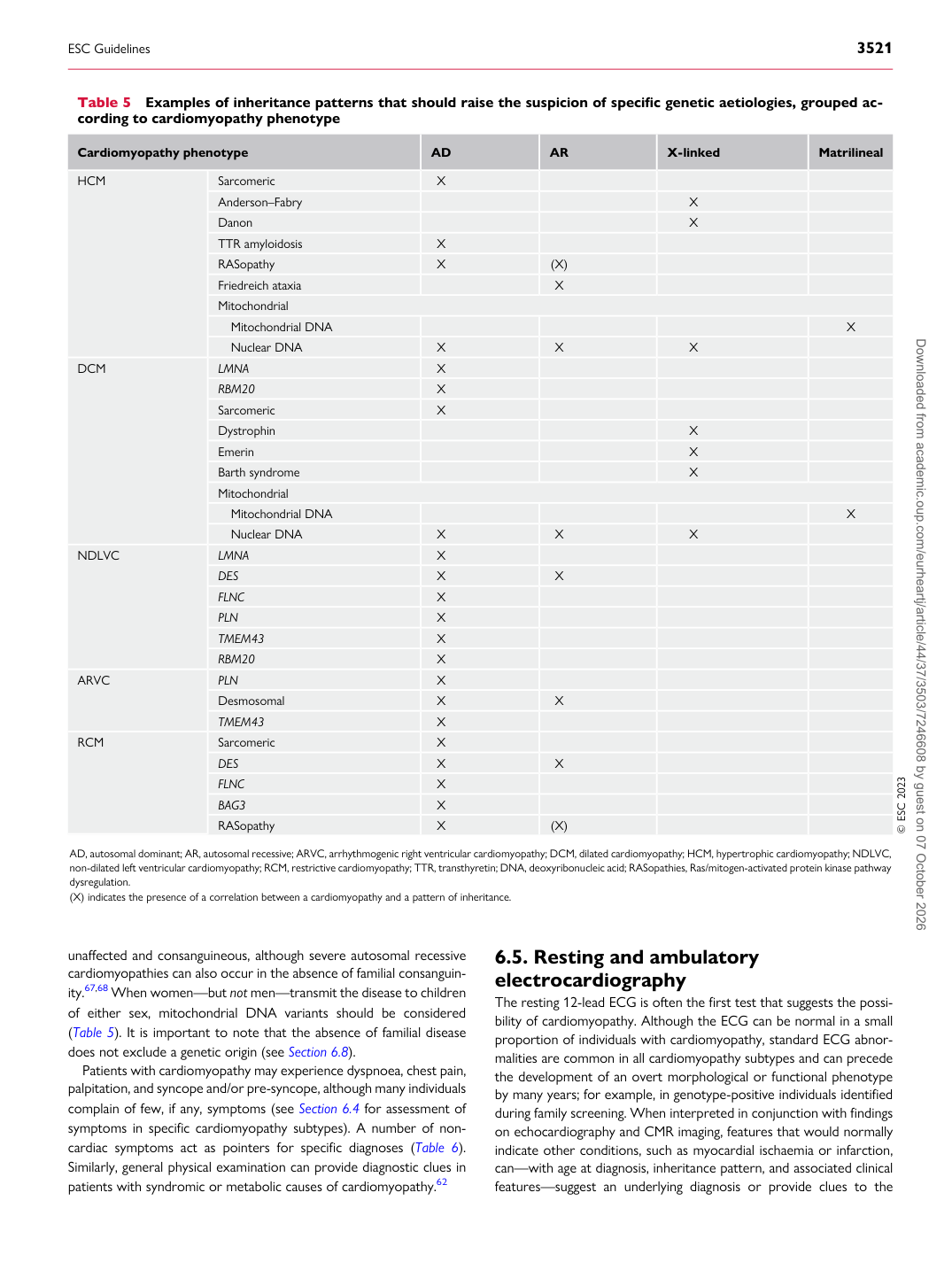
unaffected and consanguineous, although severe autosomal recessive cardiomyopathies can also occur in the absence of familial consanguinity.67,68 When women—but not men—transmit the disease to children of either sex, mitochondrial DNA variants should be considered (Table 5). It is important to note that the absence of familial disease does not exclude a genetic origin (see Section 6.8). Patients with cardiomyopathy may experience dyspnoea, chest pain, palpitation, and syncope and/or pre-syncope, although many individuals complain of few, if any, symptoms (see Section 6.4 for assessment of symptoms in specific cardiomyopathy subtypes). A number of noncardiac symptoms act as pointers for specific diagnoses (Table 6). Similarly, general physical examination can provide diagnostic clues in patients with syndromic or metabolic causes of cardiomyopathy.62 6.5 Resting and ambulatory

electrocardiography The resting 12-lead ECG is often the first test that suggests the possibility of cardiomyopathy. Although the ECG can be normal in a small proportion of individuals with cardiomyopathy, standard ECG abnormalities are common in all cardiomyopathy subtypes and can precede the development of an overt morphological or functional phenotype by many years; for example, in genotype-positive individuals identified during family screening. When interpreted in conjunction with findings on echocardiography and CMR imaging, features that would normally indicate other conditions, such as myocardial ischaemia or infarction, can—with age at diagnosis, inheritance pattern, and associated clinical features—suggest an underlying diagnosis or provide clues to the

Table 5 Examples of inheritance patterns that should raise the suspicion of specific genetic aetiologies, grouped according to cardiomyopathy phenotype

Cardiomyopathy phenotype AD AR X-linked Matrilineal

HCM Sarcomeric X

Anderson–Fabry X Danon X TTR amyloidosis X RASopathy X (X) Friedreich ataxia X Mitochondrial

Mitochondrial DNA X Nuclear DNA X X X

DCM LMNA X

RBM20 X Sarcomeric X Dystrophin X Emerin X Barth syndrome X Mitochondrial

Mitochondrial DNA X Nuclear DNA X X X

NDLVC LMNA X

DES X X FLNC X PLN X TMEM43 X RBM20 X

ARVC PLN X

Desmosomal X X TMEM43 X

RCM Sarcomeric X

DES X X FLNC X BAG3 X RASopathy X (X) © ESC 2023

AD, autosomal dominant; AR, autosomal recessive; ARVC, arrhythmogenic right ventricular cardiomyopathy; DCM, dilated cardiomyopathy; HCM, hypertrophic cardiomyopathy; NDLVC, non-dilated left ventricular cardiomyopathy; RCM, restrictive cardiomyopathy; TTR, transthyretin; DNA, deoxyribonucleic acid; RASopathies, Ras/mitogen-activated protein kinase pathway dysregulation. (X) indicates the presence of a correlation between a cardiomyopathy and a pattern of inheritance.

ESC Guidelines                                                                                                                                                                                          3521

Downloaded from academic.oup.com/eurheartj/article/44/37/3503/7246608 by guest on 07 October 2026