p.18 抽出テキスト
6.1 Clinical presentation

Patients with cardiomyopathy may access health services through several pathways. Referral from primary care (e.g. general practitioners and general paediatricians) may be triggered by symptoms (most commonly dyspnoea, chest pain, palpitation, syncope) or incidental findings (e.g. an abnormal electrocardiogram [ECG] in the context of community, school, work-related medical check-ups, or sports preparticipation screening; the incidental detection of a murmur; or, increasingly, genotype-first identification as a result of secondary findings during research or clinical sequencing for other indications). In secondary and tertiary care (general cardiology and paediatric cardiology), patients with cardiomyopathy may present to the heart failure clinic with symptoms of heart failure with reduced ejection fraction (HFrEF), mildly reduced ejection fraction (HFmrEF), or preserved ejection fraction (HFpEF); to the arrhythmia clinic with early-onset conduction disease, atrial arrhythmia, or ventricular arrhythmia; or to the emergency department with suspected myocarditis. Frequently, patients enter the cardiomyopathy pathway in primary, secondary, or tertiary care as a result of family screening following the diagnosis of cardiomyopathy or a sudden death in a relative, and may also be identified as part of the work-up for multiorgan disease known to be associated with cardiovascular involvement. Clinicians in all these settings therefore need to consider the possibility of cardiomyopathy as a cause and use a systematic, cardiomyopathy-oriented approach to clinical evaluation.

6.2 Initial work-up

The cardiomyopathy-oriented approach is based on interpreting clinical and instrumental findings to suspect and ultimately generate a phenotype-based aetiological diagnosis to guide disease-specific management.62 This approach requires deliberate analysis of multiparametric investigations in the individual and their relatives and an integrated probabilistic analysis of clinical investigations. Re-analysis of clinical data is required as new information emerges, and family information can provide important clues to the diagnosis, given the variable expression and incomplete penetrance of most cardiomyopathies, and can result in differences in diagnostic criteria between probands and relatives. In this context, relatives of individuals with cardiomyopathy can have non-diagnostic morphological and electrocardiographic abnormalities that can indicate mild and early phenotypic expression of disease and can increase diagnostic accuracy for predicting disease in genotyped populations. The identification of diagnostic clues, or red flags, is a crucial aspect of the initial work-up.

6.3 Systematic approach to diagnosis of

cardiomyopathy A multiparametric approach to the evaluation of patients with suspected cardiomyopathy is recommended, with the aims of: (i) establishing and characterizing the presence of a cardiomyopathy phenotype; and (ii) identifying the underlying aetiological diagnosis.62 Clinicians should approach a patient with suspected cardiomyopathy using a ‘cardiomyopathy mindset’ (Figure 2): • Use multimodality imaging to characterize the phenotype and identify abnormal ventricular morphology (e.g. hypertrophy, dilatation) and function (systolic/diastolic, global/regional), and detect abnormalities of tissue characterization (e.g. non-ischaemic myocardial scar and fatty replacement). • Use a combination of personal and family history, clinical examination, electrocardiography, and laboratory investigations to achieve an aetiological diagnosis, looking for specific signs and symptoms and laboratory markers suggestive of a specific diagnosis; the presence of ventricular and atrial arrhythmia and conduction disease to aid diagnosis, suggest specific causes, and monitor disease progression and risk stratification; and clues from the pedigree to suggest specific inheritance patterns and identify at-risk relatives. This approach should result in a timely and accurate diagnosis to enable early treatment of symptoms and prevention of disease-related complications.

6.4 History and physical examination

Age is one of the most important factors to take into account when considering the possible causes of cardiomyopathy. For example, inherited metabolic disorders and congenital dysmorphic syndromes are more common in neonates and infants (see Section 6.9.1) than in older children or adults, whereas wild-type transthyretin amyloidosis (ATTRwt) is a disease mostly of adults over the age of 65 years (see Section 7.6). Construction of a three- to four-generation family pedigree helps to identify Mendelian forms of inheritance and identifies other family members who may be at risk of disease development.62 Specific features to note in the family history include premature deaths (taking into account that SCDs may sometimes be reported as accidental deaths, e.g. drowning, unexplained traffic accident, and, rarely, as stillbirth or sudden infant death syndromes), unexplained heart failure, cardiac transplantation, pacemaker and defibrillator implants, and evidence for systemic disease (e.g. stroke at a young age, skeletal muscle weakness, renal dysfunction, diabetes, deafness). Most Mendelian forms of cardiomyopathy are autosomal dominant and are therefore characterized by the presence of affected individuals across generations, with transmission from parents of either sex (including male-to-male) and a 50% risk of allele transmission to offspring (although, due to incomplete penetrance, the proportion of affected individuals in an individual pedigree will be lower). X-linked inheritance should be suspected if males are the most severely affected individuals and there is no male-to-male transmission. Autosomal recessive inheritance, the least common pattern, is likely when both parents of the proband are

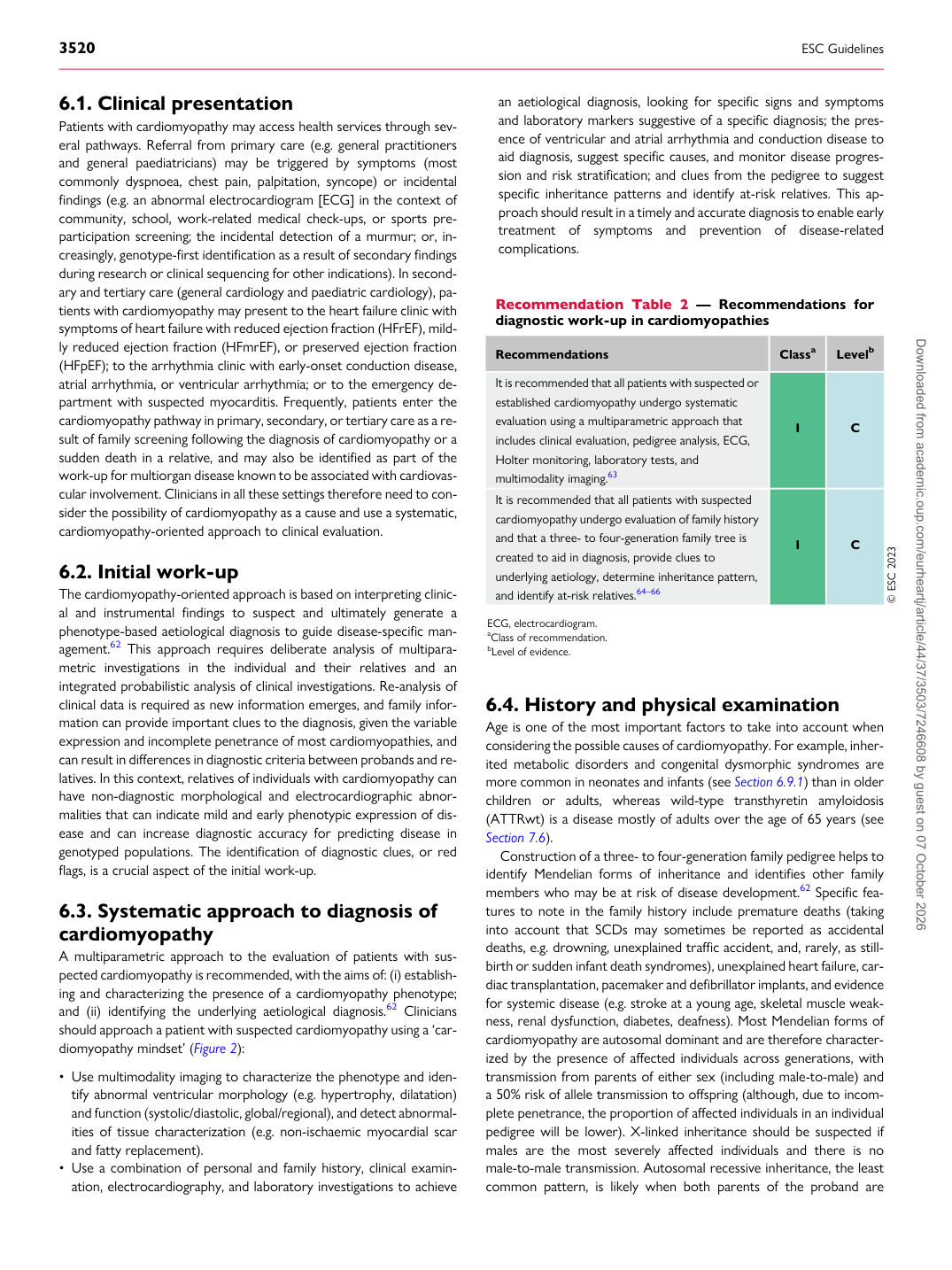
Recommendation Table 2 — Recommendations for diagnostic work-up in cardiomyopathies

Recommendations Classa Levelb

It is recommended that all patients with suspected or established cardiomyopathy undergo systematic evaluation using a multiparametric approach that includes clinical evaluation, pedigree analysis, ECG, Holter monitoring, laboratory tests, and multimodality imaging.63 I C It is recommended that all patients with suspected cardiomyopathy undergo evaluation of family history and that a three- to four-generation family tree is created to aid in diagnosis, provide clues to underlying aetiology, determine inheritance pattern, and identify at-risk relatives.64–66 I C © ESC 2023

ECG, electrocardiogram. aClass of recommendation. bLevel of evidence. Downloaded from academic.oup.com/eurheartj/article/44/37/3503/7246608 by guest on 07 October 2026