p.81 抽出テキスト
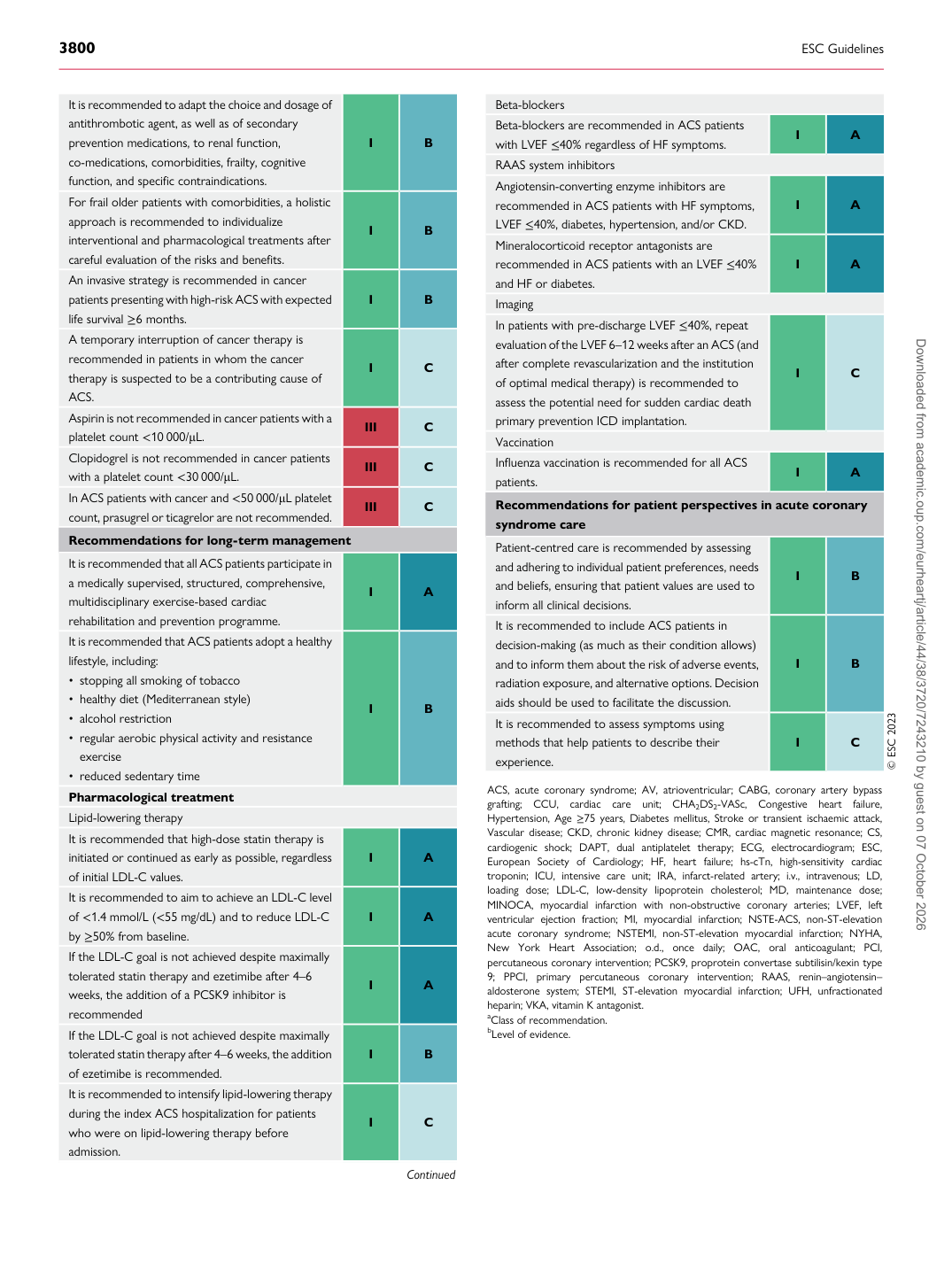
It is recommended to adapt the choice and dosage of antithrombotic agent, as well as of secondary prevention medications, to renal function, co-medications, comorbidities, frailty, cognitive function, and specific contraindications. I B For frail older patients with comorbidities, a holistic approach is recommended to individualize interventional and pharmacological treatments after careful evaluation of the risks and benefits. I B An invasive strategy is recommended in cancer patients presenting with high-risk ACS with expected life survival ≥6 months. I B A temporary interruption of cancer therapy is recommended in patients in whom the cancer therapy is suspected to be a contributing cause of ACS. I C Aspirin is not recommended in cancer patients with a platelet count <10 000/μL. III C Clopidogrel is not recommended in cancer patients with a platelet count <30 000/μL. III C In ACS patients with cancer and <50 000/μL platelet count, prasugrel or ticagrelor are not recommended. III C Recommendations for long-term management It is recommended that all ACS patients participate in a medically supervised, structured, comprehensive, multidisciplinary exercise-based cardiac rehabilitation and prevention programme. I A It is recommended that ACS patients adopt a healthy lifestyle, including: • stopping all smoking of tobacco • healthy diet (Mediterranean style) • alcohol restriction • regular aerobic physical activity and resistance

exercise • reduced sedentary time I B Pharmacological treatment Lipid-lowering therapy It is recommended that high-dose statin therapy is initiated or continued as early as possible, regardless of initial LDL-C values. I A It is recommended to aim to achieve an LDL-C level of <1.4 mmol/L (<55 mg/dL) and to reduce LDL-C by ≥50% from baseline. I A If the LDL-C goal is not achieved despite maximally tolerated statin therapy and ezetimibe after 4–6 weeks, the addition of a PCSK9 inhibitor is recommended I A If the LDL-C goal is not achieved despite maximally tolerated statin therapy after 4–6 weeks, the addition of ezetimibe is recommended. I B It is recommended to intensify lipid-lowering therapy during the index ACS hospitalization for patients who were on lipid-lowering therapy before admission. I C

Continued Beta-blockers

Beta-blockers are recommended in ACS patients with LVEF ≤40% regardless of HF symptoms. I A RAAS system inhibitors Angiotensin-converting enzyme inhibitors are recommended in ACS patients with HF symptoms, LVEF ≤40%, diabetes, hypertension, and/or CKD. I A Mineralocorticoid receptor antagonists are recommended in ACS patients with an LVEF ≤40% and HF or diabetes. I A Imaging In patients with pre-discharge LVEF ≤40%, repeat evaluation of the LVEF 6–12 weeks after an ACS (and after complete revascularization and the institution of optimal medical therapy) is recommended to assess the potential need for sudden cardiac death primary prevention ICD implantation. I C Vaccination Influenza vaccination is recommended for all ACS patients. I A Recommendations for patient perspectives in acute coronary syndrome care Patient-centred care is recommended by assessing and adhering to individual patient preferences, needs and beliefs, ensuring that patient values are used to inform all clinical decisions. I B It is recommended to include ACS patients in decision-making (as much as their condition allows) and to inform them about the risk of adverse events, radiation exposure, and alternative options. Decision aids should be used to facilitate the discussion. I B It is recommended to assess symptoms using methods that help patients to describe their experience. I C © ESC 2023

ACS, acute coronary syndrome; AV, atrioventricular; CABG, coronary artery bypass grafting; CCU, cardiac care unit; CHA2DS2-VASc, Congestive heart failure, Hypertension, Age ≥75 years, Diabetes mellitus, Stroke or transient ischaemic attack, Vascular disease; CKD, chronic kidney disease; CMR, cardiac magnetic resonance; CS, cardiogenic shock; DAPT, dual antiplatelet therapy; ECG, electrocardiogram; ESC, European Society of Cardiology; HF, heart failure; hs-cTn, high-sensitivity cardiac troponin; ICU, intensive care unit; IRA, infarct-related artery; i.v., intravenous; LD, loading dose; LDL-C, low-density lipoprotein cholesterol; MD, maintenance dose; MINOCA, myocardial infarction with non-obstructive coronary arteries; LVEF, left ventricular ejection fraction; MI, myocardial infarction; NSTE-ACS, non-ST-elevation acute coronary syndrome; NSTEMI, non-ST-elevation myocardial infarction; NYHA, New York Heart Association; o.d., once daily; OAC, oral anticoagulant; PCI, percutaneous coronary intervention; PCSK9, proprotein convertase subtilisin/kexin type 9; PPCI, primary percutaneous coronary intervention; RAAS, renin–angiotensin– aldosterone system; STEMI, ST-elevation myocardial infarction; UFH, unfractionated heparin; VKA, vitamin K antagonist. aClass of recommendation. bLevel of evidence. Downloaded from academic.oup.com/eurheartj/article/44/38/3720/7243210 by guest on 07 October 2026