p.80 抽出テキスト
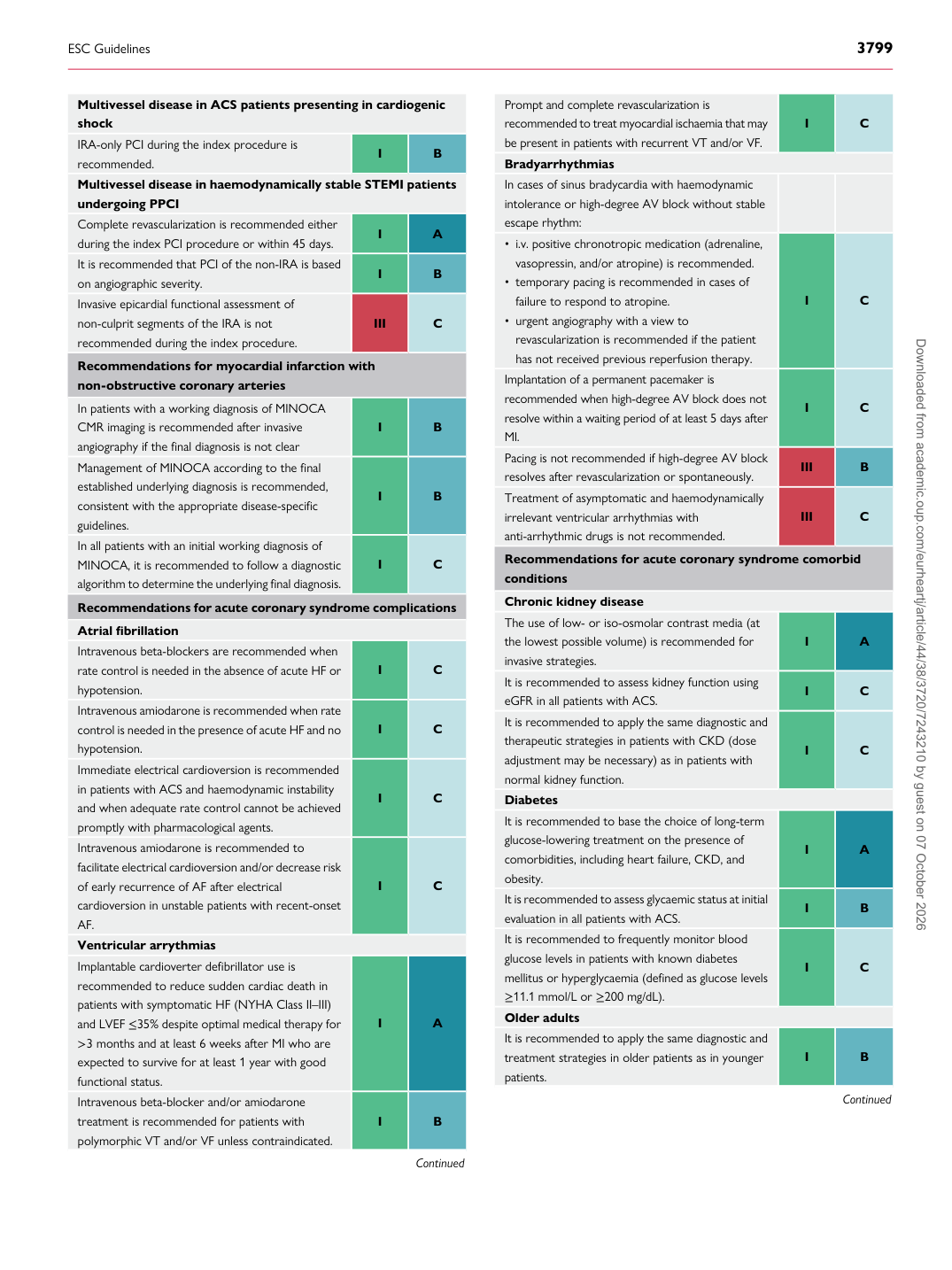
Multivessel disease in ACS patients presenting in cardiogenic shock IRA-only PCI during the index procedure is recommended. I B Multivessel disease in haemodynamically stable STEMI patients undergoing PPCI Complete revascularization is recommended either during the index PCI procedure or within 45 days. I A It is recommended that PCI of the non-IRA is based on angiographic severity. I B Invasive epicardial functional assessment of non-culprit segments of the IRA is not recommended during the index procedure. III C Recommendations for myocardial infarction with non-obstructive coronary arteries In patients with a working diagnosis of MINOCA CMR imaging is recommended after invasive angiography if the final diagnosis is not clear I B Management of MINOCA according to the final established underlying diagnosis is recommended, consistent with the appropriate disease-specific guidelines. I B In all patients with an initial working diagnosis of MINOCA, it is recommended to follow a diagnostic algorithm to determine the underlying final diagnosis. I C Recommendations for acute coronary syndrome complications Atrial fibrillation Intravenous beta-blockers are recommended when rate control is needed in the absence of acute HF or hypotension. I C Intravenous amiodarone is recommended when rate control is needed in the presence of acute HF and no hypotension. I C Immediate electrical cardioversion is recommended in patients with ACS and haemodynamic instability and when adequate rate control cannot be achieved promptly with pharmacological agents. I C Intravenous amiodarone is recommended to facilitate electrical cardioversion and/or decrease risk of early recurrence of AF after electrical cardioversion in unstable patients with recent-onset AF. I C Ventricular arrythmias Implantable cardioverter defibrillator use is recommended to reduce sudden cardiac death in patients with symptomatic HF (NYHA Class II–III) and LVEF ≤35% despite optimal medical therapy for >3 months and at least 6 weeks after MI who are expected to survive for at least 1 year with good functional status. I A Intravenous beta-blocker and/or amiodarone treatment is recommended for patients with polymorphic VT and/or VF unless contraindicated. I B

Continued Prompt and complete revascularization is

recommended to treat myocardial ischaemia that may be present in patients with recurrent VT and/or VF. I C Bradyarrhythmias In cases of sinus bradycardia with haemodynamic intolerance or high-degree AV block without stable escape rhythm: • i.v. positive chronotropic medication (adrenaline, vasopressin, and/or atropine) is recommended. • temporary pacing is recommended in cases of

failure to respond to atropine. • urgent angiography with a view to revascularization is recommended if the patient

has not received previous reperfusion therapy. I C Implantation of a permanent pacemaker is recommended when high-degree AV block does not resolve within a waiting period of at least 5 days after MI. I C Pacing is not recommended if high-degree AV block resolves after revascularization or spontaneously. III B Treatment of asymptomatic and haemodynamically irrelevant ventricular arrhythmias with anti-arrhythmic drugs is not recommended. III C Recommendations for acute coronary syndrome comorbid conditions Chronic kidney disease The use of low- or iso-osmolar contrast media (at the lowest possible volume) is recommended for invasive strategies. I A It is recommended to assess kidney function using eGFR in all patients with ACS. I C It is recommended to apply the same diagnostic and therapeutic strategies in patients with CKD (dose adjustment may be necessary) as in patients with normal kidney function. I C Diabetes It is recommended to base the choice of long-term glucose-lowering treatment on the presence of comorbidities, including heart failure, CKD, and obesity. I A It is recommended to assess glycaemic status at initial evaluation in all patients with ACS. I B It is recommended to frequently monitor blood glucose levels in patients with known diabetes mellitus or hyperglycaemia (defined as glucose levels ≥11.1 mmol/L or ≥200 mg/dL). I C Older adults It is recommended to apply the same diagnostic and treatment strategies in older patients as in younger patients. I B

Continued

ESC Guidelines                                                                                                                                                                                          3799

Downloaded from academic.oup.com/eurheartj/article/44/38/3720/7243210 by guest on 07 October 2026