p.79 抽出テキスト
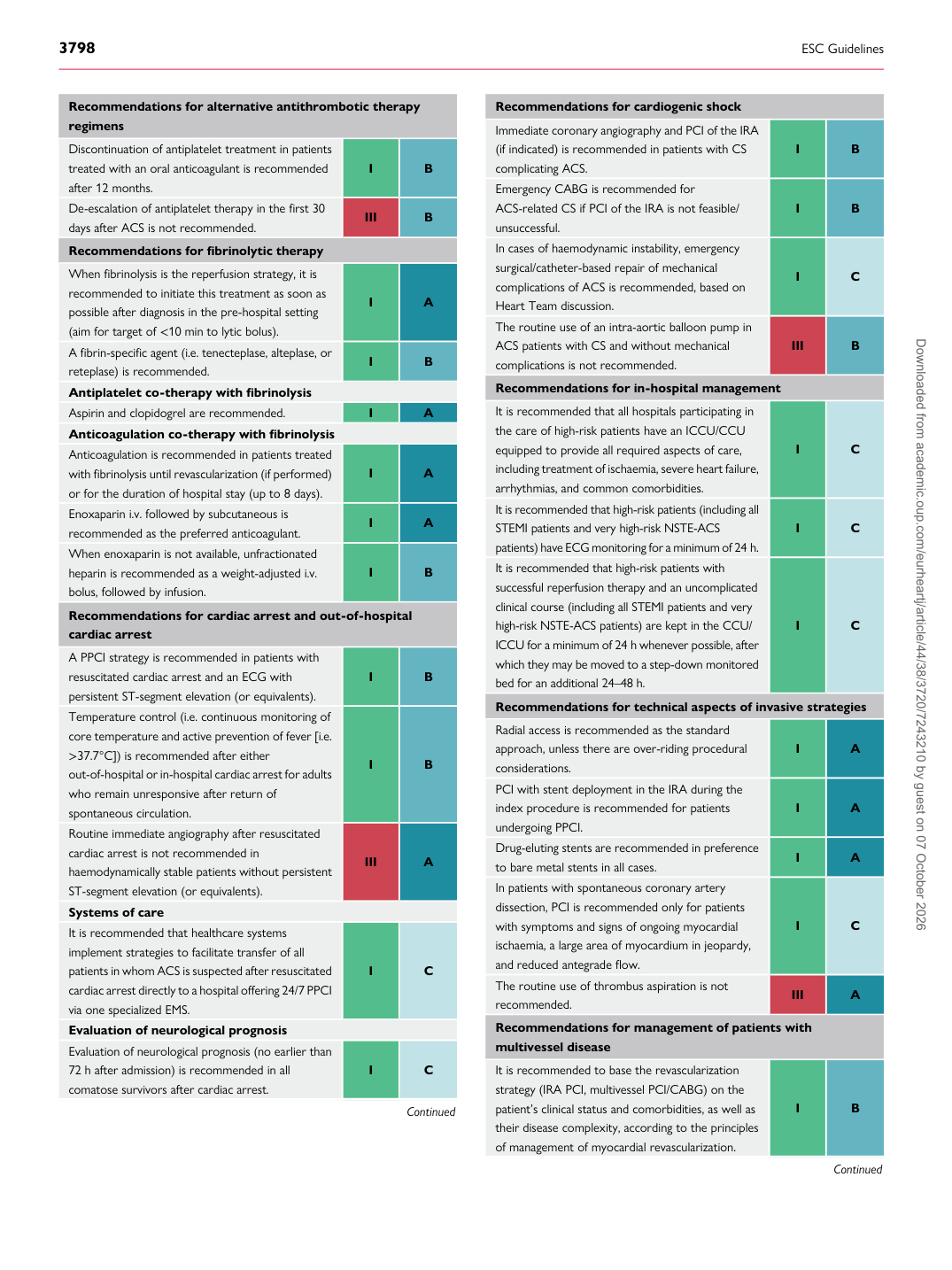
Recommendations for alternative antithrombotic therapy regimens Discontinuation of antiplatelet treatment in patients treated with an oral anticoagulant is recommended after 12 months. I B De-escalation of antiplatelet therapy in the first 30 days after ACS is not recommended. III B Recommendations for fibrinolytic therapy When fibrinolysis is the reperfusion strategy, it is recommended to initiate this treatment as soon as possible after diagnosis in the pre-hospital setting (aim for target of <10 min to lytic bolus). I A A fibrin-specific agent (i.e. tenecteplase, alteplase, or reteplase) is recommended. I B Antiplatelet co-therapy with fibrinolysis Aspirin and clopidogrel are recommended. I A Anticoagulation co-therapy with fibrinolysis Anticoagulation is recommended in patients treated with fibrinolysis until revascularization (if performed) or for the duration of hospital stay (up to 8 days). I A Enoxaparin i.v. followed by subcutaneous is recommended as the preferred anticoagulant. I A When enoxaparin is not available, unfractionated heparin is recommended as a weight-adjusted i.v. bolus, followed by infusion. I B Recommendations for cardiac arrest and out-of-hospital cardiac arrest A PPCI strategy is recommended in patients with resuscitated cardiac arrest and an ECG with persistent ST-segment elevation (or equivalents). I B Temperature control (i.e. continuous monitoring of core temperature and active prevention of fever [i.e. >37.7°C]) is recommended after either out-of-hospital or in-hospital cardiac arrest for adults who remain unresponsive after return of spontaneous circulation. I B Routine immediate angiography after resuscitated cardiac arrest is not recommended in haemodynamically stable patients without persistent ST-segment elevation (or equivalents). III A Systems of care It is recommended that healthcare systems implement strategies to facilitate transfer of all patients in whom ACS is suspected after resuscitated cardiac arrest directly to a hospital offering 24/7 PPCI via one specialized EMS. I C Evaluation of neurological prognosis Evaluation of neurological prognosis (no earlier than 72 h after admission) is recommended in all comatose survivors after cardiac arrest. I C

Continued Recommendations for cardiogenic shock

Immediate coronary angiography and PCI of the IRA (if indicated) is recommended in patients with CS complicating ACS. I B Emergency CABG is recommended for ACS-related CS if PCI of the IRA is not feasible/ unsuccessful. I B In cases of haemodynamic instability, emergency surgical/catheter-based repair of mechanical complications of ACS is recommended, based on Heart Team discussion. I C The routine use of an intra-aortic balloon pump in ACS patients with CS and without mechanical complications is not recommended. III B Recommendations for in-hospital management It is recommended that all hospitals participating in the care of high-risk patients have an ICCU/CCU equipped to provide all required aspects of care, including treatment of ischaemia, severe heart failure, arrhythmias, and common comorbidities. I C It is recommended that high-risk patients (including all STEMI patients and very high-risk NSTE-ACS patients) have ECG monitoring for a minimum of 24 h. I C It is recommended that high-risk patients with successful reperfusion therapy and an uncomplicated clinical course (including all STEMI patients and very high-risk NSTE-ACS patients) are kept in the CCU/ ICCU for a minimum of 24 h whenever possible, after which they may be moved to a step-down monitored bed for an additional 24–48 h. I C Recommendations for technical aspects of invasive strategies Radial access is recommended as the standard approach, unless there are over-riding procedural considerations. I A PCI with stent deployment in the IRA during the index procedure is recommended for patients undergoing PPCI. I A Drug-eluting stents are recommended in preference to bare metal stents in all cases. I A In patients with spontaneous coronary artery dissection, PCI is recommended only for patients with symptoms and signs of ongoing myocardial ischaemia, a large area of myocardium in jeopardy, and reduced antegrade flow. I C The routine use of thrombus aspiration is not recommended. III A Recommendations for management of patients with multivessel disease It is recommended to base the revascularization strategy (IRA PCI, multivessel PCI/CABG) on the patient’s clinical status and comorbidities, as well as their disease complexity, according to the principles of management of myocardial revascularization. I B

Continued Downloaded from academic.oup.com/eurheartj/article/44/38/3720/7243210 by guest on 07 October 2026