p.76 抽出テキスト
17 Sex differences

There are currently no data supporting the differential management of ACS based on sex. However, several studies have reported that women presenting with ACS are treated differently than men.914–918 This includes being less likely than men to receive ICA, timely revascularization, CR, and secondary prevention medications.914–918 Healthcare providers and policymakers should be conscious of this potential gender bias in the management of ACS and make a concerted effort to ensure that women with ACS receive evidence-based care. In order to ensure the generalizability of the findings yielded by RCTs, patient recruitment should be reflective of real-world populations from different socioeconomic backgrounds.919 Several studies have reported that a disproportionately low proportion of women are recruited to CV trials.920–922 Alongside historic underrepresentation of other subsets of patients, including older patients and ethnic minorities, this suggests an underlying recruitment bias.923

Increased representation of female patients in future clinical trials is required to better inform the optimal management of women with ACS.924

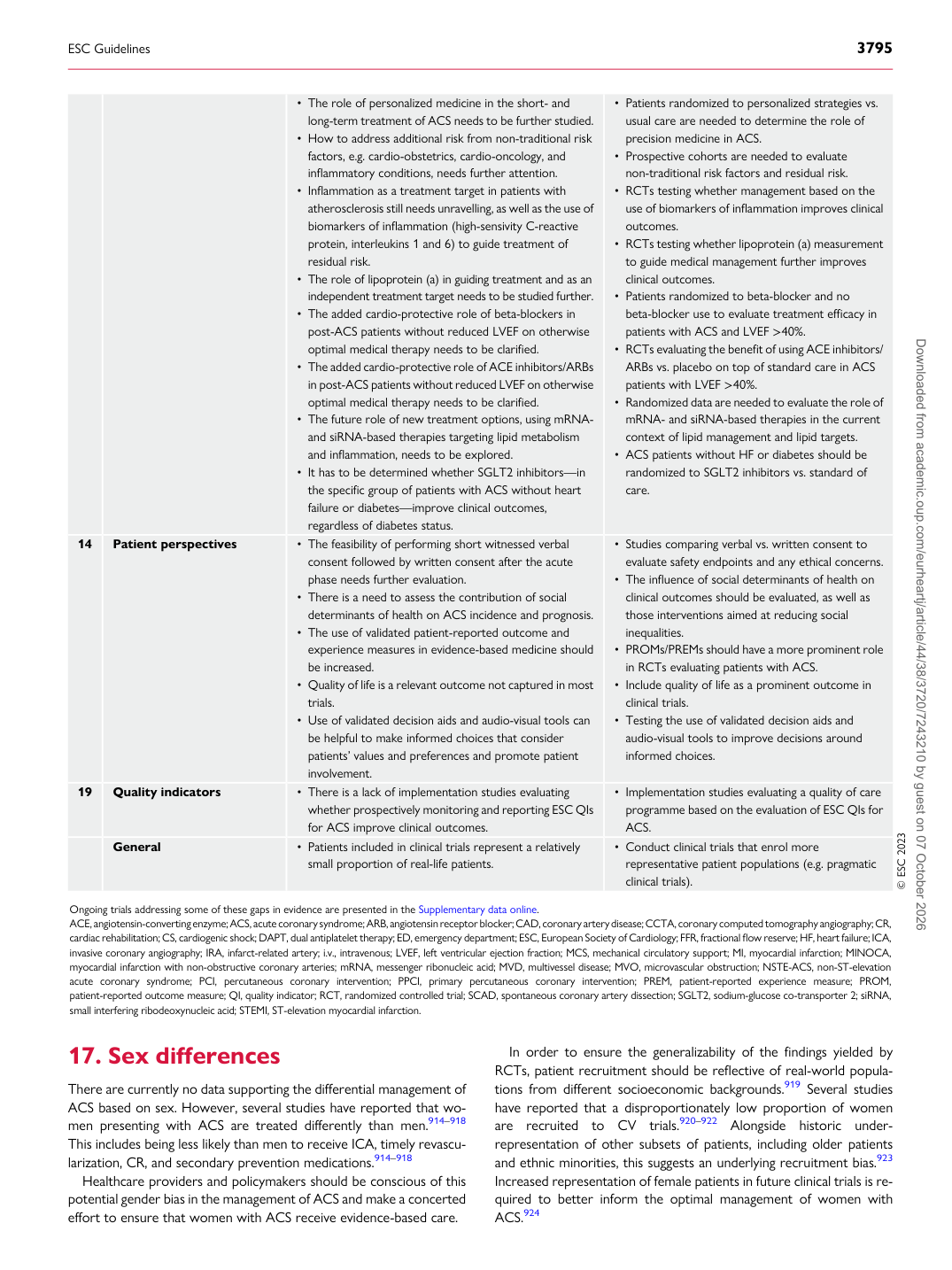
• The role of personalized medicine in the short- and long-term treatment of ACS needs to be further studied. • How to address additional risk from non-traditional risk factors, e.g. cardio-obstetrics, cardio-oncology, and inflammatory conditions, needs further attention. • Inflammation as a treatment target in patients with atherosclerosis still needs unravelling, as well as the use of biomarkers of inflammation (high-sensivity C-reactive protein, interleukins 1 and 6) to guide treatment of residual risk. • The role of lipoprotein (a) in guiding treatment and as an independent treatment target needs to be studied further. • The added cardio-protective role of beta-blockers in post-ACS patients without reduced LVEF on otherwise optimal medical therapy needs to be clarified. • The added cardio-protective role of ACE inhibitors/ARBs in post-ACS patients without reduced LVEF on otherwise optimal medical therapy needs to be clarified. • The future role of new treatment options, using mRNAand siRNA-based therapies targeting lipid metabolism and inflammation, needs to be explored. • It has to be determined whether SGLT2 inhibitors—in the specific group of patients with ACS without heart failure or diabetes—improve clinical outcomes, regardless of diabetes status. • Patients randomized to personalized strategies vs. usual care are needed to determine the role of precision medicine in ACS. • Prospective cohorts are needed to evaluate non-traditional risk factors and residual risk. • RCTs testing whether management based on the use of biomarkers of inflammation improves clinical outcomes. • RCTs testing whether lipoprotein (a) measurement to guide medical management further improves clinical outcomes. • Patients randomized to beta-blocker and no beta-blocker use to evaluate treatment efficacy in patients with ACS and LVEF >40%. • RCTs evaluating the benefit of using ACE inhibitors/ ARBs vs. placebo on top of standard care in ACS patients with LVEF >40%. • Randomized data are needed to evaluate the role of mRNA- and siRNA-based therapies in the current context of lipid management and lipid targets. • ACS patients without HF or diabetes should be randomized to SGLT2 inhibitors vs. standard of care.

14 Patient perspectives • The feasibility of performing short witnessed verbal consent followed by written consent after the acute phase needs further evaluation. • There is a need to assess the contribution of social determinants of health on ACS incidence and prognosis. • The use of validated patient-reported outcome and experience measures in evidence-based medicine should be increased. • Quality of life is a relevant outcome not captured in most trials. • Use of validated decision aids and audio-visual tools can be helpful to make informed choices that consider patients’ values and preferences and promote patient involvement. • Studies comparing verbal vs. written consent to evaluate safety endpoints and any ethical concerns. • The influence of social determinants of health on clinical outcomes should be evaluated, as well as those interventions aimed at reducing social inequalities. • PROMs/PREMs should have a more prominent role in RCTs evaluating patients with ACS. • Include quality of life as a prominent outcome in clinical trials. • Testing the use of validated decision aids and audio-visual tools to improve decisions around informed choices. 19 Quality indicators • There is a lack of implementation studies evaluating whether prospectively monitoring and reporting ESC QIs for ACS improve clinical outcomes. • Implementation studies evaluating a quality of care programme based on the evaluation of ESC QIs for ACS.

General • Patients included in clinical trials represent a relatively small proportion of real-life patients. • Conduct clinical trials that enrol more representative patient populations (e.g. pragmatic clinical trials). © ESC 2023

Ongoing trials addressing some of these gaps in evidence are presented in the Supplementary data online. ACE, angiotensin-converting enzyme; ACS, acute coronary syndrome; ARB, angiotensin receptor blocker; CAD, coronary artery disease; CCTA, coronary computed tomography angiography; CR, cardiac rehabilitation; CS, cardiogenic shock; DAPT, dual antiplatelet therapy; ED, emergency department; ESC, European Society of Cardiology; FFR, fractional flow reserve; HF, heart failure; ICA, invasive coronary angiography; IRA, infarct-related artery; i.v., intravenous; LVEF, left ventricular ejection fraction; MCS, mechanical circulatory support; MI, myocardial infarction; MINOCA, myocardial infarction with non-obstructive coronary arteries; mRNA, messenger ribonucleic acid; MVD, multivessel disease; MVO, microvascular obstruction; NSTE-ACS, non-ST-elevation acute coronary syndrome; PCI, percutaneous coronary intervention; PPCI, primary percutaneous coronary intervention; PREM, patient-reported experience measure; PROM, patient-reported outcome measure; QI, quality indicator; RCT, randomized controlled trial; SCAD, spontaneous coronary artery dissection; SGLT2, sodium-glucose co-transporter 2; siRNA, small interfering ribodeoxynucleic acid; STEMI, ST-elevation myocardial infarction.

ESC Guidelines                                                                                                                                                                                          3795

Downloaded from academic.oup.com/eurheartj/article/44/38/3720/7243210 by guest on 07 October 2026