p.75 抽出テキスト
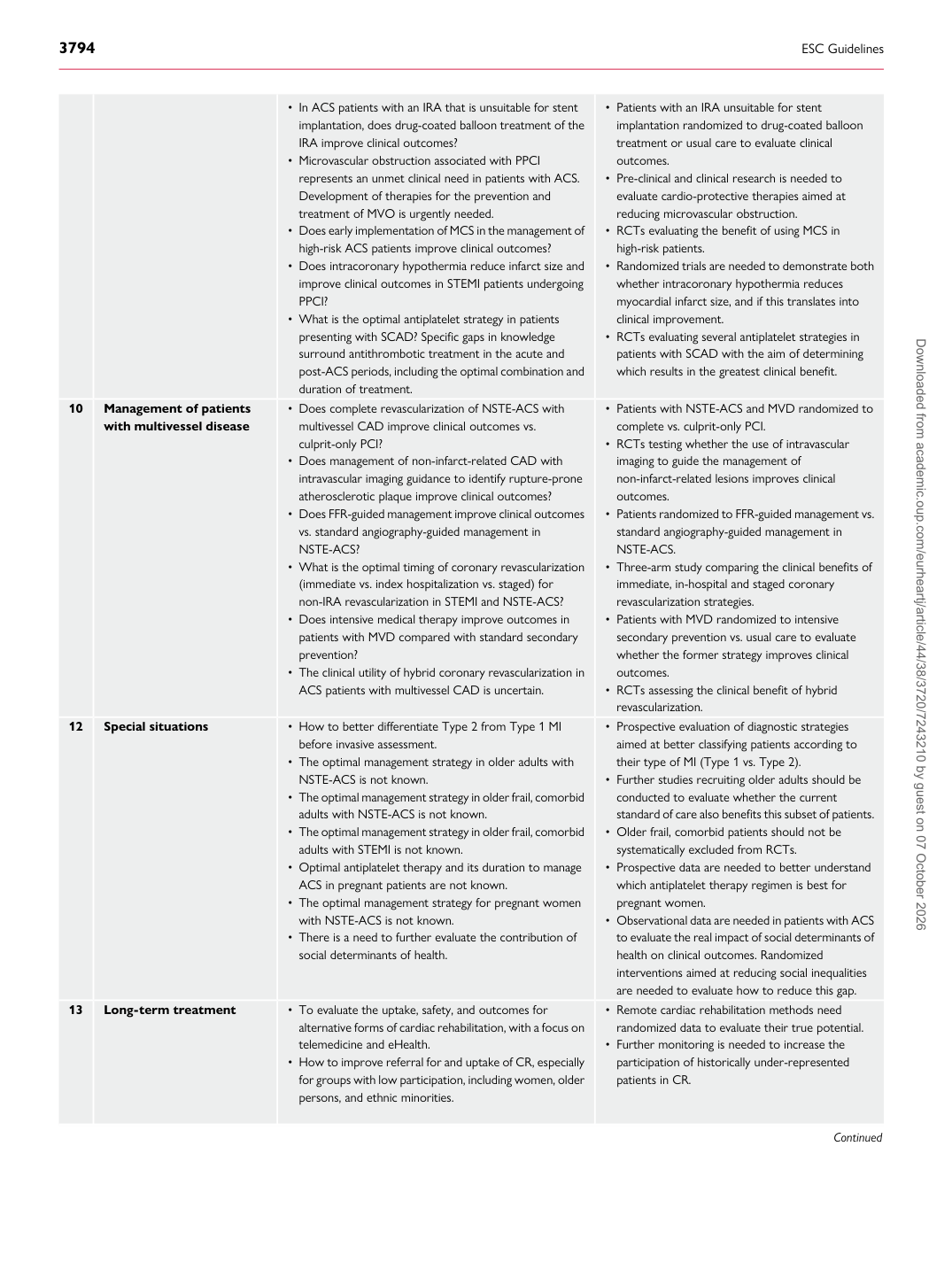
• In ACS patients with an IRA that is unsuitable for stent implantation, does drug-coated balloon treatment of the IRA improve clinical outcomes? • Microvascular obstruction associated with PPCI represents an unmet clinical need in patients with ACS. Development of therapies for the prevention and treatment of MVO is urgently needed. • Does early implementation of MCS in the management of high-risk ACS patients improve clinical outcomes? • Does intracoronary hypothermia reduce infarct size and improve clinical outcomes in STEMI patients undergoing PPCI? • What is the optimal antiplatelet strategy in patients presenting with SCAD? Specific gaps in knowledge surround antithrombotic treatment in the acute and post-ACS periods, including the optimal combination and duration of treatment. • Patients with an IRA unsuitable for stent implantation randomized to drug-coated balloon treatment or usual care to evaluate clinical outcomes. • Pre-clinical and clinical research is needed to evaluate cardio-protective therapies aimed at reducing microvascular obstruction. • RCTs evaluating the benefit of using MCS in high-risk patients. • Randomized trials are needed to demonstrate both whether intracoronary hypothermia reduces myocardial infarct size, and if this translates into clinical improvement. • RCTs evaluating several antiplatelet strategies in patients with SCAD with the aim of determining which results in the greatest clinical benefit.

10 Management of patients with multivessel disease • Does complete revascularization of NSTE-ACS with multivessel CAD improve clinical outcomes vs. culprit-only PCI? • Does management of non-infarct-related CAD with intravascular imaging guidance to identify rupture-prone atherosclerotic plaque improve clinical outcomes? • Does FFR-guided management improve clinical outcomes vs. standard angiography-guided management in NSTE-ACS? • What is the optimal timing of coronary revascularization (immediate vs. index hospitalization vs. staged) for non-IRA revascularization in STEMI and NSTE-ACS? • Does intensive medical therapy improve outcomes in patients with MVD compared with standard secondary prevention? • The clinical utility of hybrid coronary revascularization in ACS patients with multivessel CAD is uncertain. • Patients with NSTE-ACS and MVD randomized to complete vs. culprit-only PCI. • RCTs testing whether the use of intravascular imaging to guide the management of non-infarct-related lesions improves clinical outcomes. • Patients randomized to FFR-guided management vs. standard angiography-guided management in NSTE-ACS. • Three-arm study comparing the clinical benefits of immediate, in-hospital and staged coronary revascularization strategies. • Patients with MVD randomized to intensive secondary prevention vs. usual care to evaluate whether the former strategy improves clinical outcomes. • RCTs assessing the clinical benefit of hybrid revascularization.

12 Special situations • How to better differentiate Type 2 from Type 1 MI before invasive assessment. • The optimal management strategy in older adults with NSTE-ACS is not known. • The optimal management strategy in older frail, comorbid adults with NSTE-ACS is not known. • The optimal management strategy in older frail, comorbid adults with STEMI is not known. • Optimal antiplatelet therapy and its duration to manage ACS in pregnant patients are not known. • The optimal management strategy for pregnant women with NSTE-ACS is not known. • There is a need to further evaluate the contribution of social determinants of health.

• Prospective evaluation of diagnostic strategies aimed at better classifying patients according to their type of MI (Type 1 vs. Type 2). • Further studies recruiting older adults should be conducted to evaluate whether the current standard of care also benefits this subset of patients. • Older frail, comorbid patients should not be systematically excluded from RCTs. • Prospective data are needed to better understand which antiplatelet therapy regimen is best for pregnant women. • Observational data are needed in patients with ACS to evaluate the real impact of social determinants of health on clinical outcomes. Randomized interventions aimed at reducing social inequalities are needed to evaluate how to reduce this gap. 13 Long-term treatment • To evaluate the uptake, safety, and outcomes for alternative forms of cardiac rehabilitation, with a focus on telemedicine and eHealth. • How to improve referral for and uptake of CR, especially for groups with low participation, including women, older persons, and ethnic minorities.

• Remote cardiac rehabilitation methods need randomized data to evaluate their true potential. • Further monitoring is needed to increase the participation of historically under-represented patients in CR.

Continued Downloaded from academic.oup.com/eurheartj/article/44/38/3720/7243210 by guest on 07 October 2026