p.74 抽出テキスト
16 Gaps in evidence

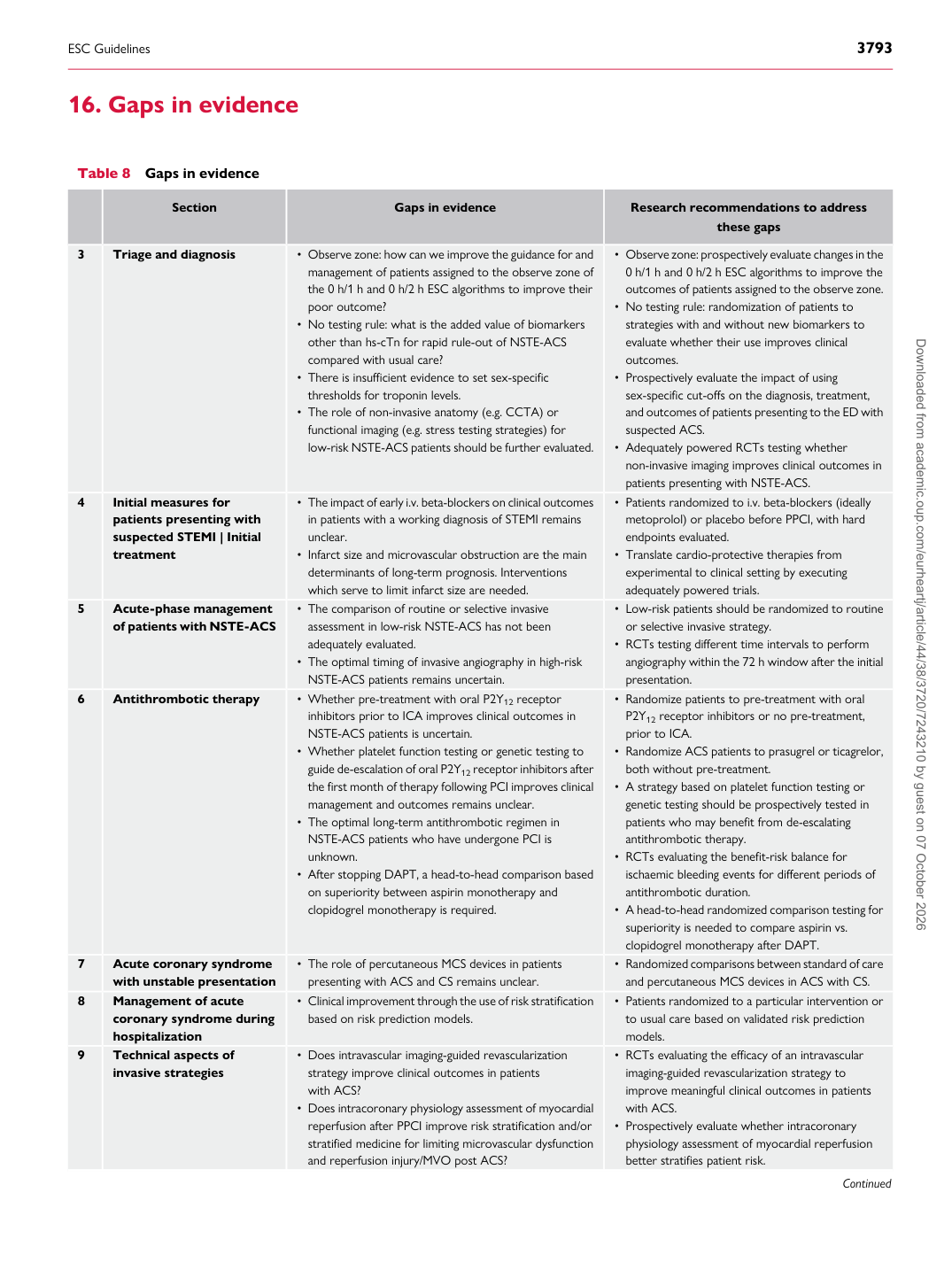
Table 8 Gaps in evidence

Section Gaps in evidence Research recommendations to address

these gaps

3 Triage and diagnosis • Observe zone: how can we improve the guidance for and management of patients assigned to the observe zone of the 0 h/1 h and 0 h/2 h ESC algorithms to improve their poor outcome? • No testing rule: what is the added value of biomarkers other than hs-cTn for rapid rule-out of NSTE-ACS compared with usual care? • There is insufficient evidence to set sex-specific thresholds for troponin levels. • The role of non-invasive anatomy (e.g. CCTA) or functional imaging (e.g. stress testing strategies) for low-risk NSTE-ACS patients should be further evaluated. • Observe zone: prospectively evaluate changes in the 0 h/1 h and 0 h/2 h ESC algorithms to improve the outcomes of patients assigned to the observe zone. • No testing rule: randomization of patients to strategies with and without new biomarkers to evaluate whether their use improves clinical outcomes. • Prospectively evaluate the impact of using sex-specific cut-offs on the diagnosis, treatment, and outcomes of patients presenting to the ED with suspected ACS. • Adequately powered RCTs testing whether non-invasive imaging improves clinical outcomes in patients presenting with NSTE-ACS.

4 Initial measures for patients presenting with suspected STEMI | Initial treatment • The impact of early i.v. beta-blockers on clinical outcomes in patients with a working diagnosis of STEMI remains unclear. • Infarct size and microvascular obstruction are the main determinants of long-term prognosis. Interventions which serve to limit infarct size are needed.

• Patients randomized to i.v. beta-blockers (ideally metoprolol) or placebo before PPCI, with hard endpoints evaluated. • Translate cardio-protective therapies from experimental to clinical setting by executing adequately powered trials. 5 Acute-phase management of patients with NSTE-ACS

• The comparison of routine or selective invasive assessment in low-risk NSTE-ACS has not been adequately evaluated. • The optimal timing of invasive angiography in high-risk NSTE-ACS patients remains uncertain.

• Low-risk patients should be randomized to routine or selective invasive strategy. • RCTs testing different time intervals to perform angiography within the 72 h window after the initial presentation. 6 Antithrombotic therapy • Whether pre-treatment with oral P2Y12 receptor inhibitors prior to ICA improves clinical outcomes in NSTE-ACS patients is uncertain. • Whether platelet function testing or genetic testing to guide de-escalation of oral P2Y12 receptor inhibitors after the first month of therapy following PCI improves clinical management and outcomes remains unclear. • The optimal long-term antithrombotic regimen in NSTE-ACS patients who have undergone PCI is unknown. • After stopping DAPT, a head-to-head comparison based on superiority between aspirin monotherapy and clopidogrel monotherapy is required.

• Randomize patients to pre-treatment with oral P2Y12 receptor inhibitors or no pre-treatment, prior to ICA. • Randomize ACS patients to prasugrel or ticagrelor, both without pre-treatment. • A strategy based on platelet function testing or genetic testing should be prospectively tested in patients who may benefit from de-escalating antithrombotic therapy. • RCTs evaluating the benefit-risk balance for ischaemic bleeding events for different periods of antithrombotic duration. • A head-to-head randomized comparison testing for superiority is needed to compare aspirin vs. clopidogrel monotherapy after DAPT. 7 Acute coronary syndrome with unstable presentation

• The role of percutaneous MCS devices in patients presenting with ACS and CS remains unclear. • Randomized comparisons between standard of care and percutaneous MCS devices in ACS with CS.

8 Management of acute coronary syndrome during hospitalization • Clinical improvement through the use of risk stratification based on risk prediction models. • Patients randomized to a particular intervention or to usual care based on validated risk prediction models.

9 Technical aspects of invasive strategies • Does intravascular imaging-guided revascularization strategy improve clinical outcomes in patients with ACS? • Does intracoronary physiology assessment of myocardial reperfusion after PPCI improve risk stratification and/or stratified medicine for limiting microvascular dysfunction and reperfusion injury/MVO post ACS? • RCTs evaluating the efficacy of an intravascular imaging-guided revascularization strategy to improve meaningful clinical outcomes in patients with ACS. • Prospectively evaluate whether intracoronary physiology assessment of myocardial reperfusion better stratifies patient risk.

Continued

ESC Guidelines                                                                                                                                                                                          3793

Downloaded from academic.oup.com/eurheartj/article/44/38/3720/7243210 by guest on 07 October 2026