p.72 抽出テキスト
14.6 Patient-reported outcome measures

and patient-reported experience measures Understanding and measuring patient expectations and health outcomes using patient-reported outcome measures (PROMs) and patient-reported experience measures (PREMs) is central to improving patient satisfaction and delivering patient-centred care.895 The quality of care for ACS patients should be measured during the patient’s journey from initial presentation until discharge. Further information can be found in the Supplementary data online. Further information on PROMs and PREMs is also provided in the Supplementary data online.

14.7 Preparation for discharge

Many ACS patients may not be fully aware of what has happened to them and how to best manage their healthcare after discharge, leading to them both wanting and needing more information upon discharge.896 Cognitive impairment can occur as a complication of ACS and some patients may have difficulty with instructions for care when transitioning towards discharge home.897 Therefore, discharge information should be provided in both verbal and written formats and should include a discharge letter outlining the key components of the evidence-based discharge plan (Supplementary data online, Table S20).898–901 Some important messages aimed at patients on how to improve their heart health after ACS are demonstrated in Supplementary data online, Figure S5. Moreover, following an ACS event, anxiety and depression are frequently encountered and confer an increased risk of non-adherence to medications and lifestyle changes, subsequent MACE, and death.902–904 Non-adherence also generally increases over time, which has additional impact on clinical outcomes.905 Assessing and identifying these patients and intervening with onward psychological referral is recommended.858 Further information can be found in the Supplementary data online. A summary of patient concerns and educational needs throughout their ACS journey is also provided in Supplementary data online, Figure S7. 15 Key messages

Epidemiology of ACS Acute coronary syndromes encompass a spectrum of conditions that include patients with a recent change in clinical symptoms or signs, with or without changes on 12-lead ECG and with or without acute elevations in cardiac troponin concentrations. ACS are commonly classified based on ECG at presentation and the presence or absence of troponin elevation into UA, NSTEMI, or STEMI. The incidence of STEMI is decreasing whereas the incidence of NSTEMI is increasing. While there are some sex differences in the epidemiology of ACS, women and men receive equal benefit from invasive and non-invasive management strategies and, in general, should be managed similarly. Diagnostic tools (ECG, troponin, and non-invasive imaging) Chest pain/discomfort is the most common symptom initiating the ACS diagnostic and therapeutic pathway. High-sensitivity troponin measurements and rapid ‘rule-in’ and ‘rule-out’ algorithms should be used in patients with suspected NSTE-ACS. MI is not the only condition resulting in cardiomyocyte injury and cardiac troponin elevation, and other conditions should also be considered in the differential diagnosis. Non-invasive imaging can be useful to increase diagnostic accuracy and optimize risk assessment. STEMI management networks Co-ordination between EMS and hospitals with common written protocols is central to the management of STEMI. EMS should transfer patients immediately to 24/7 high-volume PCI centres regardless of the initial treatment strategy (PPCI or pre-hospital fibrinolysis). EMS should always alert the PCI centre immediately after selection of the reperfusion strategy, and patient transfer to the PCI centre should bypass the ED. Invasive strategy and reperfusion therapy An invasive strategy is recommended for patients with ACS. Invasive strategies are time sensitive. For STEMI and very high-risk NSTE-ACS, an immediate invasive strategy is recommended. For patients with NSTE-ACS an inpatient invasive strategy is recommended; in NSTE-ACS patients with high-risk characteristics, an early invasive strategy (<24 h) should be considered. If timely (within 120 min from time of diagnosis) PPCI cannot be performed in patients with STEMI, fibrinolytic therapy is indicated within 12 h of symptom onset in patients without contraindications. Antithrombotic therapy Antithrombotic therapy is indicated in all ACS patients, regardless of the management strategy. This consists of both antiplatelet and anticoagulant therapy. Aspirin is recommended for all ACS patients at an initial loading dose and a longer-term maintenance dose. In addition to aspirin, a P2Y12 receptor inhibitor is recommended, and should be maintained over 12

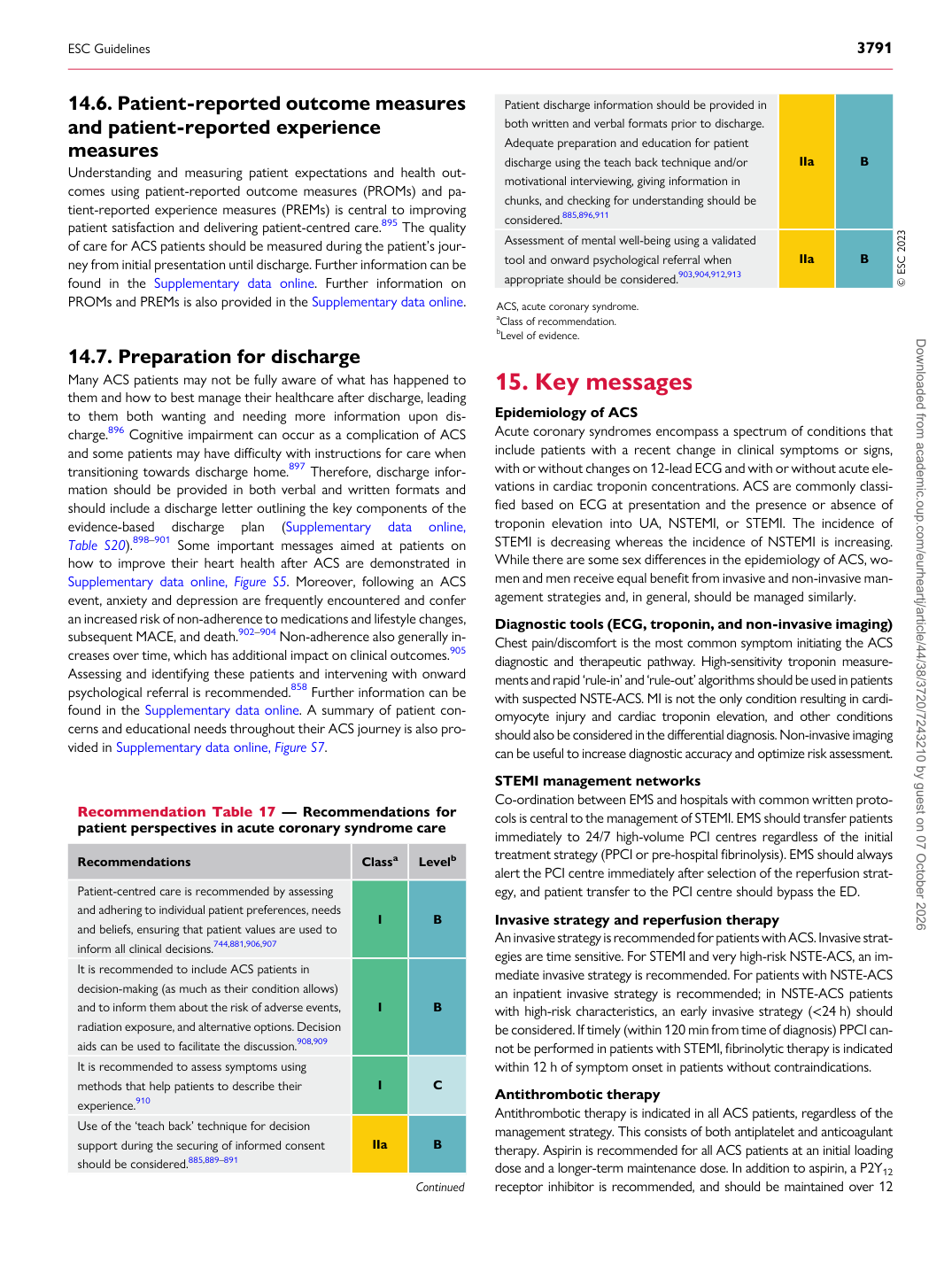
Recommendation Table 17 — Recommendations for patient perspectives in acute coronary syndrome care

Recommendations Classa Levelb

Patient-centred care is recommended by assessing and adhering to individual patient preferences, needs and beliefs, ensuring that patient values are used to inform all clinical decisions.744,881,906,907 I B It is recommended to include ACS patients in decision-making (as much as their condition allows) and to inform them about the risk of adverse events, radiation exposure, and alternative options. Decision aids can be used to facilitate the discussion.908,909 I B It is recommended to assess symptoms using methods that help patients to describe their experience.910 I C Use of the ‘teach back’ technique for decision support during the securing of informed consent should be considered.885,889–891 IIa B

Continued Patient discharge information should be provided in

both written and verbal formats prior to discharge. Adequate preparation and education for patient discharge using the teach back technique and/or motivational interviewing, giving information in chunks, and checking for understanding should be considered.885,896,911 IIa B Assessment of mental well-being using a validated tool and onward psychological referral when appropriate should be considered.903,904,912,913 IIa B © ESC 2023

ACS, acute coronary syndrome. aClass of recommendation. bLevel of evidence.

ESC Guidelines                                                                                                                                                                                          3791

Downloaded from academic.oup.com/eurheartj/article/44/38/3720/7243210 by guest on 07 October 2026