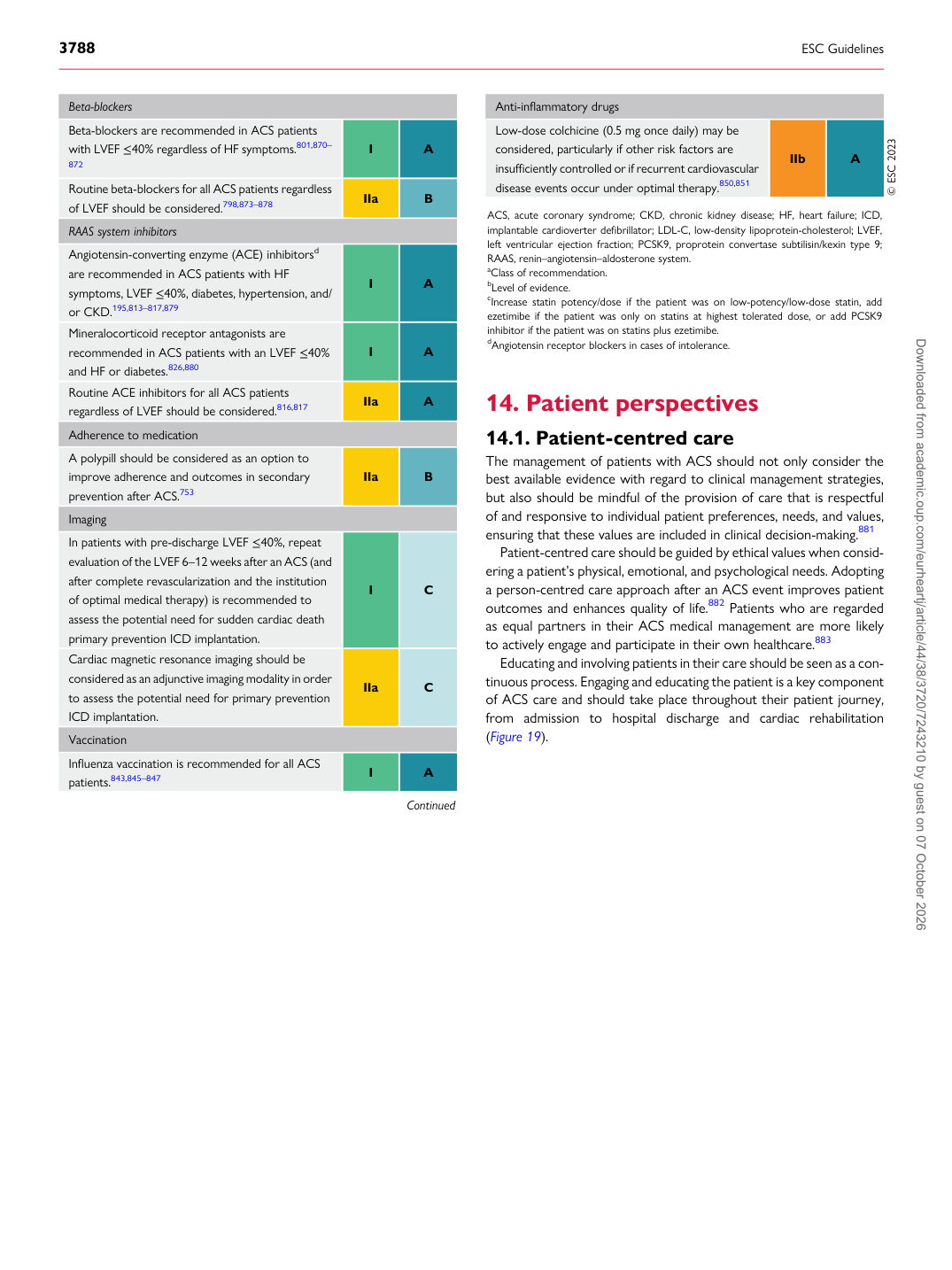
p.69 抽出テキスト
14 Patient perspectives

14.1 Patient-centred care

The management of patients with ACS should not only consider the best available evidence with regard to clinical management strategies, but also should be mindful of the provision of care that is respectful of and responsive to individual patient preferences, needs, and values, ensuring that these values are included in clinical decision-making.881 Patient-centred care should be guided by ethical values when considering a patient’s physical, emotional, and psychological needs. Adopting a person-centred care approach after an ACS event improves patient outcomes and enhances quality of life.882 Patients who are regarded as equal partners in their ACS medical management are more likely to actively engage and participate in their own healthcare.883 Educating and involving patients in their care should be seen as a continuous process. Engaging and educating the patient is a key component of ACS care and should take place throughout their patient journey, from admission to hospital discharge and cardiac rehabilitation (Figure 19).

Beta-blockers Beta-blockers are recommended in ACS patients with LVEF ≤40% regardless of HF symptoms.801,870–

872 I A

Routine beta-blockers for all ACS patients regardless of LVEF should be considered.798,873–878 IIa B RAAS system inhibitors Angiotensin-converting enzyme (ACE) inhibitorsd are recommended in ACS patients with HF symptoms, LVEF ≤40%, diabetes, hypertension, and/ or CKD.195,813–817,879 I A Mineralocorticoid receptor antagonists are recommended in ACS patients with an LVEF ≤40% and HF or diabetes.826,880 I A Routine ACE inhibitors for all ACS patients regardless of LVEF should be considered.816,817 IIa A Adherence to medication A polypill should be considered as an option to improve adherence and outcomes in secondary prevention after ACS.753 IIa B Imaging In patients with pre-discharge LVEF ≤40%, repeat evaluation of the LVEF 6–12 weeks after an ACS (and after complete revascularization and the institution of optimal medical therapy) is recommended to assess the potential need for sudden cardiac death primary prevention ICD implantation. I C Cardiac magnetic resonance imaging should be considered as an adjunctive imaging modality in order to assess the potential need for primary prevention ICD implantation. IIa C Vaccination Influenza vaccination is recommended for all ACS patients.843,845–847 I A

Continued Anti-inflammatory drugs

Low-dose colchicine (0.5 mg once daily) may be considered, particularly if other risk factors are insufficiently controlled or if recurrent cardiovascular disease events occur under optimal therapy.850,851 IIb A © ESC 2023

ACS, acute coronary syndrome; CKD, chronic kidney disease; HF, heart failure; ICD, implantable cardioverter defibrillator; LDL-C, low-density lipoprotein-cholesterol; LVEF, left ventricular ejection fraction; PCSK9, proprotein convertase subtilisin/kexin type 9; RAAS, renin–angiotensin–aldosterone system. aClass of recommendation. bLevel of evidence. cIncrease statin potency/dose if the patient was on low-potency/low-dose statin, add ezetimibe if the patient was only on statins at highest tolerated dose, or add PCSK9 inhibitor if the patient was on statins plus ezetimibe. dAngiotensin receptor blockers in cases of intolerance. Downloaded from academic.oup.com/eurheartj/article/44/38/3720/7243210 by guest on 07 October 2026