p.68 抽出テキスト
diabetes.702,703,832,833 In the EMMY (EMpagliflozin in patients with acute MYocardial infarction) trial, empagliflozin led to a significant improvement in NT-pro BNP reduction over 26 weeks post-MI, accompanied by a significant improvement in echocardiographic functional and structural parameters.834 Ongoing outcome trials in ACS populations will be useful to better define the role of these agents in the absence of HF.835

13.3.6.2 Glucagon-like peptide-1 receptor agonists

In a systematic review and meta-analysis of seven trials (56 004 patients with type 2 diabetes) testing different GLP1-RAs, their use was associated with reductions in the incidence of MACE, CV death, all-cause mortality, MI, and stroke.699

13.3.7 Proton pump inhibitors

Proton pump inhibitors (PPIs) reduce the risk of upper gastroduodenal bleeding in patients treated with antiplatelet agents.287,836,837 Therapy with a PPI is indicated for patients receiving any antithrombotic regimen who are at high risk of gastrointestinal bleeding (for details see Section 8.2.2.3, Bleeding risk assessment, in the Supplementary data online). PPIs that inhibit CYP2C19, particularly omeprazole and esomeprazole, may reduce the pharmacodynamic response to clopidogrel, though there is no strong evidence that this results in an increased risk of ischaemic events or stent thrombosis in clinical trials and propensity score-matched studies.287,288,838–842 Importantly, no interaction between the concomitant use of PPIs and aspirin, prasugrel or ticagrelor has been observed.

13.3.8 Vaccination

An annual influenza vaccination in patients with stable ASCVD appears to be associated with reduced incidence of MI, an improved prognosis in patients with HF, and decreased CV risk in adults aged 65 years and older.843,844 In addition, influenza vaccination given early after an MI or in high-risk CAD has been shown to result in a lower risk of all-cause death and CV death at 12 months.845–847 Therefore, influenza vaccination is recommended for all ACS patients and should be given preferentially during index hospitalization during influenza season for those not protected by a seasonal influenza vaccination.

13.3.9 Anti-inflammatory drugs

Inflammation plays a central role in the pathogenesis of atherosclerosis and acute coronary events. Several recent trials have tested the role of the anti-inflammatory agent colchicine in acute and chronic coronary syndromes.848,849 In the Colchicine Cardiovascular Outcomes Trial (COLCOT), which enrolled 4745 patients with a recent ACS event, low-dose colchicine (0.5 mg daily) was associated with a significant reduction of the primary composite endpoint (CV death, resuscitated cardiac arrest, MI, stroke, or urgent revascularization) in comparison to placebo.850 Of note, pneumonia was more frequent in the colchicine group. The Low-dose Colchicine trial-2 (LoDoCo2) enrolled 5522 patients with CCS (84% of whom had prior ACS) who were randomized to colchicine (0.5 mg daily) or placebo.851 The primary endpoint (composite of CV death, MI, stroke, or ischaemia-driven coronary revascularization) rate was significantly lower in the colchicine group; however, the incidence of non-CV death was higher in the colchicine group. The benefits of colchicine in reducing CV events have been shown to be consistent irrespective of history and timing of prior ACS.852 13.3.10 Hormone replacement therapy

For further information on hormone replacement therapy in patients with ACS, please see the Supplementary data online.

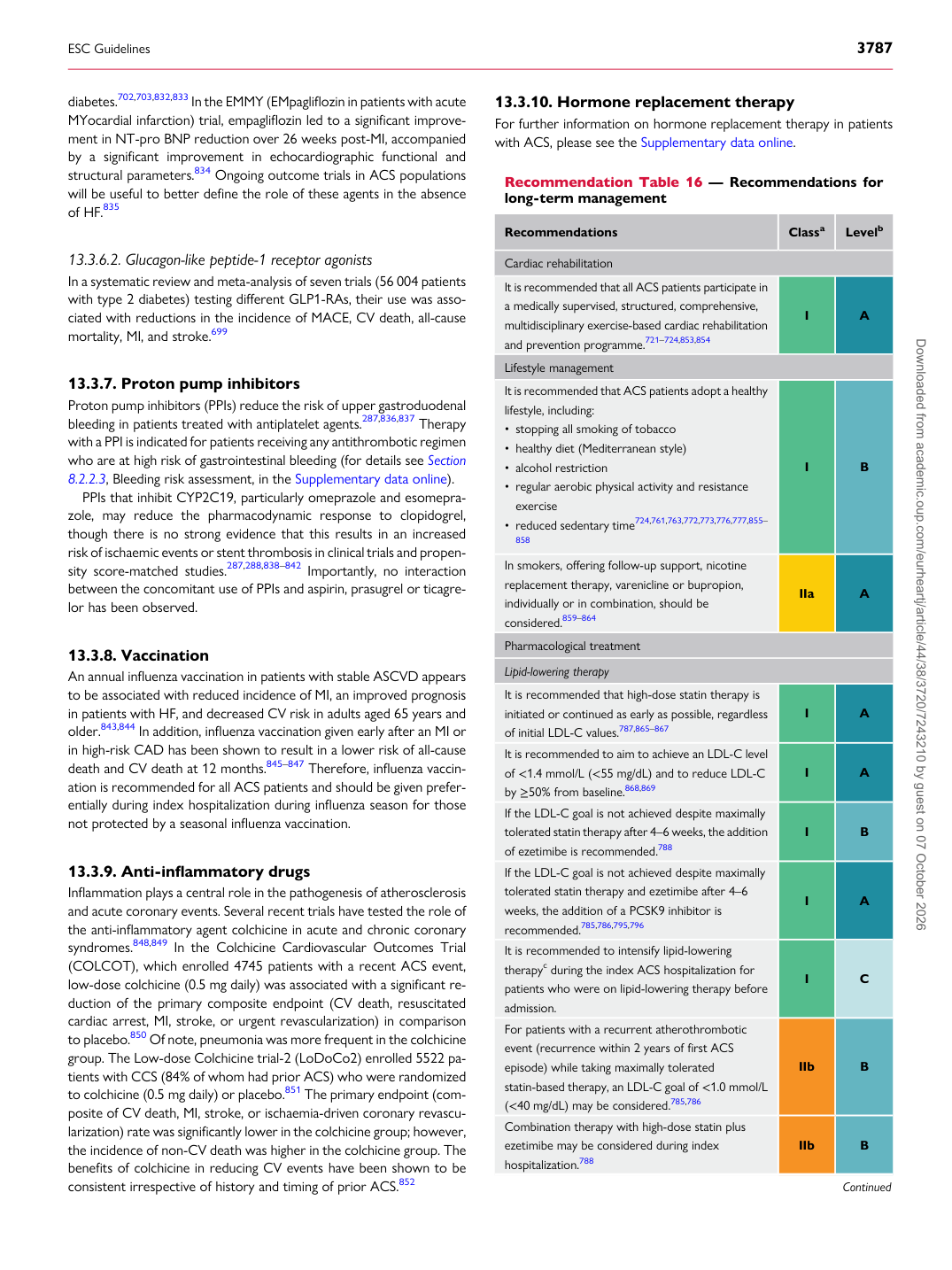
Recommendation Table 16 — Recommendations for long-term management

Recommendations Classa Levelb

Cardiac rehabilitation It is recommended that all ACS patients participate in a medically supervised, structured, comprehensive, multidisciplinary exercise-based cardiac rehabilitation and prevention programme.721–724,853,854 I A Lifestyle management It is recommended that ACS patients adopt a healthy lifestyle, including: • stopping all smoking of tobacco • healthy diet (Mediterranean style) • alcohol restriction • regular aerobic physical activity and resistance exercise • reduced sedentary time724,761,763,772,773,776,777,855–

858 I B

In smokers, offering follow-up support, nicotine replacement therapy, varenicline or bupropion, individually or in combination, should be considered.859–864 IIa A Pharmacological treatment Lipid-lowering therapy It is recommended that high-dose statin therapy is initiated or continued as early as possible, regardless of initial LDL-C values.787,865–867 I A It is recommended to aim to achieve an LDL-C level of <1.4 mmol/L (<55 mg/dL) and to reduce LDL-C by ≥50% from baseline.868,869 I A If the LDL-C goal is not achieved despite maximally tolerated statin therapy after 4–6 weeks, the addition of ezetimibe is recommended.788 I B If the LDL-C goal is not achieved despite maximally tolerated statin therapy and ezetimibe after 4–6 weeks, the addition of a PCSK9 inhibitor is recommended.785,786,795,796 I A It is recommended to intensify lipid-lowering therapyc during the index ACS hospitalization for patients who were on lipid-lowering therapy before admission. I C For patients with a recurrent atherothrombotic event (recurrence within 2 years of first ACS episode) while taking maximally tolerated statin-based therapy, an LDL-C goal of <1.0 mmol/L (<40 mg/dL) may be considered.785,786 IIb B Combination therapy with high-dose statin plus ezetimibe may be considered during index hospitalization.788 IIb B

Continued

ESC Guidelines                                                                                                                                                                                          3787

Downloaded from academic.oup.com/eurheartj/article/44/38/3720/7243210 by guest on 07 October 2026