p.62 抽出テキスト
13 Long-term treatment

Secondary prevention after ACS is central to increase quality of life and to decrease morbidity and mortality. This should start as early as possible after the index event.716–718 The topic is covered in detail in the 2019 CCS Guidelines and the 2021 Prevention Guidelines.195,646 Optimal medical therapy and treatment targets are well defined and are summarized in Figure 17. A figure aimed at educating patients on improving their ‘heart health’ after an ACS event is provided in the Supplementary data online, Figure S5.

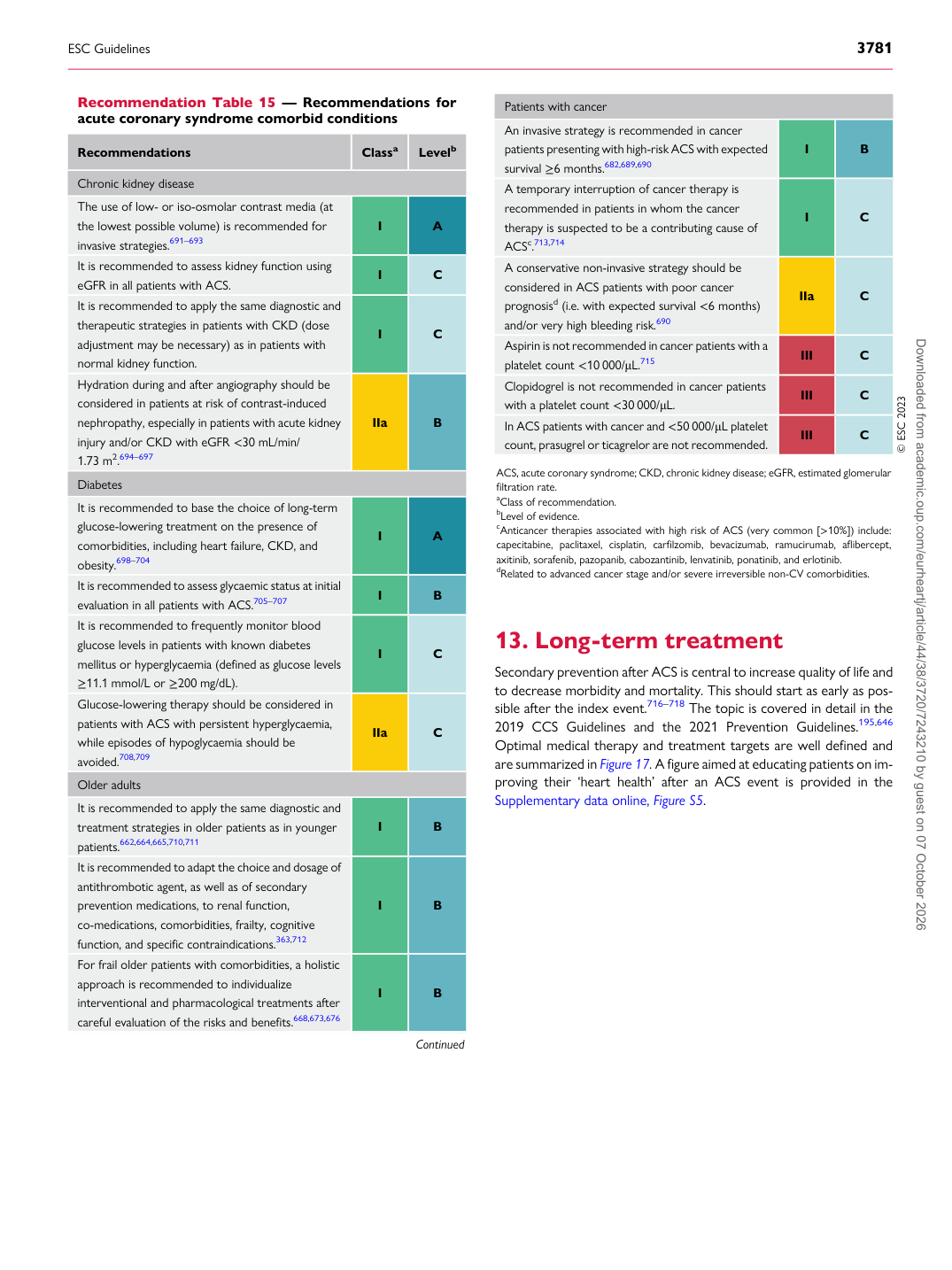
Recommendation Table 15 — Recommendations for acute coronary syndrome comorbid conditions

Recommendations Classa Levelb

Chronic kidney disease The use of low- or iso-osmolar contrast media (at the lowest possible volume) is recommended for invasive strategies.691–693 I A It is recommended to assess kidney function using eGFR in all patients with ACS. I C It is recommended to apply the same diagnostic and therapeutic strategies in patients with CKD (dose adjustment may be necessary) as in patients with normal kidney function. I C Hydration during and after angiography should be considered in patients at risk of contrast-induced nephropathy, especially in patients with acute kidney injury and/or CKD with eGFR <30 mL/min/ 1.73 m2.694–697 IIa B Diabetes It is recommended to base the choice of long-term glucose-lowering treatment on the presence of comorbidities, including heart failure, CKD, and obesity.698–704 I A It is recommended to assess glycaemic status at initial evaluation in all patients with ACS.705–707 I B It is recommended to frequently monitor blood glucose levels in patients with known diabetes mellitus or hyperglycaemia (defined as glucose levels ≥11.1 mmol/L or ≥200 mg/dL). I C Glucose-lowering therapy should be considered in patients with ACS with persistent hyperglycaemia, while episodes of hypoglycaemia should be avoided.708,709 IIa C Older adults It is recommended to apply the same diagnostic and treatment strategies in older patients as in younger patients.662,664,665,710,711 I B It is recommended to adapt the choice and dosage of antithrombotic agent, as well as of secondary prevention medications, to renal function, co-medications, comorbidities, frailty, cognitive function, and specific contraindications.363,712 I B For frail older patients with comorbidities, a holistic approach is recommended to individualize interventional and pharmacological treatments after careful evaluation of the risks and benefits.668,673,676 I B

Continued Patients with cancer

An invasive strategy is recommended in cancer patients presenting with high-risk ACS with expected survival ≥6 months.682,689,690 I B A temporary interruption of cancer therapy is recommended in patients in whom the cancer therapy is suspected to be a contributing cause of ACSc.713,714 I C A conservative non-invasive strategy should be considered in ACS patients with poor cancer prognosisd (i.e. with expected survival <6 months) and/or very high bleeding risk.690 IIa C Aspirin is not recommended in cancer patients with a platelet count <10 000/μL.715 III C Clopidogrel is not recommended in cancer patients with a platelet count <30 000/μL. III C In ACS patients with cancer and <50 000/μL platelet count, prasugrel or ticagrelor are not recommended. III C © ESC 2023

ACS, acute coronary syndrome; CKD, chronic kidney disease; eGFR, estimated glomerular filtration rate. aClass of recommendation. bLevel of evidence. cAnticancer therapies associated with high risk of ACS (very common [>10%]) include: capecitabine, paclitaxel, cisplatin, carfilzomib, bevacizumab, ramucirumab, aflibercept, axitinib, sorafenib, pazopanib, cabozantinib, lenvatinib, ponatinib, and erlotinib. dRelated to advanced cancer stage and/or severe irreversible non-CV comorbidities.

ESC Guidelines                                                                                                                                                                                          3781

Downloaded from academic.oup.com/eurheartj/article/44/38/3720/7243210 by guest on 07 October 2026