p.59 抽出テキスト
12.3 Comorbid conditions

12.3.1. Patients at high bleeding risk and with blood disorders (anaemia and thrombocytopaenia) Anaemia is more prevalent in elderly/frail ACS patients and in patients with multimorbidity (i.e. HF, chronic kidney disease [CKD], diabetes mellitus, cancer, and autoimmune diseases). In some cases, severe anaemia may precipitate Type 2 MI. Persistent or worsening anaemia in patients with ACS is associated with an increased risk of recurrent ischaemic events, death, and major bleeding.623–625 According to the ARC-HBR, haemoglobin <11 g/dL at the time of PCI constitutes a major criterion for HBR, whereas haemoglobin between 11 and 13 g/dL (12 g/dL for women) is a minor criterion. There is no established strategy for treating anaemia in patients with ACS. The efficacy and safety of blood transfusion in this clinical scenario remains unknown. In the majority of studies investigating different transfusion protocols, a liberal blood transfusion strategy has been defined as any red blood cell transfusion at a haemoglobin level <9–10 g/ dL, while a restrictive blood transfusion strategy has been defined as any transfusion at a haemoglobin level <7–8 g/dL. Observational data suggest that a liberal blood transfusion strategy may be associated with an increase in all-cause mortality.626–630 The open-label Restrictive and Liberal Transfusion Strategies in Patients With Acute Myocardial Infarction (REALITY) trial enrolled 668 ACS patients who were randomized to management with a restrictive (triggered by haemoglobin ≤8) or a liberal (triggered by haemoglobin ≤10) transfusion strategy.631 The composite outcome (all-cause death, stroke, recurrent MI, or emergency revascularization) at 30 days occurred in a comparable number of patients in both arms (11% vs. 14%, RR 0.79, with a one-sided 97.5% CI of 0.00–1.19), meeting the pre-specified non-inferiority criterion. All components of the composite endpoint were numerically higher in the liberal transfusion strategy arm. The trial was not powered to detect superiority of the restrictive strategy, and the CI included what may be a clinically important harm. The pre-specified 1-year follow-up of the REALITY trial yielded contradictory conclusions to the 30-day outcomes: at 1 year, the restrictive transfusion strategy (vs. a liberal

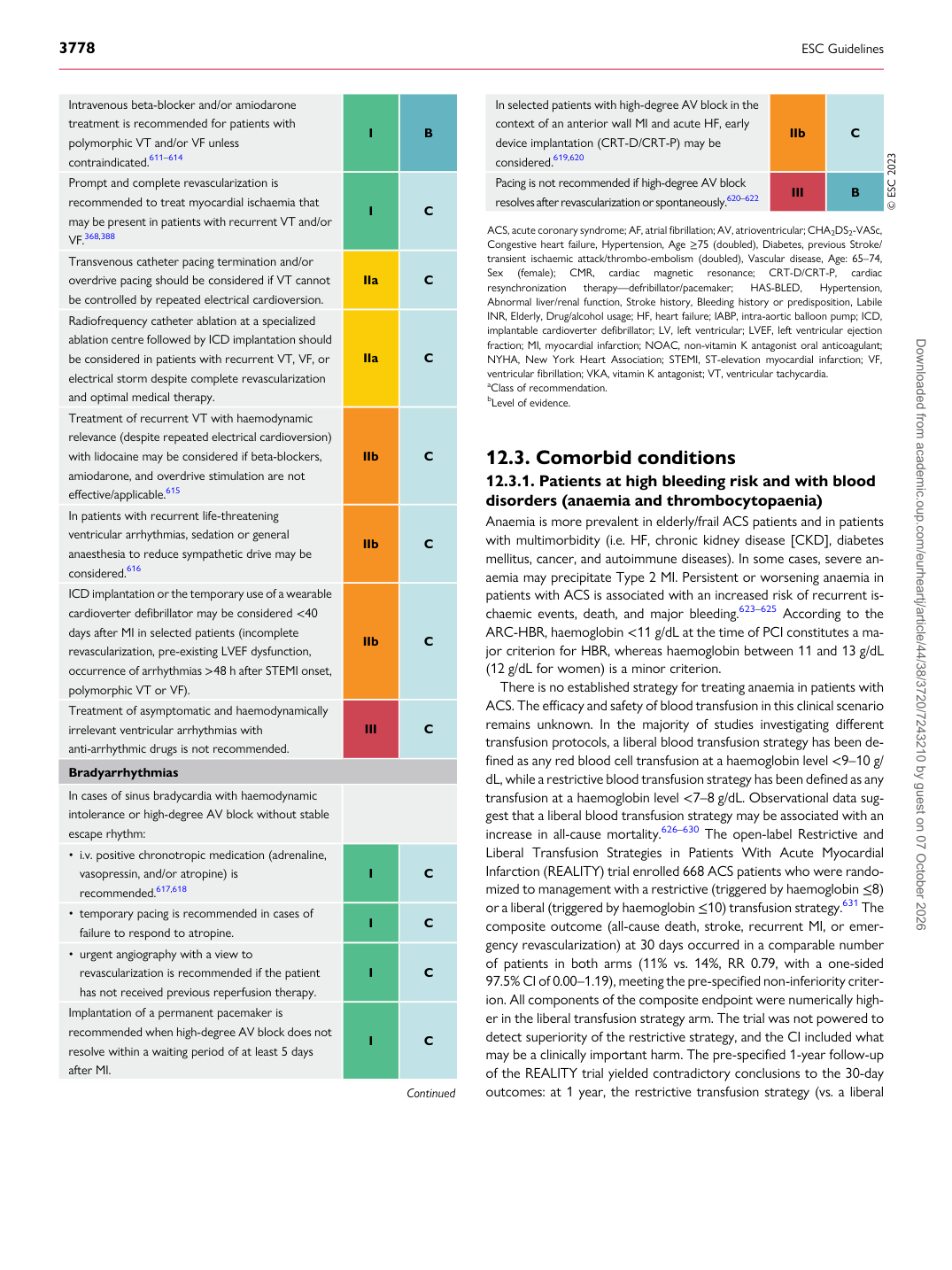
Intravenous beta-blocker and/or amiodarone treatment is recommended for patients with polymorphic VT and/or VF unless contraindicated.611–614 I B Prompt and complete revascularization is recommended to treat myocardial ischaemia that may be present in patients with recurrent VT and/or VF.368,388 I C Transvenous catheter pacing termination and/or overdrive pacing should be considered if VT cannot be controlled by repeated electrical cardioversion. IIa C Radiofrequency catheter ablation at a specialized ablation centre followed by ICD implantation should be considered in patients with recurrent VT, VF, or electrical storm despite complete revascularization and optimal medical therapy. IIa C Treatment of recurrent VT with haemodynamic relevance (despite repeated electrical cardioversion) with lidocaine may be considered if beta-blockers, amiodarone, and overdrive stimulation are not effective/applicable.615 IIb C In patients with recurrent life-threatening ventricular arrhythmias, sedation or general anaesthesia to reduce sympathetic drive may be considered.616 IIb C ICD implantation or the temporary use of a wearable cardioverter defibrillator may be considered <40 days after MI in selected patients (incomplete revascularization, pre-existing LVEF dysfunction, occurrence of arrhythmias >48 h after STEMI onset, polymorphic VT or VF). IIb C Treatment of asymptomatic and haemodynamically irrelevant ventricular arrhythmias with anti-arrhythmic drugs is not recommended. III C Bradyarrhythmias In cases of sinus bradycardia with haemodynamic intolerance or high-degree AV block without stable escape rhythm: • i.v. positive chronotropic medication (adrenaline,

vasopressin, and/or atropine) is recommended.617,618 I C • temporary pacing is recommended in cases of failure to respond to atropine. I C • urgent angiography with a view to revascularization is recommended if the patient

has not received previous reperfusion therapy. I C Implantation of a permanent pacemaker is recommended when high-degree AV block does not resolve within a waiting period of at least 5 days after MI. I C

Continued In selected patients with high-degree AV block in the

context of an anterior wall MI and acute HF, early device implantation (CRT-D/CRT-P) may be considered.619,620 IIb C Pacing is not recommended if high-degree AV block resolves after revascularization or spontaneously.620–622 III B © ESC 2023

ACS, acute coronary syndrome; AF, atrial fibrillation; AV, atrioventricular; CHA2DS2-VASc, Congestive heart failure, Hypertension, Age ≥75 (doubled), Diabetes, previous Stroke/ transient ischaemic attack/thrombo-embolism (doubled), Vascular disease, Age: 65–74, Sex (female); CMR, cardiac magnetic resonance; CRT-D/CRT-P, cardiac resynchronization therapy—defribillator/pacemaker; HAS-BLED, Hypertension, Abnormal liver/renal function, Stroke history, Bleeding history or predisposition, Labile INR, Elderly, Drug/alcohol usage; HF, heart failure; IABP, intra-aortic balloon pump; ICD, implantable cardioverter defibrillator; LV, left ventricular; LVEF, left ventricular ejection fraction; MI, myocardial infarction; NOAC, non-vitamin K antagonist oral anticoagulant; NYHA, New York Heart Association; STEMI, ST-elevation myocardial infarction; VF, ventricular fibrillation; VKA, vitamin K antagonist; VT, ventricular tachycardia. aClass of recommendation. bLevel of evidence. Downloaded from academic.oup.com/eurheartj/article/44/38/3720/7243210 by guest on 07 October 2026