p.58 抽出テキスト
length have worse short- and long-term prognoses when compared with patients in sinus rhythm.584,586 There is some evidence to suggest that transient, self-terminating AF during STEMI may be a predictor of an increased risk of stroke during long-term follow-up.584,587

12.2.5.2 Ventricular arrhythmias

With the widespread increased uptake of emergency reperfusion therapies for patients with STEMI, the incidence of malignant arrhythmias (ventricular tachycardia [VT] and ventricular fibrillation [VF]) has significantly declined. Nevertheless, 6–8% of patients with STEMI develop haemodynamically significant VT or VF.588 The typical arrhythmia presentation is unstable, frequently polymorphic, and relatively fast VT, often degenerating into VF. Urgent reperfusion is most important as ischaemia is often the trigger for these arrhythmias. Early administration of i.v. or oral beta-blockers reduces the incidence of malignant arrhythmias.163,164,169,589 Beta-blockers or amiodarone are recommended if malignant arrhythmias occur and lidocaine may be considered if these are contraindicated.163,164,169,589,590 The prognostic role of early VT/VF within the first 48 h of STEMI is still controversial. Several studies have suggested that patients with early VT/VF have increased 30-day mortality but no increase in long-term arrhythmic risk.591–593 Another study has suggested that while malignant ventricular arrhythmias occurring at the time of reperfusion do not confer poor prognosis, sustained VT or VF occurring during ongoing ischaemia or late after reperfusion (>48 h) is associated with an increase in long-term mortality.594 Sustained VT/VF late after reperfusion (>48 h) requires an evaluation for ICD implantation for secondary prevention of sudden cardiac death. Ventricular premature beats are very frequent during the first 24 h after reperfusion for STEMI and no specific therapy is required. Primary prevention of sudden cardiac death with ICD implantation within 40 days after MI is generally not indicated. Patients should be reevaluated for ICD implantation post-revascularization after a period of 6–12 weeks on evidence-based treatments, although patients with a pre-existing impaired LVEF may be considered for ICD implantation for primary prevention even within the early post-infarction period. Some patients may develop electrical storm and/or incessant VT despite complete revascularization and treatment with anti-arrhythmic drugs. Overdrive stimulation may help to control this situation; however, recurrence of VT/VF upon cessation of stimulation is frequent and catheter ablation of such triggers appears to be the preferred treatment option in centres with that expertise. Successful radiofrequency ablation has been shown to abolish recurrent VT/VF.595 Non-sustained monomorphic VT is the most common form of ventricular arrhythmia in the early phase of ACS, and usually does not require anti-arrhythmic treatment. Accelerated idioventricular rhythm at reperfusion is frequent and does not require intervention given its benign nature.596

12.2.6 Bleeding

Bleeding is associated with a poor prognosis in ACS patients.231,597,598 The mechanisms by which bleeding increases the risk of death are complex and multifactorial.599 While intracranial or massive haemorrhage directly threatens life through fatal brain damage or sudden cardiocirculatory collapse, other less severe forms of haemorrhage may increase the risk of death through indirect mechanisms. Blood transfusion may increase systemic inflammation and represents one of the possible links between bleeding and subsequent mortality.600 Bleeding is also a major driver of unplanned DAPT discontinuation and the interruption of other medication (e.g. statins, beta-blockers).601,602 12.2.6.1 Management of bleeding

See Supplementary data online, Section 12.1.3.1.

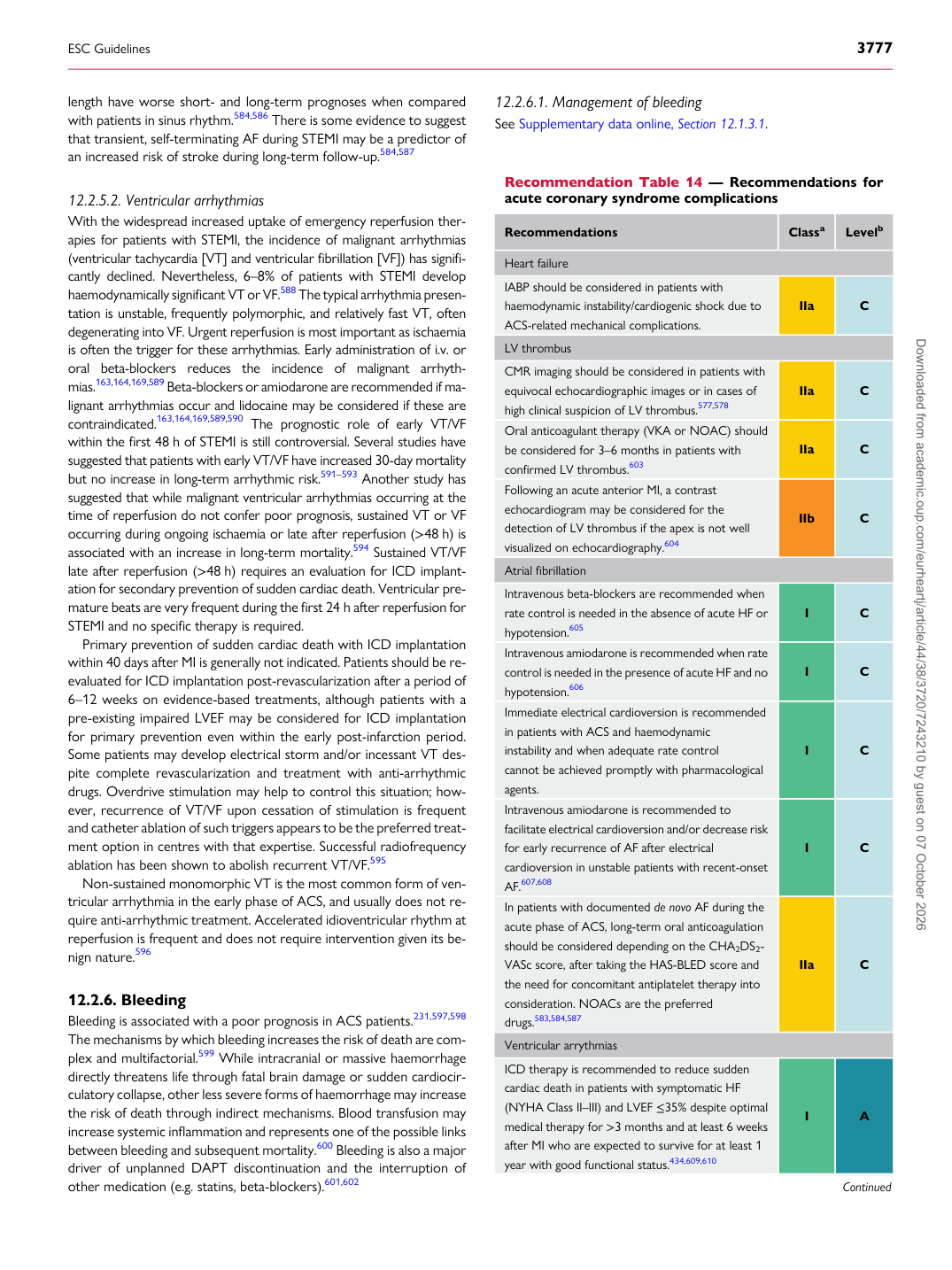
Recommendation Table 14 — Recommendations for acute coronary syndrome complications

Recommendations Classa Levelb

Heart failure IABP should be considered in patients with haemodynamic instability/cardiogenic shock due to ACS-related mechanical complications. IIa C LV thrombus CMR imaging should be considered in patients with equivocal echocardiographic images or in cases of high clinical suspicion of LV thrombus.577,578 IIa C Oral anticoagulant therapy (VKA or NOAC) should be considered for 3–6 months in patients with confirmed LV thrombus.603 IIa C Following an acute anterior MI, a contrast echocardiogram may be considered for the detection of LV thrombus if the apex is not well visualized on echocardiography.604 IIb C Atrial fibrillation Intravenous beta-blockers are recommended when rate control is needed in the absence of acute HF or hypotension.605 I C Intravenous amiodarone is recommended when rate control is needed in the presence of acute HF and no hypotension.606 I C Immediate electrical cardioversion is recommended in patients with ACS and haemodynamic instability and when adequate rate control cannot be achieved promptly with pharmacological agents. I C Intravenous amiodarone is recommended to facilitate electrical cardioversion and/or decrease risk for early recurrence of AF after electrical cardioversion in unstable patients with recent-onset AF.607,608 I C In patients with documented de novo AF during the acute phase of ACS, long-term oral anticoagulation should be considered depending on the CHA2DS2- VASc score, after taking the HAS-BLED score and the need for concomitant antiplatelet therapy into consideration. NOACs are the preferred drugs.583,584,587 IIa C Ventricular arrythmias ICD therapy is recommended to reduce sudden cardiac death in patients with symptomatic HF (NYHA Class II–III) and LVEF ≤35% despite optimal medical therapy for >3 months and at least 6 weeks after MI who are expected to survive for at least 1 year with good functional status.434,609,610 I A

Continued

ESC Guidelines                                                                                                                                                                                          3777

Downloaded from academic.oup.com/eurheartj/article/44/38/3720/7243210 by guest on 07 October 2026