p.53 抽出テキスト
guided by angiography (PCI if diameter stenosis >50%) of the non-IRA(s) in patients presenting with AMI who had undergone successful PCI of the IRA (47% STEMI, 53% NSTEMI).528 This study reported that at a median follow-up of 3.5 years, the primary endpoint (death, MI, or repeat revascularization) occurred less frequently in patients randomized to the FFR-guided strategy, mainly driven by differences in patients presenting with NSTEMI. However, the trial was terminated early, with only 562 out of an intended 1292 patients enrolled, and there was a relatively small number of primary outcome events.

10.5 Hybrid revascularization

Hybrid coronary revascularization (HCR) is defined as combined or consecutive procedures consisting of an internal mammary artery graft to the left anterior descending artery (LAD) and PCI to the other non-LAD vessels for the treatment of MVD.529 The preferred surgical technique for HCR is a minimally invasive left anterior minithoracotomy or robotic-assisted left internal mammary artery (LIMA)-LAD. The rationale for HCR is to combine the prognostic benefits of a LIMA for grafting of the LAD with the potential benefits of contemporary PCI with DES for disease in arteries that would otherwise be revascularized using vein grafts (which are prone to occlusion).530 There is limited evidence from RCTs to support hybrid revascularization. Clinical decision-making in this regard should involve the Heart Team. Clinical criteria supporting an HCR strategy in ACS patients with an indication for CABG may include MVD with LAD suitable for CABG and non-LAD lesions suitable for PCI, atheroma in the ascending aorta, an unprotected left main coronary artery that is unsuitable for PCI, complex LAD disease, advanced age, low LVEF (≤30%), frailty, diabetes mellitus, renal failure, prior sternotomy, and the lack of available bypass conduits. 11. Myocardial infarction with non-obstructive coronary arteries

Myocardial infarction with non-obstructive coronary arteries (MINOCA) refers to the clinical situation when a patient presents with symptoms suggestive of ACS, demonstrates troponin elevation, and has non-obstructive coronary arteries at the time of coronary angiography (defined as coronary artery stenosis <50% in any major epicardial vessel). The reported prevalence of MINOCA varies widely across studies (from around 1% to 14% of patients with ACS undergoing angiography).533 MINOCA can be considered as an umbrella term that encompasses a heterogeneous group of underlying causes. This includes both coronary and non-coronary pathologies, with the latter including both cardiac and extra-cardiac disorders (Figure 15).4,18,534–537

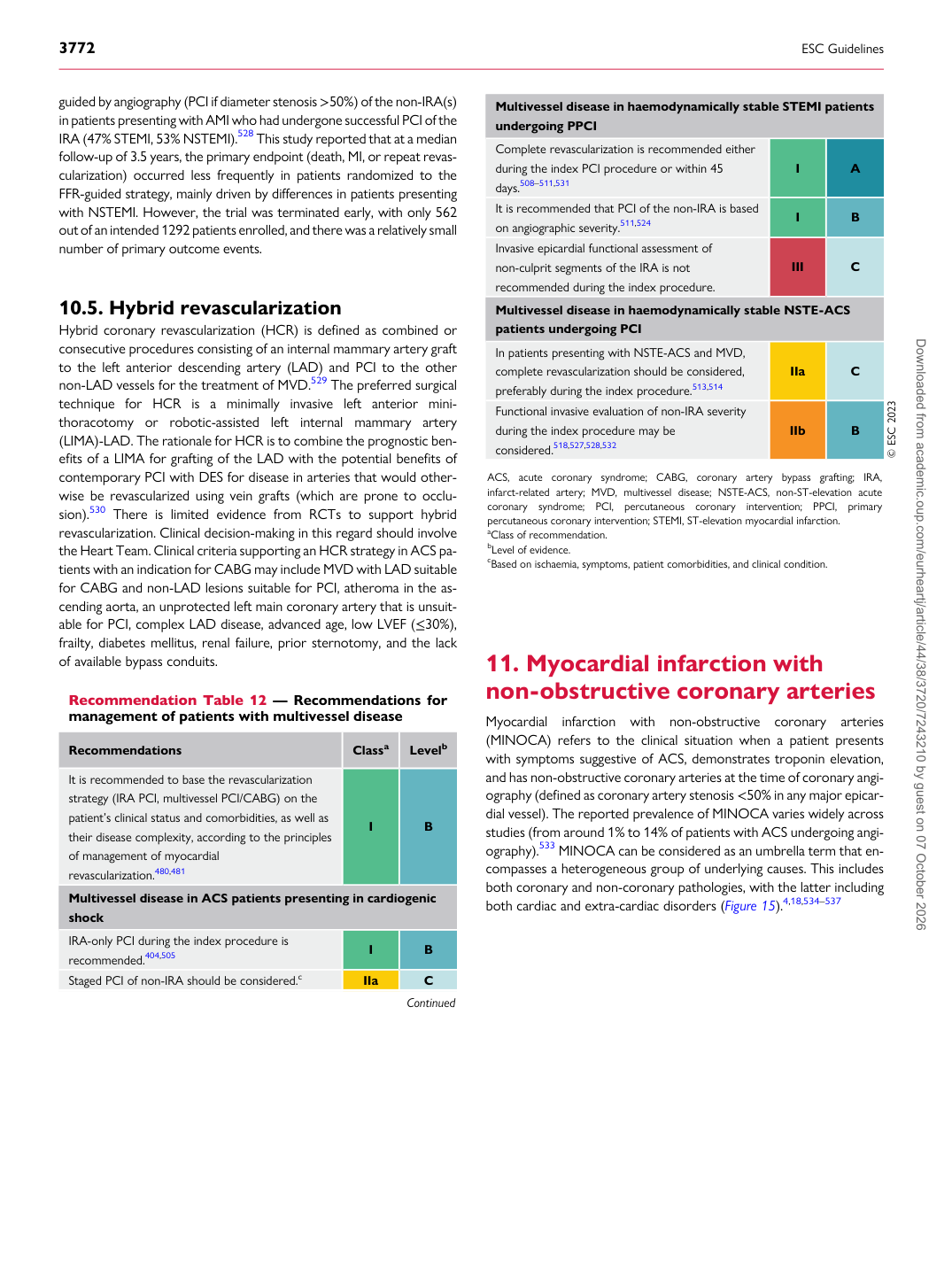
Recommendation Table 12 — Recommendations for management of patients with multivessel disease

Recommendations Classa Levelb

It is recommended to base the revascularization strategy (IRA PCI, multivessel PCI/CABG) on the patient’s clinical status and comorbidities, as well as their disease complexity, according to the principles of management of myocardial revascularization.480,481 I B Multivessel disease in ACS patients presenting in cardiogenic shock IRA-only PCI during the index procedure is recommended.404,505 I B Staged PCI of non-IRA should be considered.c IIa C

Continued Multivessel disease in haemodynamically stable STEMI patients

undergoing PPCI Complete revascularization is recommended either during the index PCI procedure or within 45 days.508–511,531 I A It is recommended that PCI of the non-IRA is based on angiographic severity.511,524 I B Invasive epicardial functional assessment of non-culprit segments of the IRA is not recommended during the index procedure. III C Multivessel disease in haemodynamically stable NSTE-ACS patients undergoing PCI In patients presenting with NSTE-ACS and MVD, complete revascularization should be considered, preferably during the index procedure.513,514 IIa C Functional invasive evaluation of non-IRA severity during the index procedure may be considered.518,527,528,532 IIb B © ESC 2023

ACS, acute coronary syndrome; CABG, coronary artery bypass grafting; IRA, infarct-related artery; MVD, multivessel disease; NSTE-ACS, non-ST-elevation acute coronary syndrome; PCI, percutaneous coronary intervention; PPCI, primary percutaneous coronary intervention; STEMI, ST-elevation myocardial infarction. aClass of recommendation. bLevel of evidence. cBased on ischaemia, symptoms, patient comorbidities, and clinical condition. Downloaded from academic.oup.com/eurheartj/article/44/38/3720/7243210 by guest on 07 October 2026