p.50 抽出テキスト
9.3.1 Intravascular imaging

There are no RCTs to guide management strategies in patients with SCAD. The use of intravascular imaging is based on observations reported from clinical cohort studies and expert opinion.482,484,485 In cases of diagnostic uncertainty after angiography, the use of intracoronary imaging with OCT or IVUS has to be carefully considered. There should be sufficient diagnostic uncertainty to justify coronary instrumentation, and even if this is the case, other factors like vessel tortuosity, vessel diameter, and a distal lesion location may prohibitively increase the risk.482 If the decision is made to perform intravascular imaging, it is imperative to ensure the guide wire is located within the true lumen of the coronary artery before advancing the imaging catheter.482 In patients with a diagnosis of SCAD on angiography and a plan for medical therapy, additional coronary instrumentation and intravascular imaging is not recommended on safety grounds.482,484,485

9.3.2 Revascularization

Conservative medical management, as opposed to PCI, is generally recommended for patients with SCAD.482 In an international case series, coronary complications following PCI occurred in >30% of patients.486–488 In a pooled analysis of three SCAD-PCI cohorts including 215 patients (94% female) drawn from Dutch, Spanish, and UK registries, and a matched cohort of conservatively managed SCAD patients (n = 221), PCI was associated with complications in ≈40% of cases (including 13% with serious complications). PCI is recommended only for SCAD with associated symptoms and signs of ongoing myocardial ischaemia, a large area of myocardium in jeopardy, and reduced antegrade flow. Useful strategies for these patients may include minimal plain balloon angioplasty to restore flow, followed by a conservative strategy, targeted stenting to seal the proximal and distal ends of the dissection, and/or extended stent lengths to prevent propagation of the haematoma. In patients with SCAD, CABG is recommended when dissection affects the left main or two proximal vessels, if PCI is not feasible or unsuccessful, and if there are symptoms and signs of ongoing myocardial ischaemia. In a small observational study, patients with SCAD treated with CABG had favourable early clinical outcomes, with an event rate up to 5 years similar to that of patients treated conservatively, despite a significant (68%) rate of graft occlusion at 5 years.486 The rate of graft occlusion over time can be explained by the fact that CABG in these patients may be technically challenging as the dissected coronary artery is more prone to anastomosis failure, and because spontaneous healing over time may restore the flow in the anastomosed vessel.486,489 For this reason, vein grafts should be considered in these patients in order to preserve arterial conduits for future use.485 10 Management of patients with

multivessel disease

Approximately half of ACS patients have coronary MVD.500 Management of non-IRA disease varies depending on the clinical setting.

10.1 Management of multivessel disease in

acute coronary syndrome complicated by cardiogenic shock Cardiogenic shock may occur in up to 4–11% of ACS patients, and occurs more frequently in the presence of complete coronary occlusion.501,502 Ischaemia-related HF, acute severe mitral regurgitation, and mechanical complications are the major precipitating causes of CS in ACS. Irrespective of the mode of presentation (i.e. with or without ST-segment elevation or equivalent ECG patterns), these patients should be transferred as soon as possible to a tertiary care centre (e.g. a shock centre) where ICA can be performed, supported by specialists with relevant experience (the Shock Team).503,504 In the SHOCK trial, which compared emergency revascularization with initial medical stabilization in 302 patients with acute MI complicated by CS, ∼60% had anterior MI and 85% had MVD.394 Among the patients assigned to emergency revascularization, 64% underwent PCI and 36% underwent CABG. There were no differences in mortality at 30 days (primary endpoint), but at 6 months mortality was lower in the group assigned to revascularization than in the group assigned to medical therapy. Based on this evidence, immediate coronary angiography, and PCI if feasible, is recommended in patients with acute MI complicated by CS. In patients with coronary anatomy unsuitable for PCI, emergency CABG is recommended.394 Nearly 80% of ACS patients with CS have MVD. Based on the Culprit Lesion Only PCI versus Multivessel PCI in Cardiogenic Shock (CULPRIT-SHOCK) trial including ACS patients (both with and without ST-segment elevation or equivalent), PCI during the index

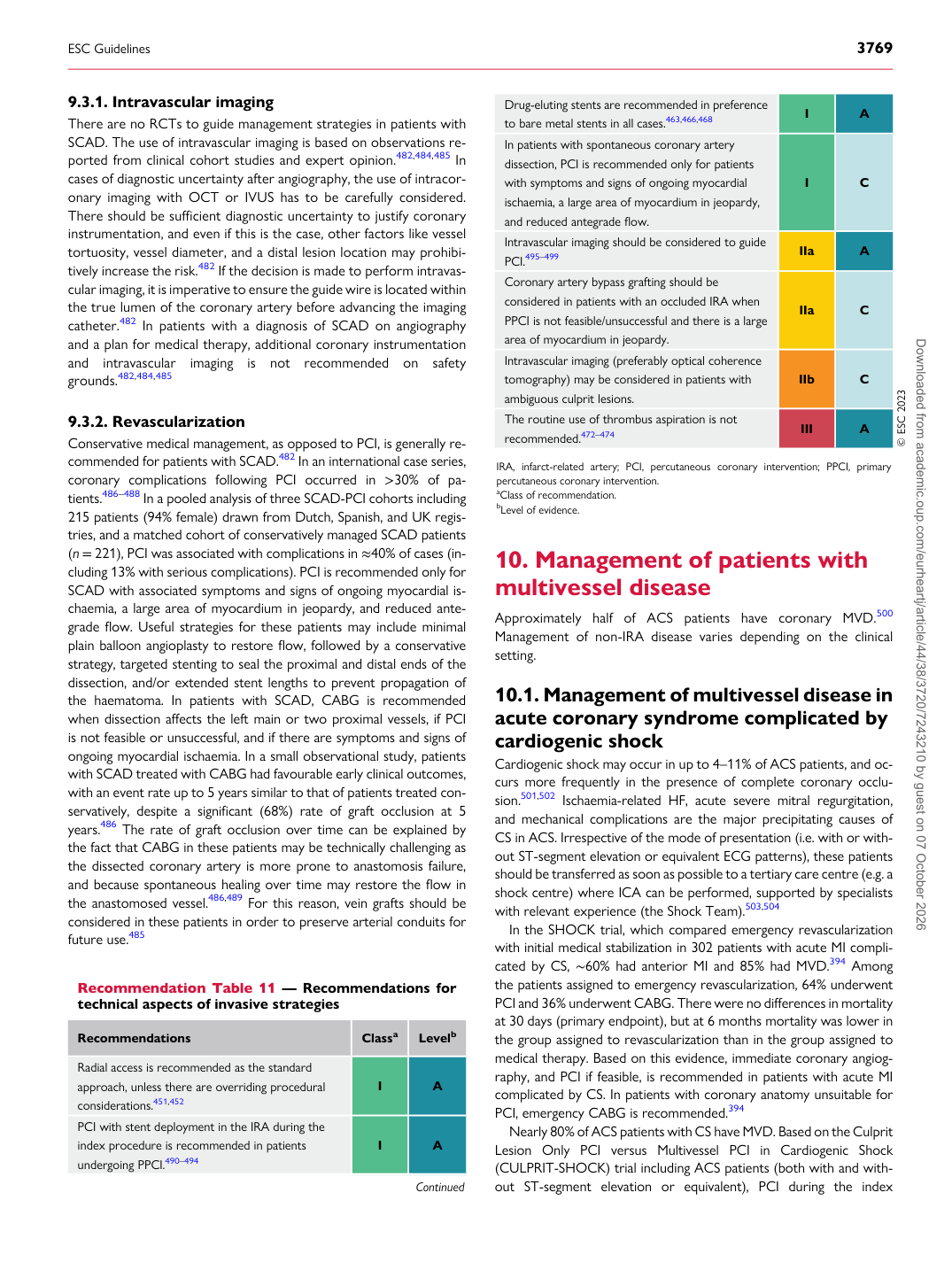
Recommendation Table 11 — Recommendations for technical aspects of invasive strategies

Recommendations Classa Levelb

Radial access is recommended as the standard approach, unless there are overriding procedural considerations.451,452 I A PCI with stent deployment in the IRA during the index procedure is recommended in patients undergoing PPCI.490–494 I A

Continued Drug-eluting stents are recommended in preference

to bare metal stents in all cases.463,466,468 I A In patients with spontaneous coronary artery dissection, PCI is recommended only for patients with symptoms and signs of ongoing myocardial ischaemia, a large area of myocardium in jeopardy, and reduced antegrade flow. I C Intravascular imaging should be considered to guide PCI.495–499 IIa A Coronary artery bypass grafting should be considered in patients with an occluded IRA when PPCI is not feasible/unsuccessful and there is a large area of myocardium in jeopardy. IIa C Intravascular imaging (preferably optical coherence tomography) may be considered in patients with ambiguous culprit lesions. IIb C The routine use of thrombus aspiration is not recommended.472–474 III A © ESC 2023

IRA, infarct-related artery; PCI, percutaneous coronary intervention; PPCI, primary percutaneous coronary intervention. aClass of recommendation. bLevel of evidence.

ESC Guidelines                                                                                                                                                                                          3769

Downloaded from academic.oup.com/eurheartj/article/44/38/3720/7243210 by guest on 07 October 2026