p.45 抽出テキスト
for Cardiogenic Shock) trial.394–396 While most patients will proceed to PCI at the time of diagnostic angiography if myocardial revascularization is indicated, surgical revascularization represents a valuable treatment option in patients in whom attempted PCI of the IRA has failed or if the coronary anatomy is not amenable to PCI.395,397,398 In the presence of CS due to AMI-related mechanical complications, surgical or percutaneous treatment may also be indicated and the strategy should be decided based on discussion between members of the Heart Team. In the IABP-SHOCK II (Intraaortic Balloon Pump in Cardiogenic Shock II) trial, intra-aortic balloon pump (IABP) use was not associated with lower 30-day mortality.399 Therefore, in the absence of mechanical complications, the routine use of an IABP is not recommended for CS complicating AMI. The role of mechanical circulatory devices (veno-arterial extracorporeal membrane oxygenation [VA-ECMO], micro-axial pump) in the AMI setting is not well established and large-scale randomized trials are warranted.400,401 The Extracorporeal Membrane Oxygenation in the Therapy of Cardiogenic Shock trial randomized 122 patients (51% with STEMI) with rapidly deteriorating or severe CS to either immediate implementation of VA-ECMO or an initially conservative strategy (which allowed for downstream use of VA-ECMO).402 The immediate implementation of VA-ECMO did not result in improved clinical outcomes.402 However, the interpretation of this trial is challenging because of the ∼40% crossover rate to VA-ECMO in the conservative arm, the inclusion of heterogenous phenotypes of CS, and inclusion of crossover in the combined primary endpoint. As a result of these limitations, this trial cannot adequately answer if mechanical circulatory support (MCS) is able to reduce mortality in this setting. It is important to note that while there is still a lack of high-quality randomized data supporting the use of MCS in ACS patients presenting with CS, some recent observational analyses have reported that the use of intravascular LV assist devices may be associated with an increased risk of adverse events in comparison to IABP in this setting, including mortality and bleeding.401,403 Therefore, while MCS may be considered in selected patients with ACS and severe/refractory CS, caution should be exercised in this regard until further randomized data are available. The management of patients with CS complicating AMI and MVD is presented in Section 10. 8 Management of acute coronary

syndrome during hospitalization

8.1 Coronary care unit/intensive cardiac

care unit Following reperfusion, it is recommended to admit high-risk ACS patients (including all STEMI patients) to a coronary care unit (CCU) or ICCU. Conditions in patients with ACS that act as acute risk modifiers include ongoing myocardial ischaemia (e.g. failed reperfusion), acute HF and/or hypoperfusion, CS, cardiac arrest with coma, malignant (lifethreatening) cardiac arrhythmias, high-degree atrioventricular block, and acute renal failure (with oliguria). All ICCUs must have appropriate diagnostic facilities to guide the delivery of pharmacological and invasive treatment. The staff should be thoroughly familiar with the management of all aspects of ACS, including: arrhythmias, HF, mechanical circulatory support, invasive and non-invasive haemodynamic monitoring (arterial and pulmonary artery pressures), respiratory monitoring, mechanical ventilation, and temperature control.408 The CCU/ICCU should also be able to manage patients with renal and pulmonary disease. The desirable organization, structure, and criteria of CCU/ ICCUs have been detailed in an ESC–Acute CardioVascular Care Association position paper.408

8.1.1 Monitoring

It is recommended to initiate ECG monitoring as soon as possible in all patients with ACS in order to detect life-threatening arrhythmias and allow prompt defibrillation if indicated. ECG monitoring for arrhythmias and new ST-segment elevation/depression is recommended for at least 24 h after symptom onset in all high-risk patients with ACS, including all STEMI patients.409 Longer monitoring could be considered in patients at intermediate to high risk of cardiac arrhythmias (i.e. those with more than one of the following criteria: haemodynamically unstable, presenting with major arrhythmias, left ventricular ejection fraction [LVEF] <40%, failed reperfusion, additional critical coronary stenoses of major vessels, or complications related to PCI). Further monitoring for arrhythmias will be dependent on the estimated risk. When a patient leaves the ICCU or equivalent, monitoring may be continued by telemetry. It is recommended that personnel adequately equipped and trained to manage lifethreatening arrhythmias and cardiac arrest accompany patients who are transferred between facilities during the time window in which they require continuous rhythm monitoring.409

8.1.2 Ambulation

Early ambulation (i.e. out of bed on day 1) is recommended in the majority of patients with ACS. This is facilitated by using radial access for

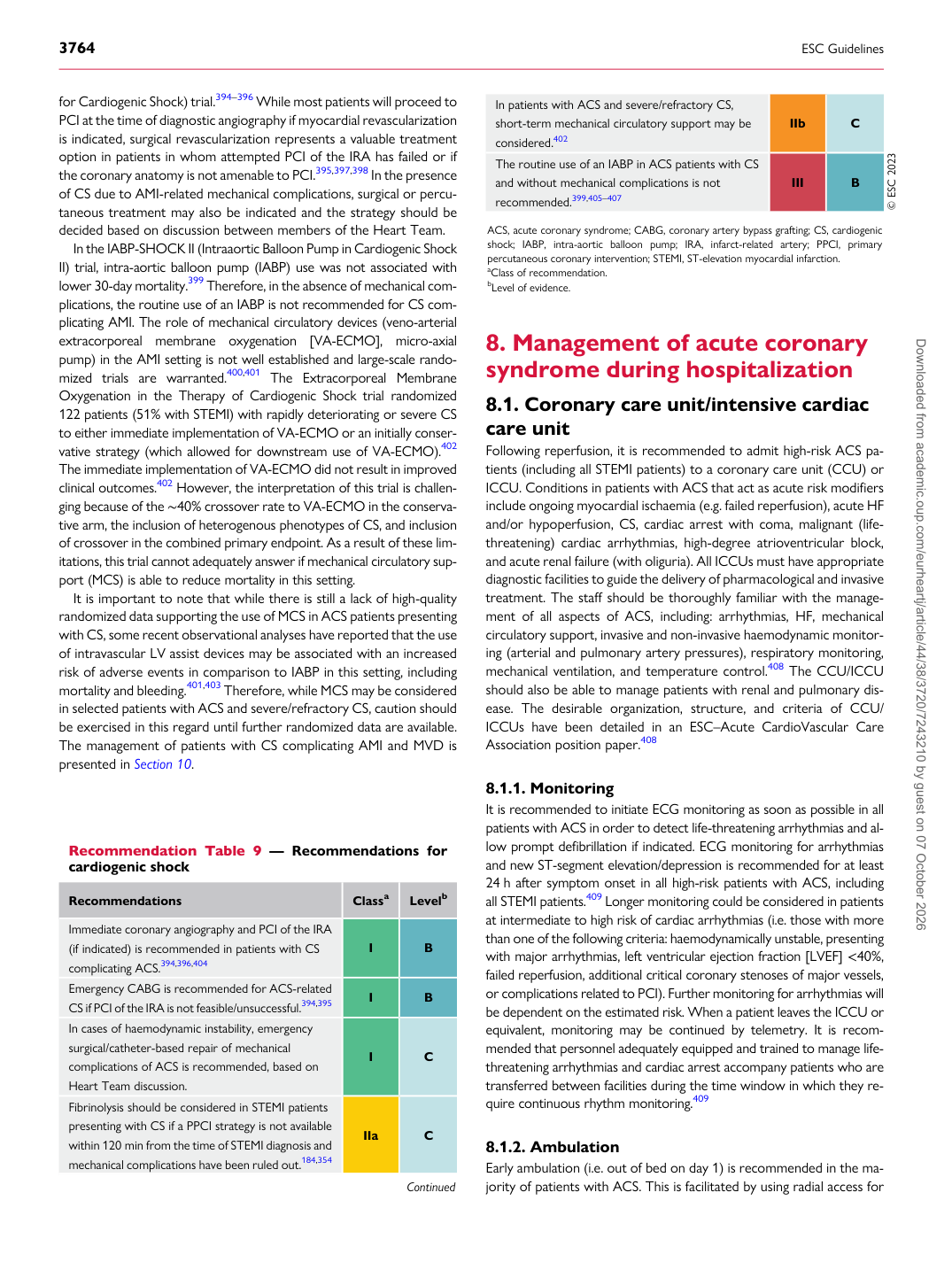
Recommendation Table 9 — Recommendations for cardiogenic shock

Recommendations Classa Levelb

Immediate coronary angiography and PCI of the IRA (if indicated) is recommended in patients with CS complicating ACS.394,396,404 I B Emergency CABG is recommended for ACS-related CS if PCI of the IRA is not feasible/unsuccessful.394,395 I B In cases of haemodynamic instability, emergency surgical/catheter-based repair of mechanical complications of ACS is recommended, based on Heart Team discussion. I C Fibrinolysis should be considered in STEMI patients presenting with CS if a PPCI strategy is not available within 120 min from the time of STEMI diagnosis and mechanical complications have been ruled out.184,354 IIa C

Continued In patients with ACS and severe/refractory CS,

short-term mechanical circulatory support may be considered.402 IIb C The routine use of an IABP in ACS patients with CS and without mechanical complications is not recommended.399,405–407 III B © ESC 2023

ACS, acute coronary syndrome; CABG, coronary artery bypass grafting; CS, cardiogenic shock; IABP, intra-aortic balloon pump; IRA, infarct-related artery; PPCI, primary percutaneous coronary intervention; STEMI, ST-elevation myocardial infarction. aClass of recommendation. bLevel of evidence.

Downloaded from academic.oup.com/eurheartj/article/44/38/3720/7243210 by guest on 07 October 2026