p.44 抽出テキスト
7.1 Out-of-hospital cardiac arrest in acute

coronary syndrome While a small minority of all patients with ACS present as OHCA, ACS is the most common cause of OHCA.364–366 In patients with OHCA, resuscitation efforts should follow the European Resuscitation Council Guidelines.367 The majority of adult cardiac arrest cases are associated with obstructive CAD and ACS should be included in the differential diagnosis.365,368 Therefore, ICA can be part of the postresuscitation management for patients who are estimated to have a high probability of acute coronary occlusion (e.g. persistent ST-segment elevation or equivalents and/or haemodynamic and/or electrical instability).367,369 Neurological status (e.g. comatose vs. noncomatose) and survival probability (i.e. favourable benefit/risk ratio vs. futility) should also be included in the decision-making algorithm. Despite the lack of dedicated trials, patients with return of spontaneous circulation (ROSC) and persistent ST-segment elevation should, in general, undergo a PPCI strategy (immediate ICA and PCI if indicated), based on the overall clinical situation and a reasonable benefit/risk ratio. Based on registry reports, emergent ICA and PCI are associated with good outcomes in this setting, particularly in patients who are noncomatose at initial assessment.368,370,371 The management of patients with ROSC without evidence of ST-segment elevation should be individualized according to haemodynamic and neurological status. In OHCA with an initial shockable rhythm and without ST-segment elevation or equivalents and without CS, routine immediate ICA is not superior to a delayed invasive strategy based on data from the COACT (Coronary Angiography after Cardiac Arrest) and TOMAHAWK (Immediate Unselected Coronary Angiography Versus Delayed Triage in Survivors of Out-of-hospital Cardiac Arrest Without ST-segment Elevation) RCTs.372,373 Smaller, underpowered trials (EMERGE [EMERGEncy versus delayed coronary angiogram in survivors of out-of-hospital cardiac arrest with no obvious non-cardiac cause of arrest], PEARL [A Pilot Randomized Clinical Trial of Early Coronary Angiography Versus No Early Coronary Angiography for Post-Cardiac Arrest Patients Without ECG ST Segment Elevation], and COUPE [Coronariography in OUt of hosPital Cardiac arrEst]) have also pointed to the same conclusion.372–377 Further detail on these trials is provided in the Supplementary data online, Evidence Tables. Based on data from the COACT and TOMAHAWK trials, it appears reasonable to delay ICA in haemodynamically stable patients with resuscitated OHCA without ST-segment elevation or equivalents. Initial evaluation in the ED or intensive cardiac care unit (ICCU) should focus on excluding non-coronary causes (cerebrovascular events, respiratory failure, non-cardiogenic shock, PE, or intoxication). Echocardiography is also useful in the evaluation of these patients. The decision to perform selective coronary angiography (and PCI if indicated) should also consider factors associated with poor neurological outcome and the likelihood of ACS. In patients who remain unresponsive after ROSC, monitoring of core temperature and actively preventing fever (defined as a temperature >37.7°C) is recommended to improve neurological outcome.367,378–385 A recent study compared device-based temperature control of 36°C for 24 h followed by targeting of 37°C for either 12 or 48 h (for total intervention times of 36 and 72 h, respectively) or until the patient regained consciousness in 789 patients with OHCA of a presumed cardiac cause (∼45% with ST segment elevation on ECG; immediate coronary angiography performed in 92% and PCI in 43%). This study reported comparable outcomes with both strategies with respect to the primary endpoint (death, severe disability, or coma) at 90 days.384 In all comatose survivors, evaluation of neurological prognosis no earlier than 72 h after admission is recommended.367,378–383,386

7.1.1 Systems of care

There is increasing evidence suggesting that specialized hospitals for patients following OHCA (referred to as cardiac arrest centres) may be associated with clinical benefits.367 See Supplementary data online, Section 7.1.1 for expanded information on this topic.

7.2 Cardiogenic shock complicating acute

coronary syndrome Early revascularization with either PCI or CABG is recommended for patients with AMI complicated by CS, based on the results of the SHOCK (Should We Emergently Revascularize Occluded Coronaries

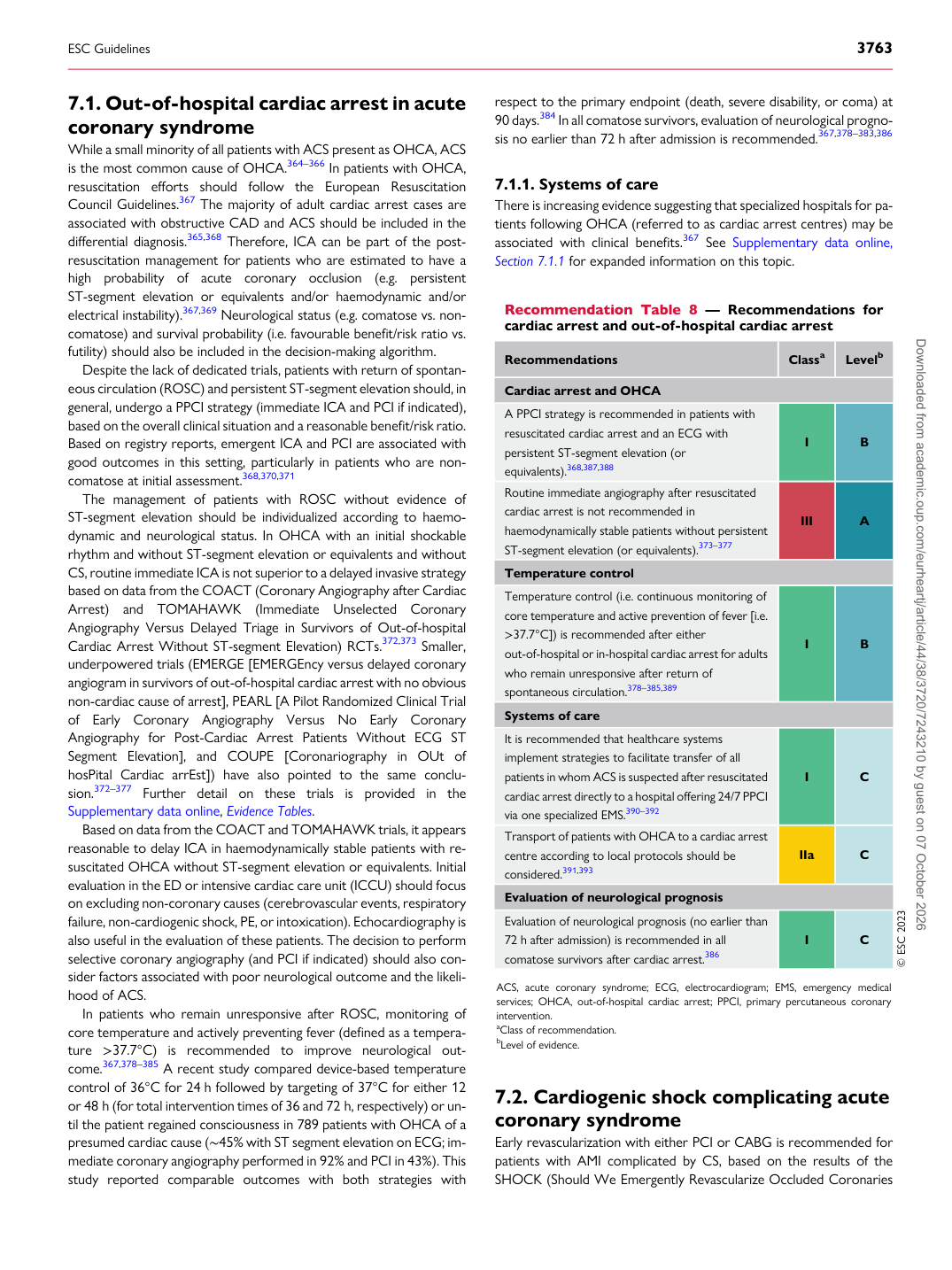
Recommendation Table 8 — Recommendations for cardiac arrest and out-of-hospital cardiac arrest

Recommendations Classa Levelb

Cardiac arrest and OHCA A PPCI strategy is recommended in patients with resuscitated cardiac arrest and an ECG with persistent ST-segment elevation (or equivalents).368,387,388 I B Routine immediate angiography after resuscitated cardiac arrest is not recommended in haemodynamically stable patients without persistent ST-segment elevation (or equivalents).373–377 III A Temperature control Temperature control (i.e. continuous monitoring of core temperature and active prevention of fever [i.e. >37.7°C]) is recommended after either out-of-hospital or in-hospital cardiac arrest for adults who remain unresponsive after return of spontaneous circulation.378–385,389 I B Systems of care It is recommended that healthcare systems implement strategies to facilitate transfer of all patients in whom ACS is suspected after resuscitated cardiac arrest directly to a hospital offering 24/7 PPCI via one specialized EMS.390–392 I C Transport of patients with OHCA to a cardiac arrest centre according to local protocols should be considered.391,393 IIa C Evaluation of neurological prognosis Evaluation of neurological prognosis (no earlier than 72 h after admission) is recommended in all comatose survivors after cardiac arrest.386 I C © ESC 2023

ACS, acute coronary syndrome; ECG, electrocardiogram; EMS, emergency medical services; OHCA, out-of-hospital cardiac arrest; PPCI, primary percutaneous coronary intervention. aClass of recommendation. bLevel of evidence.

ESC Guidelines                                                                                                                                                                                          3763

Downloaded from academic.oup.com/eurheartj/article/44/38/3720/7243210 by guest on 07 October 2026