p.43 抽出テキスト
6.5.2 Patients requiring vitamin K antagonists or

undergoing coronary artery bypass surgery In patients for whom a VKA is mandated (e.g. patients with mechanical prosthetic valves), DAT with a VKA and SAPT (preferably clopidogrel) is indicated after an up to 1-week period of TAT (with aspirin and clopidogrel).306 A network meta-analysis has reported that compared with TAT (consisting of VKA plus aspirin and clopidogrel), DAT (VKA plus clopidogrel) was associated with a trend towards a reduction in TIMI major bleeding, with no significant difference observed in MACE.336 In ACS patients undergoing CABG with an established indication for OAC, anticoagulation in combination with SAPT should be resumed after CABG as soon as possible and TAT should be avoided.

6.6 Antithrombotic therapy as an adjunct

to fibrinolysis ISIS-2 (Second International Study Of Infarct Survival) demonstrated that the benefits of aspirin and fibrinolytics (i.e. streptokinase) were additive.340 The first dose of aspirin (162–325 mg) should be chewed or given i.v. and a low dose (75–100 mg) given orally daily from the next day thereafter. Clopidogrel added to aspirin reduces the risk of CV events and overall mortality in patients treated with fibrinolysis and should be added to aspirin following lytic therapy.341,342 Based on the available RCTs, there is insufficient evidence to support or refute improved outcomes with ticagrelor or prasugrel in patients with STEMI treated with thrombolytics.343–345 There is no evidence that administration of GP IIb/IIIa receptor inhibitors improves myocardial perfusion or outcomes in patients treated with fibrinolysis, and it may increase the risk of bleeding events.346 Parenteral anticoagulation is recommended until revascularization, if performed. Despite an increased risk of major bleeding, the net clinical benefit favoured enoxaparin over UFH in the ASsessment of the Safety and Efficacy of a New Thrombolytic 3 (ASSENT 3) trial (n = 6095).347 In the large Enoxaparin and Thrombolysis Reperfusion for Acute myocardial infarction Treatment–Thrombolysis In Myocardial Infarction 25 (ExTRACT–TIMI 25) trial (n = 20 506), a lower dose of enoxaparin was given to patients ≥75 years old and to those with impaired renal function (estimated creatinine clearance <30 mL/min). Enoxaparin was associated with a reduction in the risk of death and re-infarction at 30 days when compared with a weight-adjusted UFH dose, but at the cost of a significant increase in non-cerebral bleeding complications. The net clinical benefit (i.e. absence of death, non-fatal infarction, and intracranial haemorrhage) favoured enoxaparin.348,349 In the large OASIS-6 trial, fondaparinux was superior to placebo or UFH in preventing death and re-infarction, especially in patients who received streptokinase.260,350 In a large trial with streptokinase, significantly fewer re-infarctions were seen with bivalirudin given for 48 h compared with UFH, although at the cost of a modest non-significant increase in non-cerebral bleeding complications.351 Bivalirudin has not been studied with fibrin-specific agents, and there is no evidence to support direct thrombin inhibitors as an adjunct to fibrinolysis.260,350 Weight-adjusted i.v. tenecteplase, low-dose aspirin, clopidogrel given orally, and enoxaparin i.v. followed by s.c. administration until the time of PCI (revascularization) represents the most extensively studied antithrombotic regimen as part of a pharmaco-invasive strategy.184,186,213,346,352 Further information on fibrinolytic therapy, including antithrombotic co-therapies and contraindications is provided in Supplementary data online, Tables S10 and S11. 6.7 Antithrombotic therapy in patients

not undergoing reperfusion Patients with a final diagnosis of ACS who do not undergo reperfusion should receive a P2Y12 receptor inhibitor in addition to aspirin, maintained over 12 months unless there is HBR. Among ACS patients who are medically managed without revascularization, the combination of aspirin and ticagrelor for up to 12 months has demonstrated a benefit in comparison to aspirin and clopidogrel.238,361 The combination of aspirin and prasugrel can also be justified in preference to aspirin and clopidogrel if coronary angiography has been performed and CAD is confirmed.239,362 As such, potent P2Y12 inhibitor-based DAPT is a reasonable option for patients with a final diagnosis of ACS not undergoing reperfusion, unless concerns over the bleeding risk prevail (e.g. based on ARC-HBR criteria).238,361 A DAPT regimen based on clopidogrel and aspirin may provide a good net clinical benefit among older ACS patients.242,363 Further information regarding antithrombotic therapy in ACS patients who do not undergo reperfusion is provided in the Supplementary data online.

7 Acute coronary syndrome with

unstable presentation

In some cases, ACS patients can present with haemodynamic compromise (i.e. out-of-hospital cardiac arrest [OHCA] and/or CS).

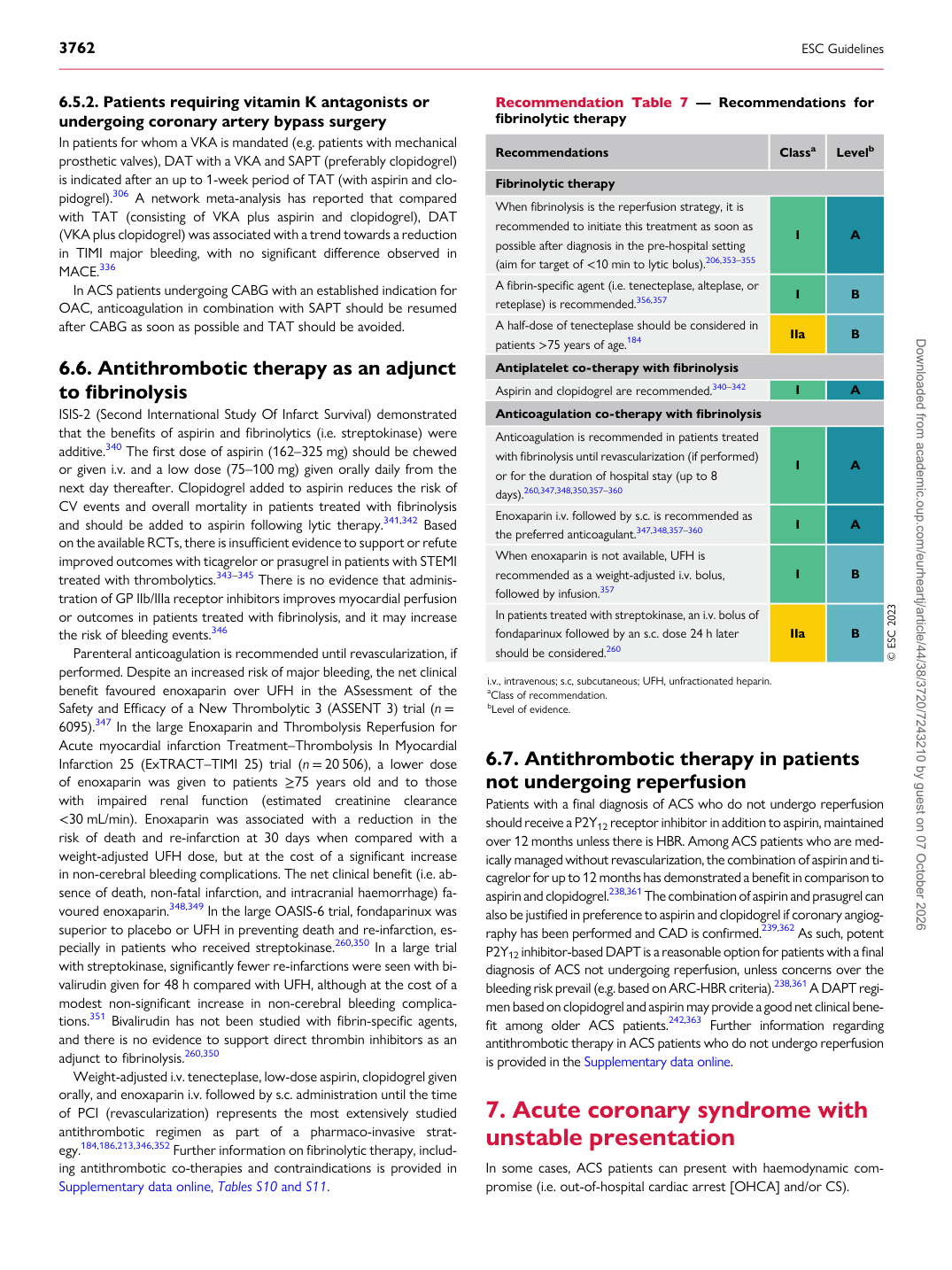
Recommendation Table 7 — Recommendations for fibrinolytic therapy

Recommendations Classa Levelb

Fibrinolytic therapy When fibrinolysis is the reperfusion strategy, it is recommended to initiate this treatment as soon as possible after diagnosis in the pre-hospital setting (aim for target of <10 min to lytic bolus).206,353–355 I A A fibrin-specific agent (i.e. tenecteplase, alteplase, or reteplase) is recommended.356,357 I B A half-dose of tenecteplase should be considered in patients >75 years of age.184 IIa B Antiplatelet co-therapy with fibrinolysis Aspirin and clopidogrel are recommended.340–342 I A Anticoagulation co-therapy with fibrinolysis Anticoagulation is recommended in patients treated with fibrinolysis until revascularization (if performed) or for the duration of hospital stay (up to 8 days).260,347,348,350,357–360 I A Enoxaparin i.v. followed by s.c. is recommended as the preferred anticoagulant.347,348,357–360 I A When enoxaparin is not available, UFH is recommended as a weight-adjusted i.v. bolus, followed by infusion.357 I B In patients treated with streptokinase, an i.v. bolus of fondaparinux followed by an s.c. dose 24 h later should be considered.260 IIa B © ESC 2023

i.v., intravenous; s.c, subcutaneous; UFH, unfractionated heparin. aClass of recommendation. bLevel of evidence. Downloaded from academic.oup.com/eurheartj/article/44/38/3720/7243210 by guest on 07 October 2026