p.42 抽出テキスト
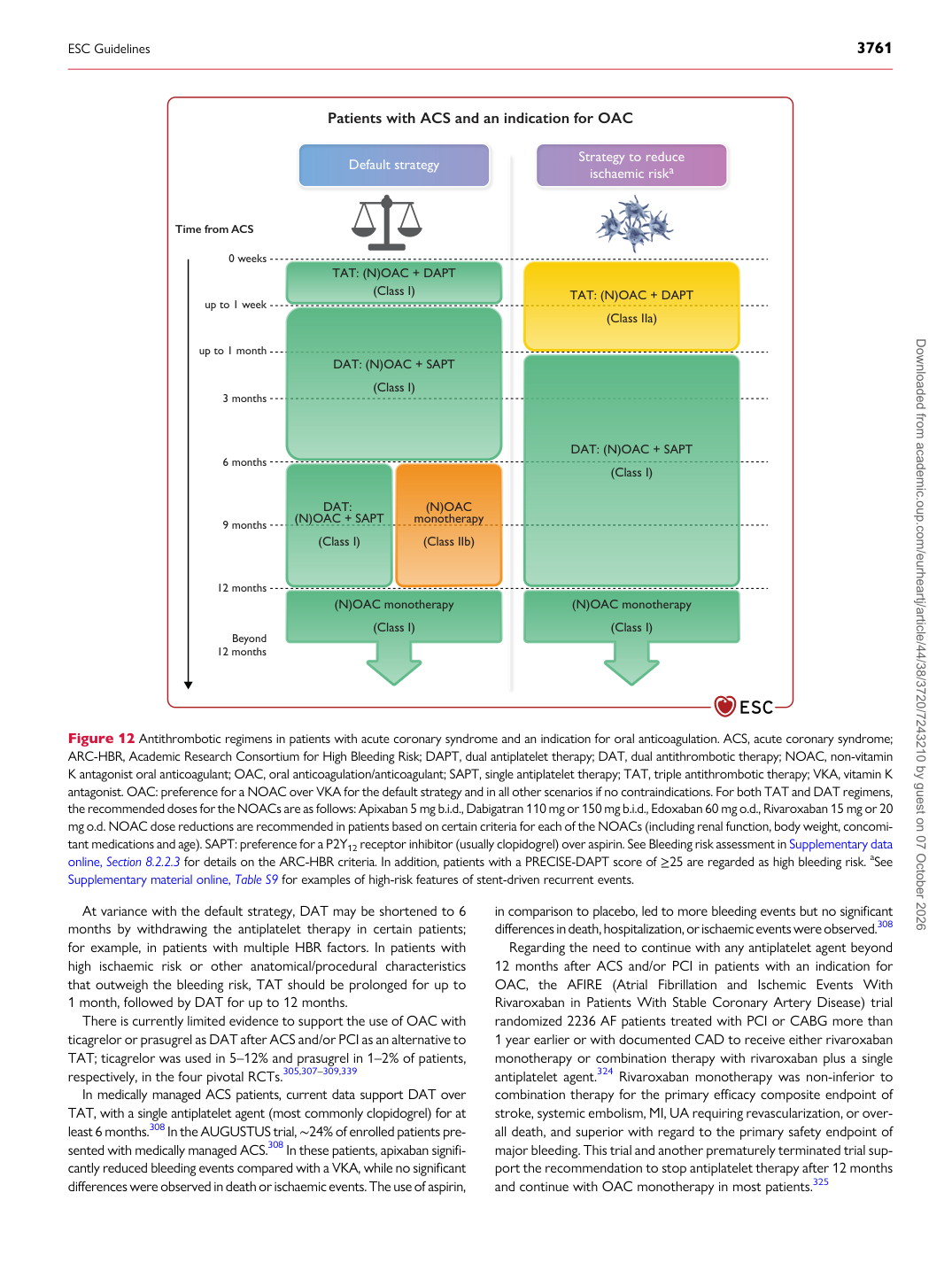
At variance with the default strategy, DAT may be shortened to 6 months by withdrawing the antiplatelet therapy in certain patients; for example, in patients with multiple HBR factors. In patients with high ischaemic risk or other anatomical/procedural characteristics that outweigh the bleeding risk, TAT should be prolonged for up to 1 month, followed by DAT for up to 12 months. There is currently limited evidence to support the use of OAC with ticagrelor or prasugrel as DAT after ACS and/or PCI as an alternative to TAT; ticagrelor was used in 5–12% and prasugrel in 1–2% of patients, respectively, in the four pivotal RCTs.305,307–309,339 In medically managed ACS patients, current data support DAT over TAT, with a single antiplatelet agent (most commonly clopidogrel) for at least 6 months.308 In the AUGUSTUS trial, ∼24% of enrolled patients presented with medically managed ACS.308 In these patients, apixaban significantly reduced bleeding events compared with a VKA, while no significant differences were observed in death or ischaemic events. The use of aspirin, in comparison to placebo, led to more bleeding events but no significant differences in death, hospitalization, or ischaemic events were observed.308

Regarding the need to continue with any antiplatelet agent beyond 12 months after ACS and/or PCI in patients with an indication for OAC, the AFIRE (Atrial Fibrillation and Ischemic Events With Rivaroxaban in Patients With Stable Coronary Artery Disease) trial randomized 2236 AF patients treated with PCI or CABG more than 1 year earlier or with documented CAD to receive either rivaroxaban monotherapy or combination therapy with rivaroxaban plus a single antiplatelet agent.324 Rivaroxaban monotherapy was non-inferior to combination therapy for the primary efficacy composite endpoint of stroke, systemic embolism, MI, UA requiring revascularization, or overall death, and superior with regard to the primary safety endpoint of major bleeding. This trial and another prematurely terminated trial support the recommendation to stop antiplatelet therapy after 12 months and continue with OAC monotherapy in most patients.325

0 weeks

up to 1 week

up to 1 month

6 months

3 months

9 months

12 months

Beyond 12 months Patients with ACS and an indication for OAC

Default strategy

TAT: (N)OAC + DAPT

(Class I)

DAT: (N)OAC + SAPT

(Class I)

DAT: (N)OAC + SAPT

(Class I)

TAT: (N)OAC + DAPT

(Class IIa)

(N)OAC monotherapy

(Class I) (N)OAC monotherapy

(Class I)

DAT: (N)OAC + SAPT

(Class I) (N)OAC monotherapy

(Class IIb) Strategy to reduce

ischaemic riska

Time from ACS

Figure 12 Antithrombotic regimens in patients with acute coronary syndrome and an indication for oral anticoagulation. ACS, acute coronary syndrome; ARC-HBR, Academic Research Consortium for High Bleeding Risk; DAPT, dual antiplatelet therapy; DAT, dual antithrombotic therapy; NOAC, non-vitamin K antagonist oral anticoagulant; OAC, oral anticoagulation/anticoagulant; SAPT, single antiplatelet therapy; TAT, triple antithrombotic therapy; VKA, vitamin K antagonist. OAC: preference for a NOAC over VKA for the default strategy and in all other scenarios if no contraindications. For both TAT and DAT regimens, the recommended doses for the NOACs are as follows: Apixaban 5 mg b.i.d., Dabigatran 110 mg or 150 mg b.i.d., Edoxaban 60 mg o.d., Rivaroxaban 15 mg or 20 mg o.d. NOAC dose reductions are recommended in patients based on certain criteria for each of the NOACs (including renal function, body weight, concomitant medications and age). SAPT: preference for a P2Y12 receptor inhibitor (usually clopidogrel) over aspirin. See Bleeding risk assessment in Supplementary data online, Section 8.2.2.3 for details on the ARC-HBR criteria. In addition, patients with a PRECISE-DAPT score of ≥25 are regarded as high bleeding risk. aSee Supplementary material online, Table S9 for examples of high-risk features of stent-driven recurrent events.

ESC Guidelines                                                                                                                                                                                          3761

Downloaded from academic.oup.com/eurheartj/article/44/38/3720/7243210 by guest on 07 October 2026