p.41 抽出テキスト
6.5 Antiplatelet therapy in patients

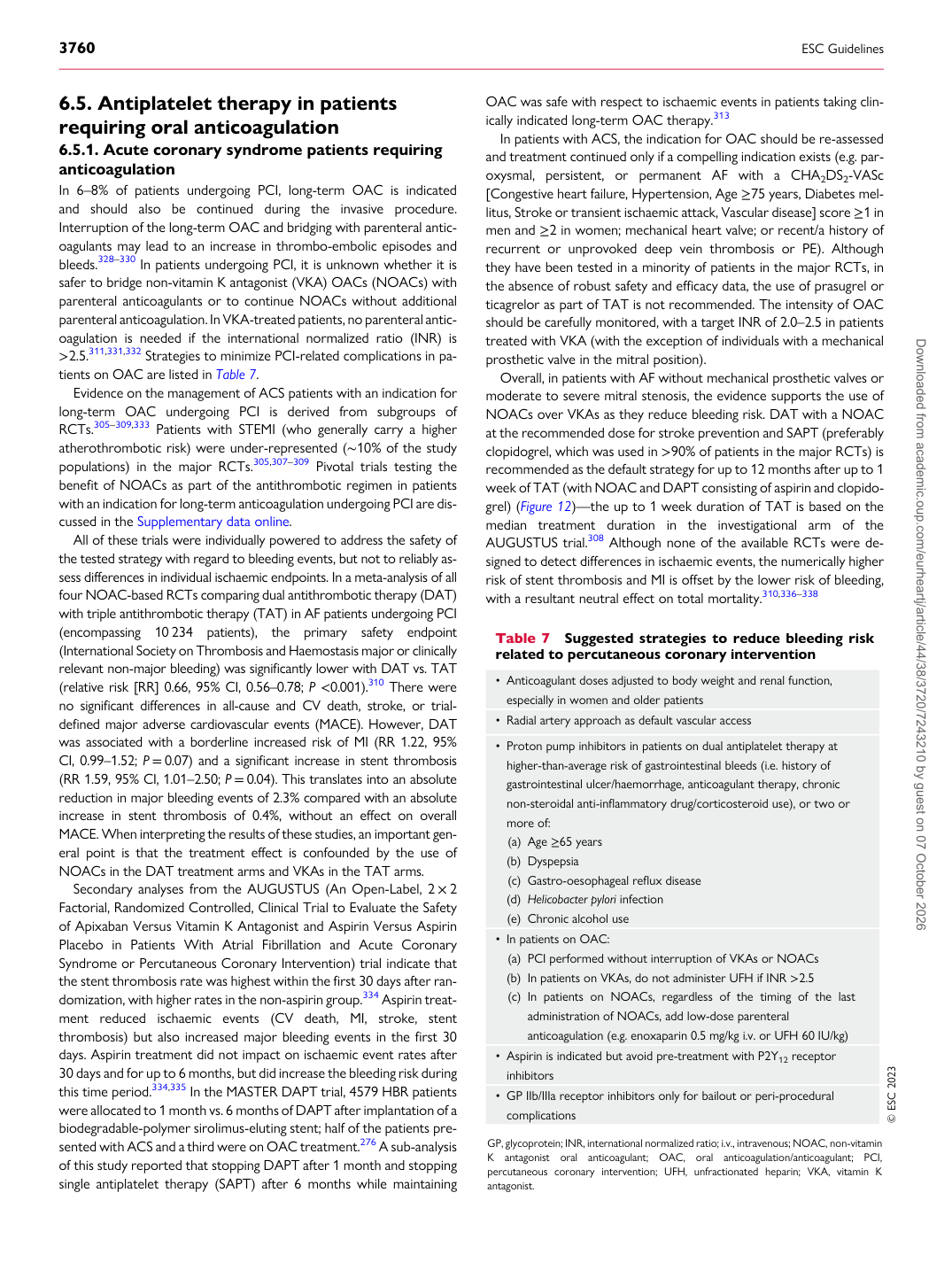
requiring oral anticoagulation 6.5.1. Acute coronary syndrome patients requiring anticoagulation In 6–8% of patients undergoing PCI, long-term OAC is indicated and should also be continued during the invasive procedure. Interruption of the long-term OAC and bridging with parenteral anticoagulants may lead to an increase in thrombo-embolic episodes and bleeds.328–330 In patients undergoing PCI, it is unknown whether it is safer to bridge non-vitamin K antagonist (VKA) OACs (NOACs) with parenteral anticoagulants or to continue NOACs without additional parenteral anticoagulation. In VKA-treated patients, no parenteral anticoagulation is needed if the international normalized ratio (INR) is >2.5.311,331,332 Strategies to minimize PCI-related complications in patients on OAC are listed in Table 7. Evidence on the management of ACS patients with an indication for long-term OAC undergoing PCI is derived from subgroups of RCTs.305–309,333 Patients with STEMI (who generally carry a higher atherothrombotic risk) were under-represented (∼10% of the study populations) in the major RCTs.305,307–309 Pivotal trials testing the benefit of NOACs as part of the antithrombotic regimen in patients with an indication for long-term anticoagulation undergoing PCI are discussed in the Supplementary data online. All of these trials were individually powered to address the safety of the tested strategy with regard to bleeding events, but not to reliably assess differences in individual ischaemic endpoints. In a meta-analysis of all four NOAC-based RCTs comparing dual antithrombotic therapy (DAT) with triple antithrombotic therapy (TAT) in AF patients undergoing PCI (encompassing 10 234 patients), the primary safety endpoint (International Society on Thrombosis and Haemostasis major or clinically relevant non-major bleeding) was significantly lower with DAT vs. TAT (relative risk [RR] 0.66, 95% CI, 0.56–0.78; P <0.001).310 There were no significant differences in all-cause and CV death, stroke, or trialdefined major adverse cardiovascular events (MACE). However, DAT was associated with a borderline increased risk of MI (RR 1.22, 95% CI, 0.99–1.52; P = 0.07) and a significant increase in stent thrombosis (RR 1.59, 95% CI, 1.01–2.50; P = 0.04). This translates into an absolute reduction in major bleeding events of 2.3% compared with an absolute increase in stent thrombosis of 0.4%, without an effect on overall MACE. When interpreting the results of these studies, an important general point is that the treatment effect is confounded by the use of NOACs in the DAT treatment arms and VKAs in the TAT arms. Secondary analyses from the AUGUSTUS (An Open-Label, 2 × 2 Factorial, Randomized Controlled, Clinical Trial to Evaluate the Safety of Apixaban Versus Vitamin K Antagonist and Aspirin Versus Aspirin Placebo in Patients With Atrial Fibrillation and Acute Coronary Syndrome or Percutaneous Coronary Intervention) trial indicate that the stent thrombosis rate was highest within the first 30 days after randomization, with higher rates in the non-aspirin group.334 Aspirin treatment reduced ischaemic events (CV death, MI, stroke, stent thrombosis) but also increased major bleeding events in the first 30 days. Aspirin treatment did not impact on ischaemic event rates after 30 days and for up to 6 months, but did increase the bleeding risk during this time period.334,335 In the MASTER DAPT trial, 4579 HBR patients were allocated to 1 month vs. 6 months of DAPT after implantation of a biodegradable-polymer sirolimus-eluting stent; half of the patients presented with ACS and a third were on OAC treatment.276 A sub-analysis of this study reported that stopping DAPT after 1 month and stopping single antiplatelet therapy (SAPT) after 6 months while maintaining OAC was safe with respect to ischaemic events in patients taking clinically indicated long-term OAC therapy.313

In patients with ACS, the indication for OAC should be re-assessed and treatment continued only if a compelling indication exists (e.g. paroxysmal, persistent, or permanent AF with a CHA2DS2-VASc [Congestive heart failure, Hypertension, Age ≥75 years, Diabetes mellitus, Stroke or transient ischaemic attack, Vascular disease] score ≥1 in men and ≥2 in women; mechanical heart valve; or recent/a history of recurrent or unprovoked deep vein thrombosis or PE). Although they have been tested in a minority of patients in the major RCTs, in the absence of robust safety and efficacy data, the use of prasugrel or ticagrelor as part of TAT is not recommended. The intensity of OAC should be carefully monitored, with a target INR of 2.0–2.5 in patients treated with VKA (with the exception of individuals with a mechanical prosthetic valve in the mitral position). Overall, in patients with AF without mechanical prosthetic valves or moderate to severe mitral stenosis, the evidence supports the use of NOACs over VKAs as they reduce bleeding risk. DAT with a NOAC at the recommended dose for stroke prevention and SAPT (preferably clopidogrel, which was used in >90% of patients in the major RCTs) is recommended as the default strategy for up to 12 months after up to 1 week of TAT (with NOAC and DAPT consisting of aspirin and clopidogrel) (Figure 12)—the up to 1 week duration of TAT is based on the median treatment duration in the investigational arm of the AUGUSTUS trial.308 Although none of the available RCTs were designed to detect differences in ischaemic events, the numerically higher risk of stent thrombosis and MI is offset by the lower risk of bleeding, with a resultant neutral effect on total mortality.310,336–338

Table 7 Suggested strategies to reduce bleeding risk related to percutaneous coronary intervention • Anticoagulant doses adjusted to body weight and renal function,

especially in women and older patients • Radial artery approach as default vascular access • Proton pump inhibitors in patients on dual antiplatelet therapy at higher-than-average risk of gastrointestinal bleeds (i.e. history of

gastrointestinal ulcer/haemorrhage, anticoagulant therapy, chronic non-steroidal anti-inflammatory drug/corticosteroid use), or two or more of: (a) Age ≥65 years (b) Dyspepsia (c) Gastro-oesophageal reflux disease (d) Helicobacter pylori infection (e) Chronic alcohol use • In patients on OAC:

(a) PCI performed without interruption of VKAs or NOACs (b) In patients on VKAs, do not administer UFH if INR >2.5 (c) In patients on NOACs, regardless of the timing of the last

administration of NOACs, add low-dose parenteral anticoagulation (e.g. enoxaparin 0.5 mg/kg i.v. or UFH 60 IU/kg) • Aspirin is indicated but avoid pre-treatment with P2Y12 receptor

inhibitors • GP IIb/IIIa receptor inhibitors only for bailout or peri-procedural

complications © ESC 2023

GP, glycoprotein; INR, international normalized ratio; i.v., intravenous; NOAC, non-vitamin K antagonist oral anticoagulant; OAC, oral anticoagulation/anticoagulant; PCI, percutaneous coronary intervention; UFH, unfractionated heparin; VKA, vitamin K antagonist. Downloaded from academic.oup.com/eurheartj/article/44/38/3720/7243210 by guest on 07 October 2026