p.40 抽出テキスト
6.4 Long-term treatment

By default, DAPT consisting of a potent P2Y12 receptor inhibitor in addition to aspirin is recommended for a minimum of 12 months after an ACS event; exceptions include patients for whom surgery is urgently needed, patients in whom OAC is indicated, and patients in whom the risk of bleeding is too high for other reasons.238,239,263 After PCI for ACS, ischaemic and bleeding events both markedly decrease over time. Further information regarding long-term antithrombotic strategies (i.e. beyond 12 months) is provided in the Supplementary data online.

6.4.1. Prolonging antithrombotic therapy beyond 12 months Prolonged antithrombotic therapy options: See Supplementary data online, Figure S4; Tables S7 and S8 for additional information.314–319

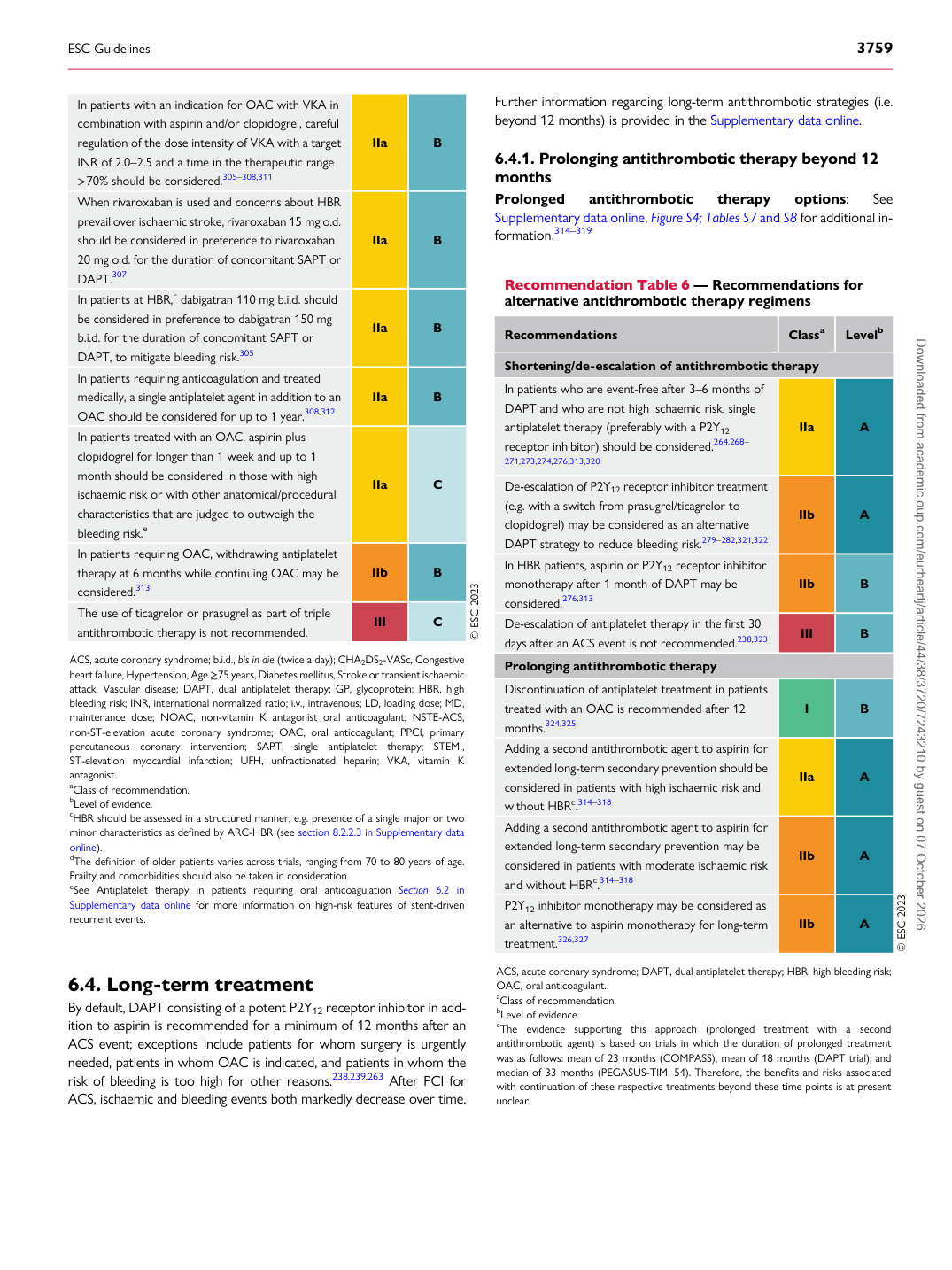
In patients with an indication for OAC with VKA in combination with aspirin and/or clopidogrel, careful regulation of the dose intensity of VKA with a target INR of 2.0–2.5 and a time in the therapeutic range >70% should be considered.305–308,311 IIa B When rivaroxaban is used and concerns about HBR prevail over ischaemic stroke, rivaroxaban 15 mg o.d. should be considered in preference to rivaroxaban 20 mg o.d. for the duration of concomitant SAPT or DAPT.307 IIa B In patients at HBR,c dabigatran 110 mg b.i.d. should be considered in preference to dabigatran 150 mg b.i.d. for the duration of concomitant SAPT or DAPT, to mitigate bleeding risk.305 IIa B In patients requiring anticoagulation and treated medically, a single antiplatelet agent in addition to an OAC should be considered for up to 1 year.308,312 IIa B In patients treated with an OAC, aspirin plus clopidogrel for longer than 1 week and up to 1 month should be considered in those with high ischaemic risk or with other anatomical/procedural characteristics that are judged to outweigh the bleeding risk.e IIa C In patients requiring OAC, withdrawing antiplatelet therapy at 6 months while continuing OAC may be considered.313 IIb B The use of ticagrelor or prasugrel as part of triple antithrombotic therapy is not recommended. III C © ESC 2023

ACS, acute coronary syndrome; b.i.d., bis in die (twice a day); CHA2DS2-VASc, Congestive heart failure, Hypertension, Age ≥75 years, Diabetes mellitus, Stroke or transient ischaemic attack, Vascular disease; DAPT, dual antiplatelet therapy; GP, glycoprotein; HBR, high bleeding risk; INR, international normalized ratio; i.v., intravenous; LD, loading dose; MD, maintenance dose; NOAC, non-vitamin K antagonist oral anticoagulant; NSTE-ACS, non-ST-elevation acute coronary syndrome; OAC, oral anticoagulant; PPCI, primary percutaneous coronary intervention; SAPT, single antiplatelet therapy; STEMI, ST-elevation myocardial infarction; UFH, unfractionated heparin; VKA, vitamin K antagonist. aClass of recommendation. bLevel of evidence. cHBR should be assessed in a structured manner, e.g. presence of a single major or two minor characteristics as defined by ARC-HBR (see section 8.2.2.3 in Supplementary data online). dThe definition of older patients varies across trials, ranging from 70 to 80 years of age. Frailty and comorbidities should also be taken in consideration. eSee Antiplatelet therapy in patients requiring oral anticoagulation Section 6.2 in Supplementary data online for more information on high-risk features of stent-driven recurrent events. Recommendation Table 6 — Recommendations for alternative antithrombotic therapy regimens

Recommendations Classa Levelb

Shortening/de-escalation of antithrombotic therapy In patients who are event-free after 3–6 months of DAPT and who are not high ischaemic risk, single antiplatelet therapy (preferably with a P2Y12 receptor inhibitor) should be considered.264,268– 271,273,274,276,313,320 IIa A

De-escalation of P2Y12 receptor inhibitor treatment (e.g. with a switch from prasugrel/ticagrelor to clopidogrel) may be considered as an alternative DAPT strategy to reduce bleeding risk.279–282,321,322 IIb A In HBR patients, aspirin or P2Y12 receptor inhibitor monotherapy after 1 month of DAPT may be considered.276,313 IIb B De-escalation of antiplatelet therapy in the first 30 days after an ACS event is not recommended.238,323 III B Prolonging antithrombotic therapy Discontinuation of antiplatelet treatment in patients treated with an OAC is recommended after 12 months.324,325 I B Adding a second antithrombotic agent to aspirin for extended long-term secondary prevention should be considered in patients with high ischaemic risk and without HBRc.314–318 IIa A Adding a second antithrombotic agent to aspirin for extended long-term secondary prevention may be considered in patients with moderate ischaemic risk and without HBRc.314–318 IIb A P2Y12 inhibitor monotherapy may be considered as an alternative to aspirin monotherapy for long-term treatment.326,327 IIb A © ESC 2023

ACS, acute coronary syndrome; DAPT, dual antiplatelet therapy; HBR, high bleeding risk; OAC, oral anticoagulant. aClass of recommendation. bLevel of evidence. cThe evidence supporting this approach (prolonged treatment with a second antithrombotic agent) is based on trials in which the duration of prolonged treatment was as follows: mean of 23 months (COMPASS), mean of 18 months (DAPT trial), and median of 33 months (PEGASUS-TIMI 54). Therefore, the benefits and risks associated with continuation of these respective treatments beyond these time points is at present unclear.

ESC Guidelines                                                                                                                                                                                          3759

Downloaded from academic.oup.com/eurheartj/article/44/38/3720/7243210 by guest on 07 October 2026