p.38 抽出テキスト
6.3.3 Summary of alternative antiplatelet strategies

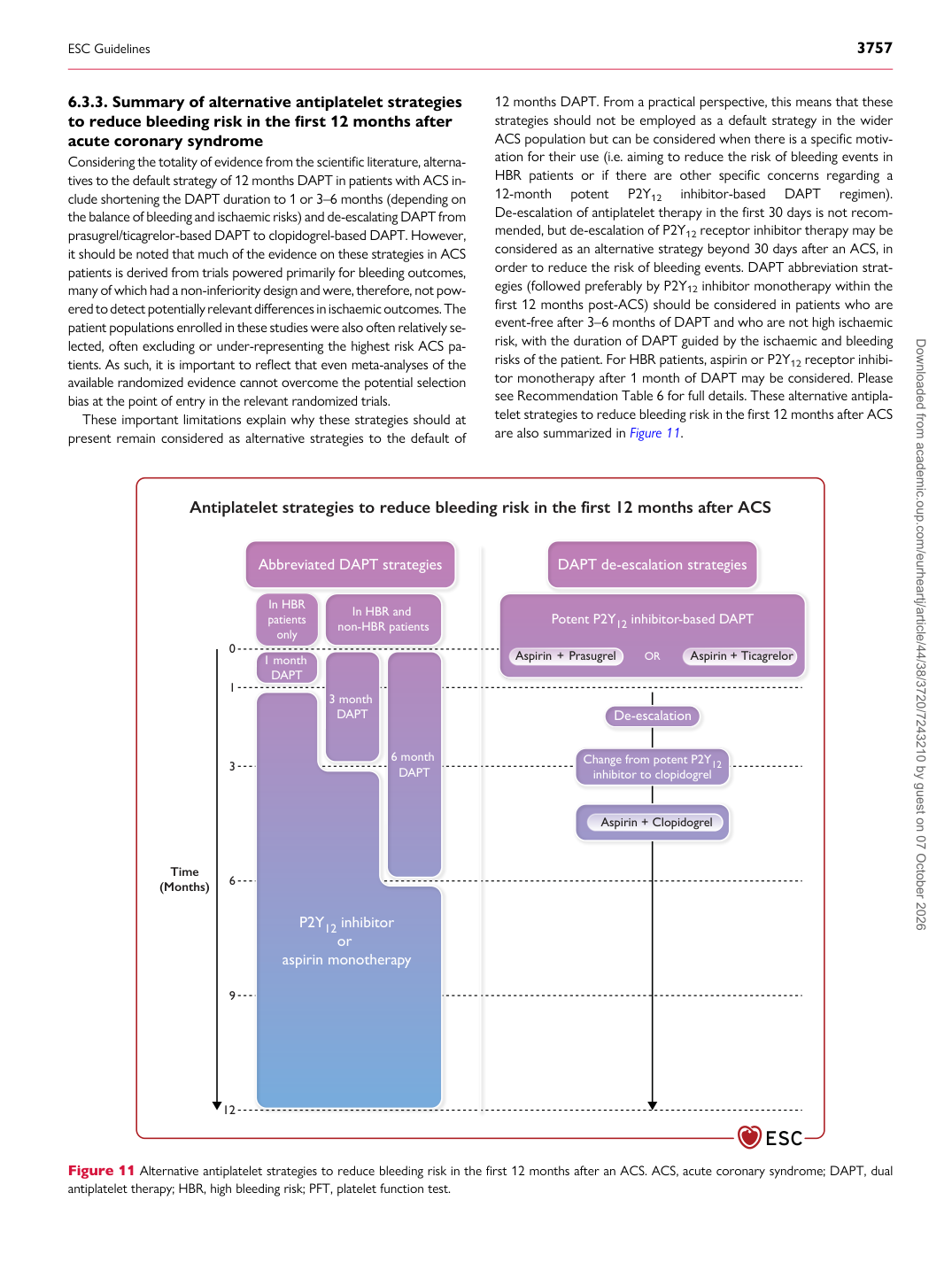
to reduce bleeding risk in the first 12 months after acute coronary syndrome Considering the totality of evidence from the scientific literature, alternatives to the default strategy of 12 months DAPT in patients with ACS include shortening the DAPT duration to 1 or 3–6 months (depending on the balance of bleeding and ischaemic risks) and de-escalating DAPT from prasugrel/ticagrelor-based DAPT to clopidogrel-based DAPT. However, it should be noted that much of the evidence on these strategies in ACS patients is derived from trials powered primarily for bleeding outcomes, many of which had a non-inferiority design and were, therefore, not powered to detect potentially relevant differences in ischaemic outcomes. The patient populations enrolled in these studies were also often relatively selected, often excluding or under-representing the highest risk ACS patients. As such, it is important to reflect that even meta-analyses of the available randomized evidence cannot overcome the potential selection bias at the point of entry in the relevant randomized trials. These important limitations explain why these strategies should at present remain considered as alternative strategies to the default of 12 months DAPT. From a practical perspective, this means that these strategies should not be employed as a default strategy in the wider ACS population but can be considered when there is a specific motivation for their use (i.e. aiming to reduce the risk of bleeding events in HBR patients or if there are other specific concerns regarding a 12-month potent P2Y12 inhibitor-based DAPT regimen). De-escalation of antiplatelet therapy in the first 30 days is not recommended, but de-escalation of P2Y12 receptor inhibitor therapy may be considered as an alternative strategy beyond 30 days after an ACS, in order to reduce the risk of bleeding events. DAPT abbreviation strategies (followed preferably by P2Y12 inhibitor monotherapy within the first 12 months post-ACS) should be considered in patients who are event-free after 3–6 months of DAPT and who are not high ischaemic risk, with the duration of DAPT guided by the ischaemic and bleeding risks of the patient. For HBR patients, aspirin or P2Y12 receptor inhibitor monotherapy after 1 month of DAPT may be considered. Please see Recommendation Table 6 for full details. These alternative antiplatelet strategies to reduce bleeding risk in the first 12 months after ACS are also summarized in Figure 11.

0

1

3

6

9

Antiplatelet strategies to reduce bleeding risk in the first 12 months after ACS

Abbreviated DAPT strategies DAPT de-escalation strategies

Time (Months) In HBR patients

only 1 month DAPT

3 month DAPT

6 month DAPT

P2Y12 inhibitor or aspirin monotherapy

In HBR and non-HBR patients Potent P2Y12 inhibitor-based DAPT

Aspirin + Prasugrel

Aspirin + Clopidogrel

Aspirin + Ticagrelor OR

De-escalation

Change from potent P2Y12

inhibitor to clopidogrel

Figure 11 Alternative antiplatelet strategies to reduce bleeding risk in the first 12 months after an ACS. ACS, acute coronary syndrome; DAPT, dual antiplatelet therapy; HBR, high bleeding risk; PFT, platelet function test.

ESC Guidelines                                                                                                                                                                                          3757

Downloaded from academic.oup.com/eurheartj/article/44/38/3720/7243210 by guest on 07 October 2026