p.31 抽出テキスト
6 Antithrombotic therapy

Antithrombotic treatment is an important component of the management of all patients presenting with ACS. The specific choice and combination of therapy, the time of its initiation, and the treatment duration depend on various patient and procedural factors. Treatment decisions must be made weighing the benefits of antithrombotic therapy against the risk of bleeding, including severe, life-threatening bleeding.231,232 Recommended anticoagulant and antiplatelet drugs and their dosing (for use during and after ACS) are summarized in Table 6 and illustrated in Figure 9.

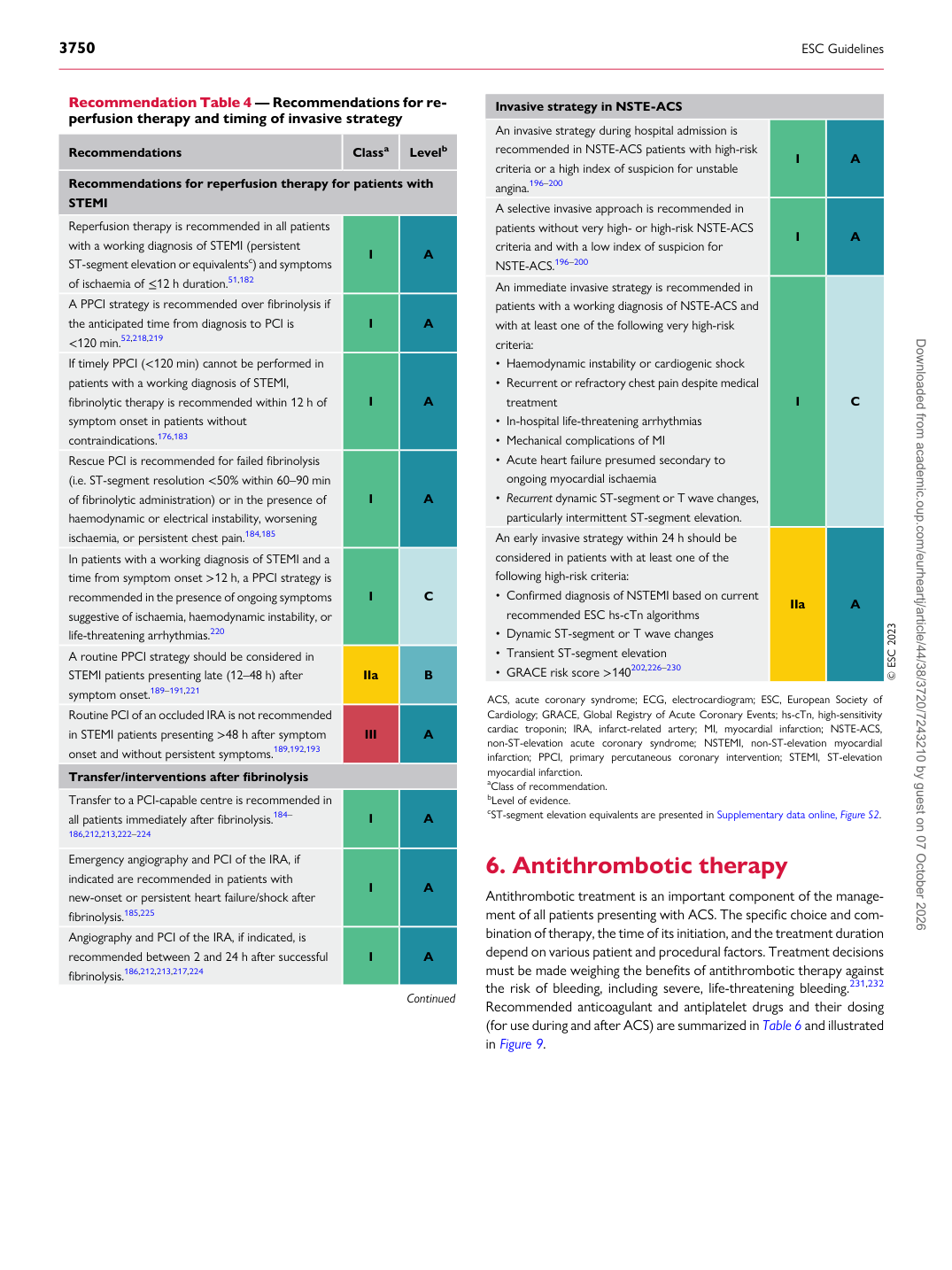
Recommendation Table 4 — Recommendations for reperfusion therapy and timing of invasive strategy

Recommendations Classa Levelb

Recommendations for reperfusion therapy for patients with STEMI Reperfusion therapy is recommended in all patients with a working diagnosis of STEMI (persistent ST-segment elevation or equivalentsc) and symptoms of ischaemia of ≤12 h duration.51,182 I A A PPCI strategy is recommended over fibrinolysis if the anticipated time from diagnosis to PCI is <120 min.52,218,219 I A If timely PPCI (<120 min) cannot be performed in patients with a working diagnosis of STEMI, fibrinolytic therapy is recommended within 12 h of symptom onset in patients without contraindications.176,183 I A Rescue PCI is recommended for failed fibrinolysis (i.e. ST-segment resolution <50% within 60–90 min of fibrinolytic administration) or in the presence of haemodynamic or electrical instability, worsening ischaemia, or persistent chest pain.184,185 I A In patients with a working diagnosis of STEMI and a time from symptom onset >12 h, a PPCI strategy is recommended in the presence of ongoing symptoms suggestive of ischaemia, haemodynamic instability, or life-threatening arrhythmias.220 I C A routine PPCI strategy should be considered in STEMI patients presenting late (12–48 h) after symptom onset.189–191,221 IIa B Routine PCI of an occluded IRA is not recommended in STEMI patients presenting >48 h after symptom onset and without persistent symptoms.189,192,193 III A Transfer/interventions after fibrinolysis Transfer to a PCI-capable centre is recommended in all patients immediately after fibrinolysis.184–

186,212,213,222–224 I A

Emergency angiography and PCI of the IRA, if indicated are recommended in patients with new-onset or persistent heart failure/shock after fibrinolysis.185,225 I A Angiography and PCI of the IRA, if indicated, is recommended between 2 and 24 h after successful fibrinolysis.186,212,213,217,224 I A

Continued Invasive strategy in NSTE-ACS

An invasive strategy during hospital admission is recommended in NSTE-ACS patients with high-risk criteria or a high index of suspicion for unstable angina.196–200 I A A selective invasive approach is recommended in patients without very high- or high-risk NSTE-ACS criteria and with a low index of suspicion for NSTE-ACS.196–200 I A An immediate invasive strategy is recommended in patients with a working diagnosis of NSTE-ACS and with at least one of the following very high-risk criteria: • Haemodynamic instability or cardiogenic shock • Recurrent or refractory chest pain despite medical treatment • In-hospital life-threatening arrhythmias • Mechanical complications of MI • Acute heart failure presumed secondary to

ongoing myocardial ischaemia • Recurrent dynamic ST-segment or T wave changes, particularly intermittent ST-segment elevation. I C An early invasive strategy within 24 h should be considered in patients with at least one of the following high-risk criteria: • Confirmed diagnosis of NSTEMI based on current recommended ESC hs-cTn algorithms • Dynamic ST-segment or T wave changes • Transient ST-segment elevation • GRACE risk score >140202,226–230 IIa A © ESC 2023

ACS, acute coronary syndrome; ECG, electrocardiogram; ESC, European Society of Cardiology; GRACE, Global Registry of Acute Coronary Events; hs-cTn, high-sensitivity cardiac troponin; IRA, infarct-related artery; MI, myocardial infarction; NSTE-ACS, non-ST-elevation acute coronary syndrome; NSTEMI, non-ST-elevation myocardial infarction; PPCI, primary percutaneous coronary intervention; STEMI, ST-elevation myocardial infarction. aClass of recommendation. bLevel of evidence. cST-segment elevation equivalents are presented in Supplementary data online, Figure S2. Downloaded from academic.oup.com/eurheartj/article/44/38/3720/7243210 by guest on 07 October 2026