p.29 抽出テキスト
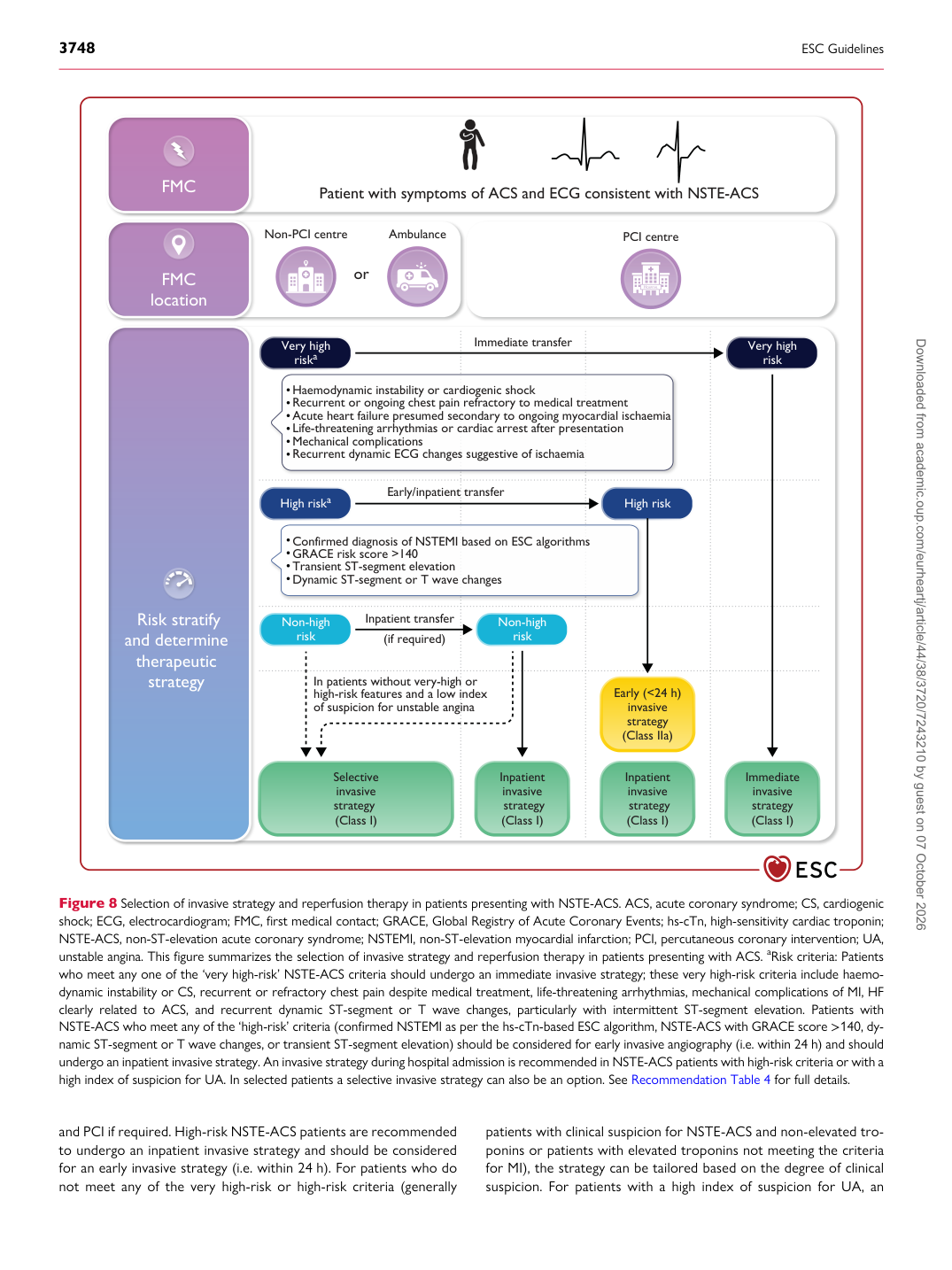
and PCI if required. High-risk NSTE-ACS patients are recommended to undergo an inpatient invasive strategy and should be considered for an early invasive strategy (i.e. within 24 h). For patients who do not meet any of the very high-risk or high-risk criteria (generally patients with clinical suspicion for NSTE-ACS and non-elevated troponins or patients with elevated troponins not meeting the criteria for MI), the strategy can be tailored based on the degree of clinical suspicion. For patients with a high index of suspicion for UA, an

FMC

FMC location PCI centre Non-PCI centre Ambulance

Immediate transfer

Early/inpatient transfer

or

Very high

riska Very high

risk

Risk stratify and determine

therapeutic

strategy Inpatient transfer

In patients without very-high or high-risk features and a low index of suspicion for unstable angina

(if required)

High riska High risk

Non-high

risk

Selective invasive strategy (Class I) Inpatient

invasive strategy (Class I) Inpatient

invasive strategy (Class I)

Early (<24 h)

invasive strategy (Class IIa)

Immediate invasive strategy (Class I)

Non-high

risk

Patient with symptoms of ACS and ECG consistent with NSTE-ACS

Haemodynamic instability or cardiogenic shock Recurrent or ongoing chest pain refractory to medical treatment Acute heart failure presumed secondary to ongoing myocardial ischaemia Life-threatening arrhythmias or cardiac arrest after presentation Mechanical complications Recurrent dynamic ECG changes suggestive of ischaemia

Confirmed diagnosis of NSTEMI based on ESC algorithms GRACE risk score >140 Transient ST-segment elevation Dynamic ST-segment or T wave changes

Figure 8 Selection of invasive strategy and reperfusion therapy in patients presenting with NSTE-ACS. ACS, acute coronary syndrome; CS, cardiogenic shock; ECG, electrocardiogram; FMC, first medical contact; GRACE, Global Registry of Acute Coronary Events; hs-cTn, high-sensitivity cardiac troponin; NSTE-ACS, non-ST-elevation acute coronary syndrome; NSTEMI, non-ST-elevation myocardial infarction; PCI, percutaneous coronary intervention; UA, unstable angina. This figure summarizes the selection of invasive strategy and reperfusion therapy in patients presenting with ACS. aRisk criteria: Patients who meet any one of the ‘very high-risk’ NSTE-ACS criteria should undergo an immediate invasive strategy; these very high-risk criteria include haemodynamic instability or CS, recurrent or refractory chest pain despite medical treatment, life-threatening arrhythmias, mechanical complications of MI, HF clearly related to ACS, and recurrent dynamic ST-segment or T wave changes, particularly with intermittent ST-segment elevation. Patients with NSTE-ACS who meet any of the ‘high-risk’ criteria (confirmed NSTEMI as per the hs-cTn-based ESC algorithm, NSTE-ACS with GRACE score >140, dynamic ST-segment or T wave changes, or transient ST-segment elevation) should be considered for early invasive angiography (i.e. within 24 h) and should undergo an inpatient invasive strategy. An invasive strategy during hospital admission is recommended in NSTE-ACS patients with high-risk criteria or with a high index of suspicion for UA. In selected patients a selective invasive strategy can also be an option. See Recommendation Table 4 for full details. Downloaded from academic.oup.com/eurheartj/article/44/38/3720/7243210 by guest on 07 October 2026