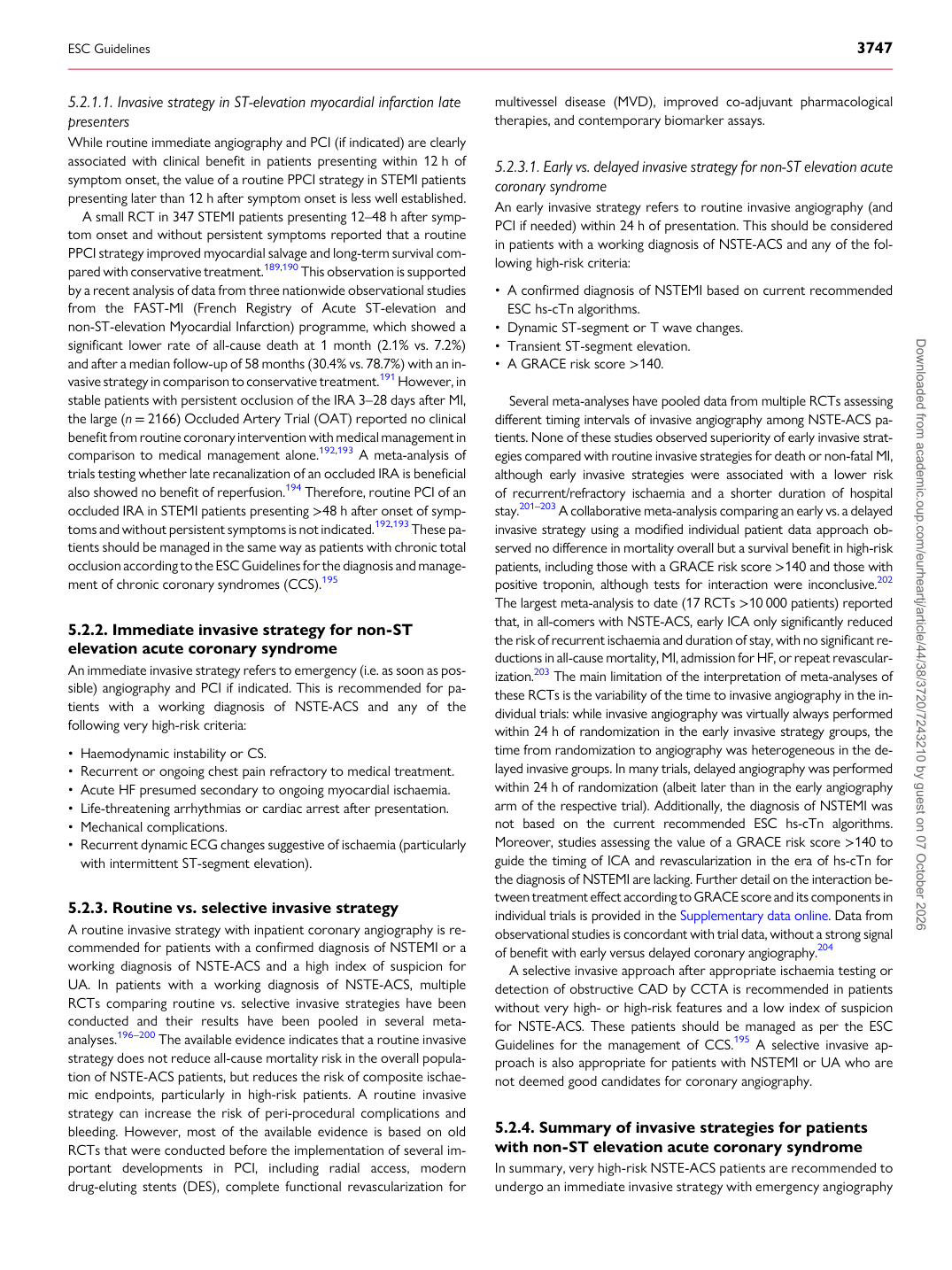
p.28 抽出テキスト
5.2.1.1 Invasive strategy in ST-elevation myocardial infarction late

presenters While routine immediate angiography and PCI (if indicated) are clearly associated with clinical benefit in patients presenting within 12 h of symptom onset, the value of a routine PPCI strategy in STEMI patients presenting later than 12 h after symptom onset is less well established. A small RCT in 347 STEMI patients presenting 12–48 h after symptom onset and without persistent symptoms reported that a routine PPCI strategy improved myocardial salvage and long-term survival compared with conservative treatment.189,190 This observation is supported by a recent analysis of data from three nationwide observational studies from the FAST-MI (French Registry of Acute ST-elevation and non-ST-elevation Myocardial Infarction) programme, which showed a significant lower rate of all-cause death at 1 month (2.1% vs. 7.2%) and after a median follow-up of 58 months (30.4% vs. 78.7%) with an invasive strategy in comparison to conservative treatment.191 However, in stable patients with persistent occlusion of the IRA 3–28 days after MI, the large (n = 2166) Occluded Artery Trial (OAT) reported no clinical benefit from routine coronary intervention with medical management in comparison to medical management alone.192,193 A meta-analysis of trials testing whether late recanalization of an occluded IRA is beneficial also showed no benefit of reperfusion.194 Therefore, routine PCI of an occluded IRA in STEMI patients presenting >48 h after onset of symptoms and without persistent symptoms is not indicated.192,193 These patients should be managed in the same way as patients with chronic total occlusion according to the ESC Guidelines for the diagnosis and management of chronic coronary syndromes (CCS).195

5.2.2 Immediate invasive strategy for non-ST

elevation acute coronary syndrome An immediate invasive strategy refers to emergency (i.e. as soon as possible) angiography and PCI if indicated. This is recommended for patients with a working diagnosis of NSTE-ACS and any of the following very high-risk criteria: • Haemodynamic instability or CS. • Recurrent or ongoing chest pain refractory to medical treatment. • Acute HF presumed secondary to ongoing myocardial ischaemia. • Life-threatening arrhythmias or cardiac arrest after presentation. • Mechanical complications. • Recurrent dynamic ECG changes suggestive of ischaemia (particularly with intermittent ST-segment elevation).

5.2.3 Routine vs. selective invasive strategy

A routine invasive strategy with inpatient coronary angiography is recommended for patients with a confirmed diagnosis of NSTEMI or a working diagnosis of NSTE-ACS and a high index of suspicion for UA. In patients with a working diagnosis of NSTE-ACS, multiple RCTs comparing routine vs. selective invasive strategies have been conducted and their results have been pooled in several metaanalyses.196–200 The available evidence indicates that a routine invasive strategy does not reduce all-cause mortality risk in the overall population of NSTE-ACS patients, but reduces the risk of composite ischaemic endpoints, particularly in high-risk patients. A routine invasive strategy can increase the risk of peri-procedural complications and bleeding. However, most of the available evidence is based on old RCTs that were conducted before the implementation of several important developments in PCI, including radial access, modern drug-eluting stents (DES), complete functional revascularization for multivessel disease (MVD), improved co-adjuvant pharmacological therapies, and contemporary biomarker assays.

5.2.3.1 Early vs. delayed invasive strategy for non-ST elevation acute

coronary syndrome An early invasive strategy refers to routine invasive angiography (and PCI if needed) within 24 h of presentation. This should be considered in patients with a working diagnosis of NSTE-ACS and any of the following high-risk criteria: • A confirmed diagnosis of NSTEMI based on current recommended ESC hs-cTn algorithms. • Dynamic ST-segment or T wave changes. • Transient ST-segment elevation. • A GRACE risk score >140.

Several meta-analyses have pooled data from multiple RCTs assessing different timing intervals of invasive angiography among NSTE-ACS patients. None of these studies observed superiority of early invasive strategies compared with routine invasive strategies for death or non-fatal MI, although early invasive strategies were associated with a lower risk of recurrent/refractory ischaemia and a shorter duration of hospital stay.201–203 A collaborative meta-analysis comparing an early vs. a delayed invasive strategy using a modified individual patient data approach observed no difference in mortality overall but a survival benefit in high-risk patients, including those with a GRACE risk score >140 and those with positive troponin, although tests for interaction were inconclusive.202 The largest meta-analysis to date (17 RCTs >10 000 patients) reported that, in all-comers with NSTE-ACS, early ICA only significantly reduced the risk of recurrent ischaemia and duration of stay, with no significant reductions in all-cause mortality, MI, admission for HF, or repeat revascularization.203 The main limitation of the interpretation of meta-analyses of these RCTs is the variability of the time to invasive angiography in the individual trials: while invasive angiography was virtually always performed within 24 h of randomization in the early invasive strategy groups, the time from randomization to angiography was heterogeneous in the delayed invasive groups. In many trials, delayed angiography was performed within 24 h of randomization (albeit later than in the early angiography arm of the respective trial). Additionally, the diagnosis of NSTEMI was not based on the current recommended ESC hs-cTn algorithms. Moreover, studies assessing the value of a GRACE risk score >140 to guide the timing of ICA and revascularization in the era of hs-cTn for the diagnosis of NSTEMI are lacking. Further detail on the interaction between treatment effect according to GRACE score and its components in individual trials is provided in the Supplementary data online. Data from observational studies is concordant with trial data, without a strong signal of benefit with early versus delayed coronary angiography.204 A selective invasive approach after appropriate ischaemia testing or detection of obstructive CAD by CCTA is recommended in patients without very high- or high-risk features and a low index of suspicion for NSTE-ACS. These patients should be managed as per the ESC Guidelines for the management of CCS.195 A selective invasive approach is also appropriate for patients with NSTEMI or UA who are not deemed good candidates for coronary angiography.

5.2.4 Summary of invasive strategies for patients

with non-ST elevation acute coronary syndrome In summary, very high-risk NSTE-ACS patients are recommended to undergo an immediate invasive strategy with emergency angiography

ESC Guidelines                                                                                                                                                                                          3747

Downloaded from academic.oup.com/eurheartj/article/44/38/3720/7243210 by guest on 07 October 2026