p.27 抽出テキスト
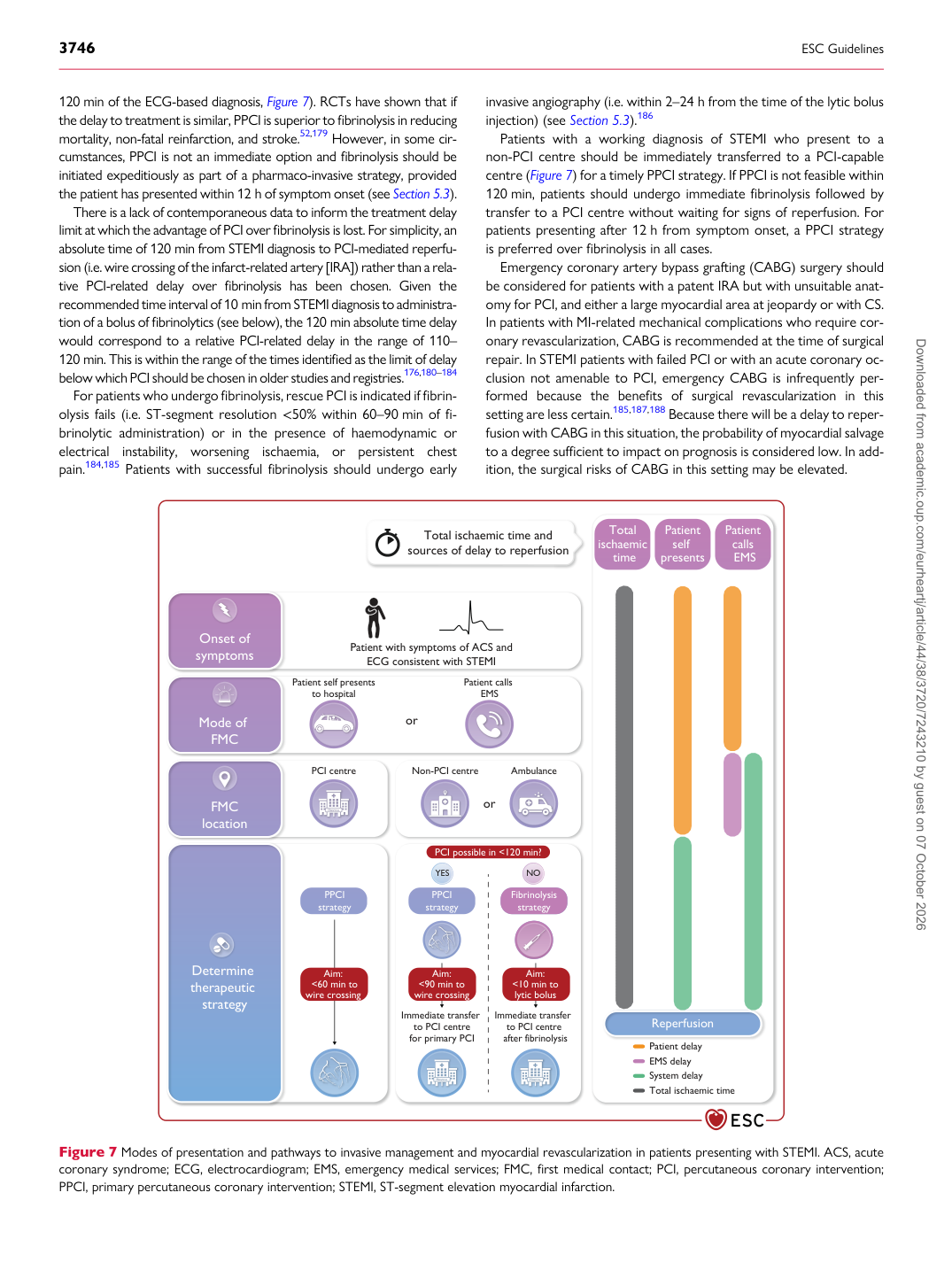
120 min of the ECG-based diagnosis, Figure 7). RCTs have shown that if the delay to treatment is similar, PPCI is superior to fibrinolysis in reducing mortality, non-fatal reinfarction, and stroke.52,179 However, in some circumstances, PPCI is not an immediate option and fibrinolysis should be initiated expeditiously as part of a pharmaco-invasive strategy, provided the patient has presented within 12 h of symptom onset (see Section 5.3). There is a lack of contemporaneous data to inform the treatment delay limit at which the advantage of PCI over fibrinolysis is lost. For simplicity, an absolute time of 120 min from STEMI diagnosis to PCI-mediated reperfusion (i.e. wire crossing of the infarct-related artery [IRA]) rather than a relative PCI-related delay over fibrinolysis has been chosen. Given the recommended time interval of 10 min from STEMI diagnosis to administration of a bolus of fibrinolytics (see below), the 120 min absolute time delay would correspond to a relative PCI-related delay in the range of 110– 120 min. This is within the range of the times identified as the limit of delay below which PCI should be chosen in older studies and registries.176,180–184 For patients who undergo fibrinolysis, rescue PCI is indicated if fibrinolysis fails (i.e. ST-segment resolution <50% within 60–90 min of fibrinolytic administration) or in the presence of haemodynamic or electrical instability, worsening ischaemia, or persistent chest pain.184,185 Patients with successful fibrinolysis should undergo early invasive angiography (i.e. within 2–24 h from the time of the lytic bolus injection) (see Section 5.3).186

Patients with a working diagnosis of STEMI who present to a non-PCI centre should be immediately transferred to a PCI-capable centre (Figure 7) for a timely PPCI strategy. If PPCI is not feasible within 120 min, patients should undergo immediate fibrinolysis followed by transfer to a PCI centre without waiting for signs of reperfusion. For patients presenting after 12 h from symptom onset, a PPCI strategy is preferred over fibrinolysis in all cases. Emergency coronary artery bypass grafting (CABG) surgery should be considered for patients with a patent IRA but with unsuitable anatomy for PCI, and either a large myocardial area at jeopardy or with CS. In patients with MI-related mechanical complications who require coronary revascularization, CABG is recommended at the time of surgical repair. In STEMI patients with failed PCI or with an acute coronary occlusion not amenable to PCI, emergency CABG is infrequently performed because the benefits of surgical revascularization in this setting are less certain.185,187,188 Because there will be a delay to reperfusion with CABG in this situation, the probability of myocardial salvage to a degree sufficient to impact on prognosis is considered low. In addition, the surgical risks of CABG in this setting may be elevated.

Onset of symptoms

FMC location

Mode of

FMC Patient self presents

to hospital

PCI centre Non-PCI centre Ambulance

Patient calls

EMS

or

or

Patient with symptoms of ACS and

ECG consistent with STEMI Total ischaemic

time Patient

self presents Patient

calls EMS

PPCI strategy

Reperfusion

PPCI strategy Fibrinolysis

strategy

Immediate transfer

to PCI centre for primary PCI Immediate transfer

to PCI centre after fibrinolysis Patient delay

System delay EMS delay Total ischaemic time

YES NO

Aim: <60 min to wire crossing

Determine therapeutic

strategy Aim: <90 min to wire crossing Aim: <10 min to

lytic bolus

PCI possible in <120 min?

Total ischaemic time and sources of delay to reperfusion

Figure 7 Modes of presentation and pathways to invasive management and myocardial revascularization in patients presenting with STEMI. ACS, acute coronary syndrome; ECG, electrocardiogram; EMS, emergency medical services; FMC, first medical contact; PCI, percutaneous coronary intervention; PPCI, primary percutaneous coronary intervention; STEMI, ST-segment elevation myocardial infarction. Downloaded from academic.oup.com/eurheartj/article/44/38/3720/7243210 by guest on 07 October 2026