p.26 抽出テキスト
cardio-protective effect in the context of ongoing acute coronary occlusion, with metoprolol demonstrating the greatest protective effect in experimental studies.162 Intravenous metoprolol is also the most widely tested beta-blocker in trials enrolling patients undergoing PPCI.163,164 While the long-term clinical benefits associated with early i.v. metoprolol administration are not clear, it is safe when used in patients without signs of acute HF and has been consistently associated with a reduction in the incidence of VF and microvascular obstruction (MVO).163–171 Based on these data, i.v. beta-blockers (preferably metoprolol) should be considered at the time of presentation in patients with a working diagnosis of STEMI undergoing PPCI with no signs of acute HF, a systolic blood pressure (SBP) >120 mmHg, and without other contraindications.163–166,169 Administration of i.v. beta-blockers in patients with suspected NSTE-ACS has not been tested.

5 Acute-phase management of

patients with acute coronary syndrome

5.1 Selection of invasive strategy and

reperfusion therapy The definitions of the terms related to invasive strategy and reperfusion therapy are presented in Table 3. Depending on the initial assessment of the ECG, the clinical context and haemodynamic stability, patients with suspected ACS should be classified as either: (i) Patients with a working diagnosis of STEMI. These patients should

be triaged for immediate reperfusion therapy (i.e. a PPCI strategy or fibrinolysis if PPCI is not possible within 120 min of diagnosis) (Figure 7). Or (ii) Patients with a working diagnosis of NSTE-ACS. For these patients:

• An inpatient invasive strategy is recommended. • An immediate invasive strategy is recommended when any very high-risk feature is present (Figure 8). • An early (i.e. within 24 h) invasive strategy should be considered when any high-risk features are present (Figure 8).

5.2 Acute coronary syndrome managed

with invasive strategy Invasive management strategies are time sensitive. It is recommended that patients triaged to an immediate invasive strategy (those with high suspicion of ongoing acute coronary artery occlusion [i.e. persistent ST-segment elevation or equivalents] or NSTE-ACS with any very highrisk characteristics) receive emergency angiography as soon as possible. High-risk NSTE-ACS patients (e.g. ruled in as NSTEMI as per the 0 h/1 h or 0 h/2 h ESC algorithms, with dynamic ST-segment or T wave changes, with transient ST-segment elevation, or with a Global Registry of Acute Coronary Events [GRACE] risk score >140) should be considered for an early invasive strategy (i.e. undergoing angiography within 24 h).

5.2.1 Primary percutaneous coronary intervention

strategy for ST-elevation myocardial infarction In patients with a working diagnosis of STEMI, a PPCI strategy (i.e. immediate angiography and PCI as needed) is the preferred reperfusion strategy, provided it can be performed in a timely manner (i.e. within

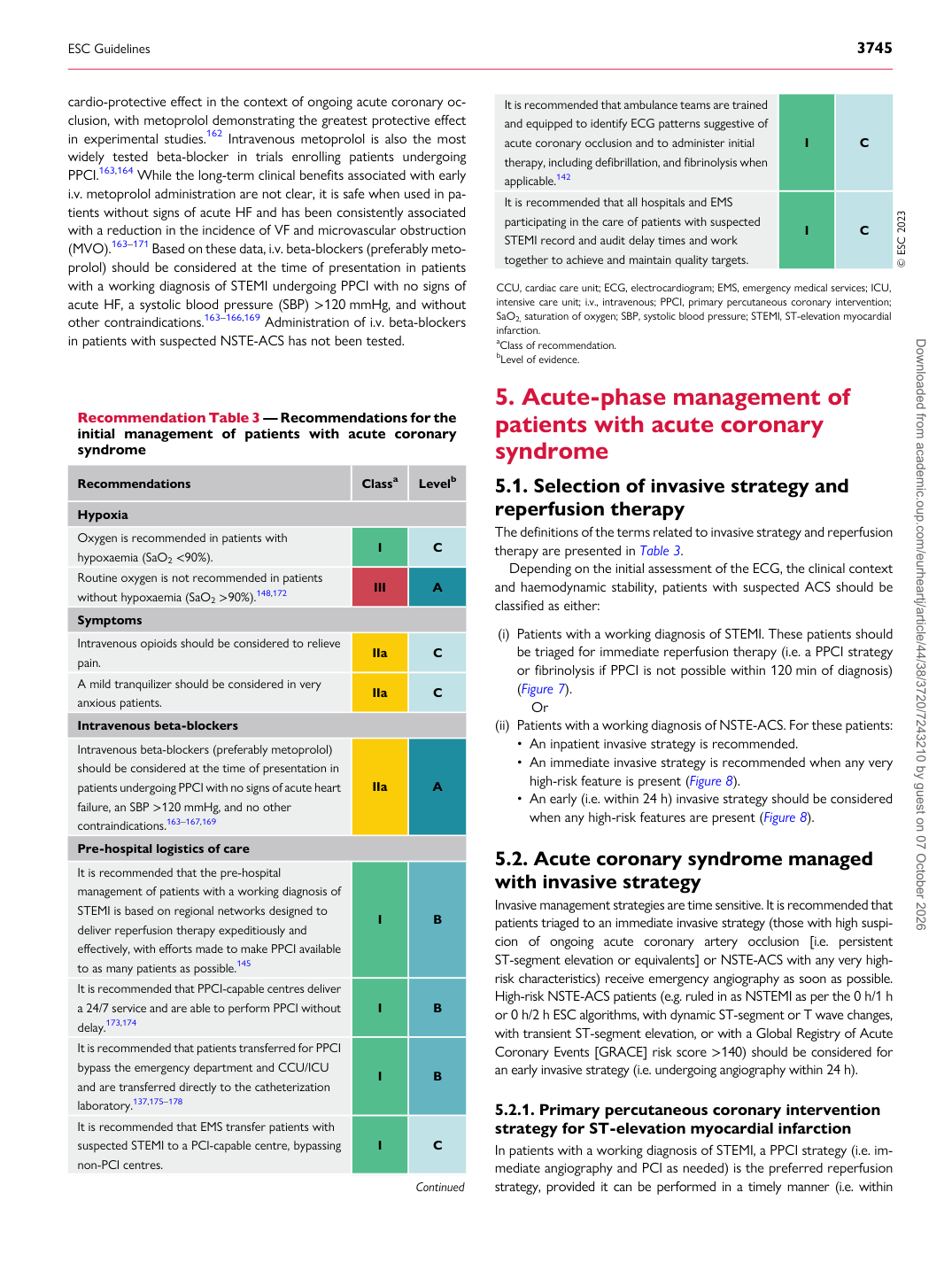
Recommendation Table 3 — Recommendations for the initial management of patients with acute coronary syndrome

Recommendations Classa Levelb

Hypoxia Oxygen is recommended in patients with hypoxaemia (SaO2 <90%). I C Routine oxygen is not recommended in patients without hypoxaemia (SaO2 >90%).148,172 III A Symptoms Intravenous opioids should be considered to relieve pain. IIa C A mild tranquilizer should be considered in very anxious patients. IIa C Intravenous beta-blockers Intravenous beta-blockers (preferably metoprolol) should be considered at the time of presentation in patients undergoing PPCI with no signs of acute heart failure, an SBP >120 mmHg, and no other contraindications.163–167,169 IIa A Pre-hospital logistics of care It is recommended that the pre-hospital management of patients with a working diagnosis of STEMI is based on regional networks designed to deliver reperfusion therapy expeditiously and effectively, with efforts made to make PPCI available to as many patients as possible.145 I B It is recommended that PPCI-capable centres deliver a 24/7 service and are able to perform PPCI without delay.173,174 I B It is recommended that patients transferred for PPCI bypass the emergency department and CCU/ICU and are transferred directly to the catheterization laboratory.137,175–178 I B It is recommended that EMS transfer patients with suspected STEMI to a PCI-capable centre, bypassing non-PCI centres. I C

Continued It is recommended that ambulance teams are trained

and equipped to identify ECG patterns suggestive of acute coronary occlusion and to administer initial therapy, including defibrillation, and fibrinolysis when applicable.142 I C It is recommended that all hospitals and EMS participating in the care of patients with suspected STEMI record and audit delay times and work together to achieve and maintain quality targets. I C © ESC 2023

CCU, cardiac care unit; ECG, electrocardiogram; EMS, emergency medical services; ICU, intensive care unit; i.v., intravenous; PPCI, primary percutaneous coronary intervention; SaO2, saturation of oxygen; SBP, systolic blood pressure; STEMI, ST-elevation myocardial infarction. aClass of recommendation. bLevel of evidence.

ESC Guidelines                                                                                                                                                                                          3745

Downloaded from academic.oup.com/eurheartj/article/44/38/3720/7243210 by guest on 07 October 2026