p.22 抽出テキスト
Patient presents with a suspected NSTEMI and without an indication for immediate invasive angiography

Appropriate management can be determined based on the hs-cTn levels and clinical situation

Take hs-cTn at 0 h and 1 h/2 h

Very low initial hs-cTna

Low initial hs-cTn and no increase in 1 h/2 h hs-cTn Patients who do not meet

the criteria for either of the other two pathways

Observe pathway Rule-out pathway Rule-in pathway

High initial hs-cTn

OR OR

Increase in 1 h/2 h hs-cTn

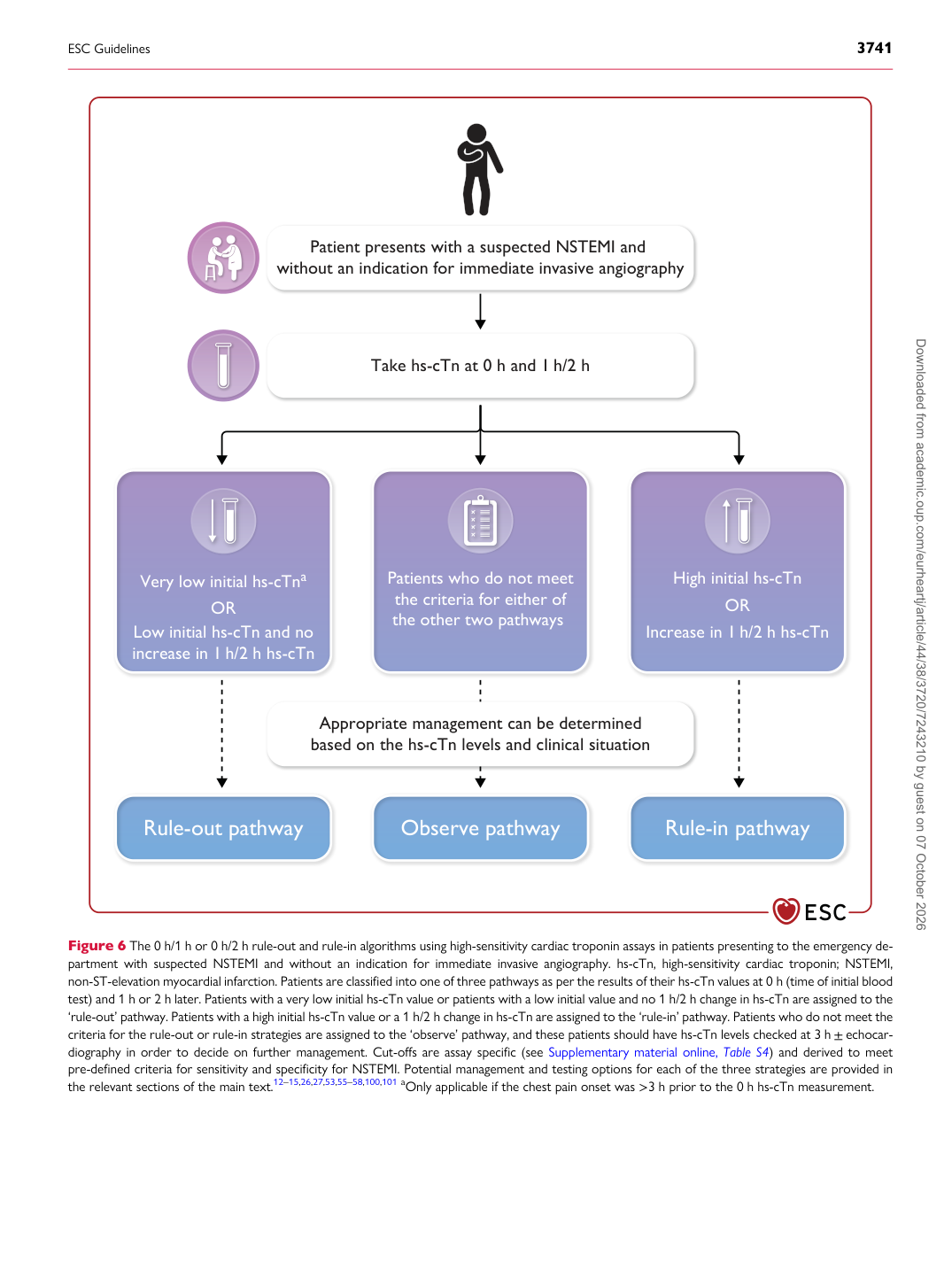
Figure 6 The 0 h/1 h or 0 h/2 h rule-out and rule-in algorithms using high-sensitivity cardiac troponin assays in patients presenting to the emergency department with suspected NSTEMI and without an indication for immediate invasive angiography. hs-cTn, high-sensitivity cardiac troponin; NSTEMI, non-ST-elevation myocardial infarction. Patients are classified into one of three pathways as per the results of their hs-cTn values at 0 h (time of initial blood test) and 1 h or 2 h later. Patients with a very low initial hs-cTn value or patients with a low initial value and no 1 h/2 h change in hs-cTn are assigned to the ‘rule-out’ pathway. Patients with a high initial hs-cTn value or a 1 h/2 h change in hs-cTn are assigned to the ‘rule-in’ pathway. Patients who do not meet the criteria for the rule-out or rule-in strategies are assigned to the ‘observe’ pathway, and these patients should have hs-cTn levels checked at 3 h ± echocardiography in order to decide on further management. Cut-offs are assay specific (see Supplementary material online, Table S4) and derived to meet pre-defined criteria for sensitivity and specificity for NSTEMI. Potential management and testing options for each of the three strategies are provided in the relevant sections of the main text.12–15,26,27,53,55–58,100,101 aOnly applicable if the chest pain onset was >3 h prior to the 0 h hs-cTn measurement.

ESC Guidelines                                                                                                                                                                                          3741

Downloaded from academic.oup.com/eurheartj/article/44/38/3720/7243210 by guest on 07 October 2026