p.20 抽出テキスト
3.3 Diagnostic tools | Biomarkers

3.3.1. High-sensitivity cardiac troponins After excluding clinical and ECG signs suggestive of STEMI or very highrisk NSTE-ACS, biomarkers play a complementary role in the diagnosis, risk stratification, and management of patients with suspected ACS. Measurement of a biomarker of cardiomyocyte injury, preferably highsensitivity cardiac troponin (hs-cTn), is recommended in all patients with suspected ACS.15,17,25–27,53,54 If the clinical presentation is compatible with myocardial ischaemia, then a rise and/or fall in cTn above the 99th percentile of healthy individuals points to a diagnosis of MI as per the criteria in the fourth universal definition of MI.1 In patients with MI, levels of cTn rise rapidly (i.e. usually within 1 h if using highsensitivity assays) after symptom onset and remain elevated for a variable period of time (usually several days).1,15,26,53,55–58 Advances in technology have led to a refinement in cTn assays and have improved their accuracy in detecting and quantifying cardiomyocyte injury.1,12–15,18,26,34,35,53,55–60 Data from large multicentre studies have consistently shown that hs-cTn assays increase diagnostic accuracy for MI at the time of presentation in comparison to conventional assays, especially in patients presenting early after chest pain onset, enabling more rapid ‘rule-in’ and ‘rule-out’ of MI.1,12–15,26,34,35,53,55–58 Overall, hs-cTn T and hs-cTn I subunit assays appear to provide comparable diagnostic accuracy in the early diagnosis of MI.28,32,61,62 The use of the terms ‘normal’ and ‘abnormal’ to describe hs-cTn levels should be avoided; instead, the terms ‘non-elevated’ and ‘elevated’ should be used to refer to hs-cTn levels below and above the 99th percentile. Some of the clinical implications of hs-cTn assays are detailed in Supplementary data online, Table S2.

It is also important to consider that there are other clinical conditions apart from Type 1 MI in which elevations in cTn can be observed (see Supplementary data online, Section 3.3.1 and Table S3).

3.3.2 Central laboratory vs. point of care

The vast majority of cTn assays that run on automated platforms in the central laboratory are sensitive (i.e. allow for the detection of cTn in ∼20–50% of healthy individuals) or high-sensitivity (i.e. allow for the detection of cTn in ∼50–95% of healthy individuals) assays. High-sensitivity assays are recommended over lower-sensitivity assays, as they provide higher diagnostic accuracy at an identical low cost.1,12,15,25–27,57,63 The majority of currently used point-of-care (POC) tests cannot be considered high-sensitivity assays.64 The advantage of POC tests is a shorter turnaround time. However, this is counterbalanced by lower sensitivity, lower diagnostic accuracy, and lower negative predictive value (NPV). A randomized trial in low-risk chest pain patients with suspected NSTE-ACS and onset of symptoms ≥2 h before ambulance presentation reported that the use of a pre-hospital rule-out strategy (with a single POC conventional troponin T test) resulted in a significant reduction of 30-day healthcare costs and a comparable major adverse cardiovascular event (MACE) rate in comparison to an ED rule-out strategy (with evaluation as per standard local practice).65 Overall, automated assays have been more thoroughly evaluated than POC tests and are currently preferred.1,12–15,26,34,35,53,55–58 However, this is a rapidly developing field and it will be important to re-evaluate this preference when more extensively validated highsensitivity POC tests are clinically available.66–68

3.3.3 Confounders of cardiac troponin concentration

In patients presenting with suspected NSTE-ACS, four clinical variables affect hs-cTn concentrations beyond the presence or absence of MI. These variables are: age (concentrations in healthy very young vs. ‘healthy’ very old individuals differ by up to 300%); renal dysfunction (differences between otherwise healthy patients with very high vs. very low estimated glomerular filtration rate [eGFR] of up to 300%); time from chest pain onset (>300%); and, to a lesser extent, sex (≈40%).28,34,35,69–76 Despite the potential baseline differences in hs-cTn values based on these four variables, absolute changes in hs-cTn levels are still of diagnostic and prognostic value. Current data on the use of sex-specific hs-cTn values in the diagnosis of MI have been controversial and failed to demonstrate a clear clinical benefit.74,75,77–80 Therefore, until automated tools (i.e. risk assessment calculators) incorporating the effect of all four clinical variables (age, eGFR, time from chest pain onset, and sex) are available, the use of uniform cut-off concentrations should remain the standard of care for the early diagnosis of MI.28,30,31,34,35,73,81,82

3.3.4 Rapid ‘rule-in’ and ‘rule-out’ algorithms

Due to their higher sensitivity and diagnostic accuracy for the detection of MI at presentation, the time interval to the second cTn assessment can be shortened with the use of hs-cTn assays. This substantially reduces the delay to diagnosis, translating into shorter stays in the ED, lower costs, and less diagnostic uncertainty for patients.15,83–88 It is recommended to use the 0 h/1 h algorithm (best option) or the 0 h/2 h

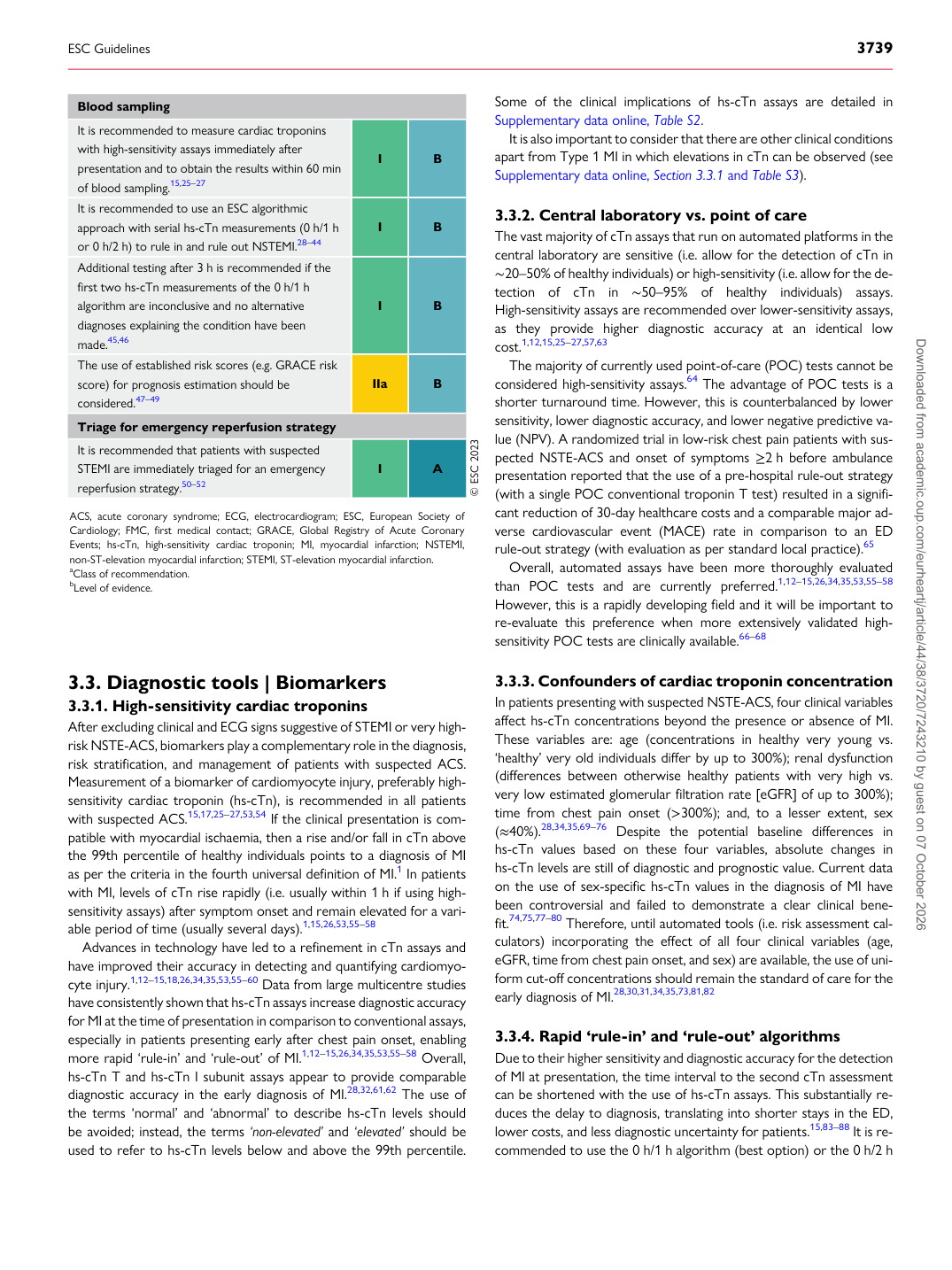
Blood sampling It is recommended to measure cardiac troponins with high-sensitivity assays immediately after presentation and to obtain the results within 60 min of blood sampling.15,25–27 I B It is recommended to use an ESC algorithmic approach with serial hs-cTn measurements (0 h/1 h or 0 h/2 h) to rule in and rule out NSTEMI.28–44 I B Additional testing after 3 h is recommended if the first two hs-cTn measurements of the 0 h/1 h algorithm are inconclusive and no alternative diagnoses explaining the condition have been made.45,46 I B The use of established risk scores (e.g. GRACE risk score) for prognosis estimation should be considered.47–49 IIa B Triage for emergency reperfusion strategy It is recommended that patients with suspected STEMI are immediately triaged for an emergency reperfusion strategy.50–52 I A © ESC 2023

ACS, acute coronary syndrome; ECG, electrocardiogram; ESC, European Society of Cardiology; FMC, first medical contact; GRACE, Global Registry of Acute Coronary Events; hs-cTn, high-sensitivity cardiac troponin; MI, myocardial infarction; NSTEMI, non-ST-elevation myocardial infarction; STEMI, ST-elevation myocardial infarction. aClass of recommendation. bLevel of evidence.

ESC Guidelines                                                                                                                                                                                          3739

Downloaded from academic.oup.com/eurheartj/article/44/38/3720/7243210 by guest on 07 October 2026