p.18 抽出テキスト
3.1.2 History taking and physical examination

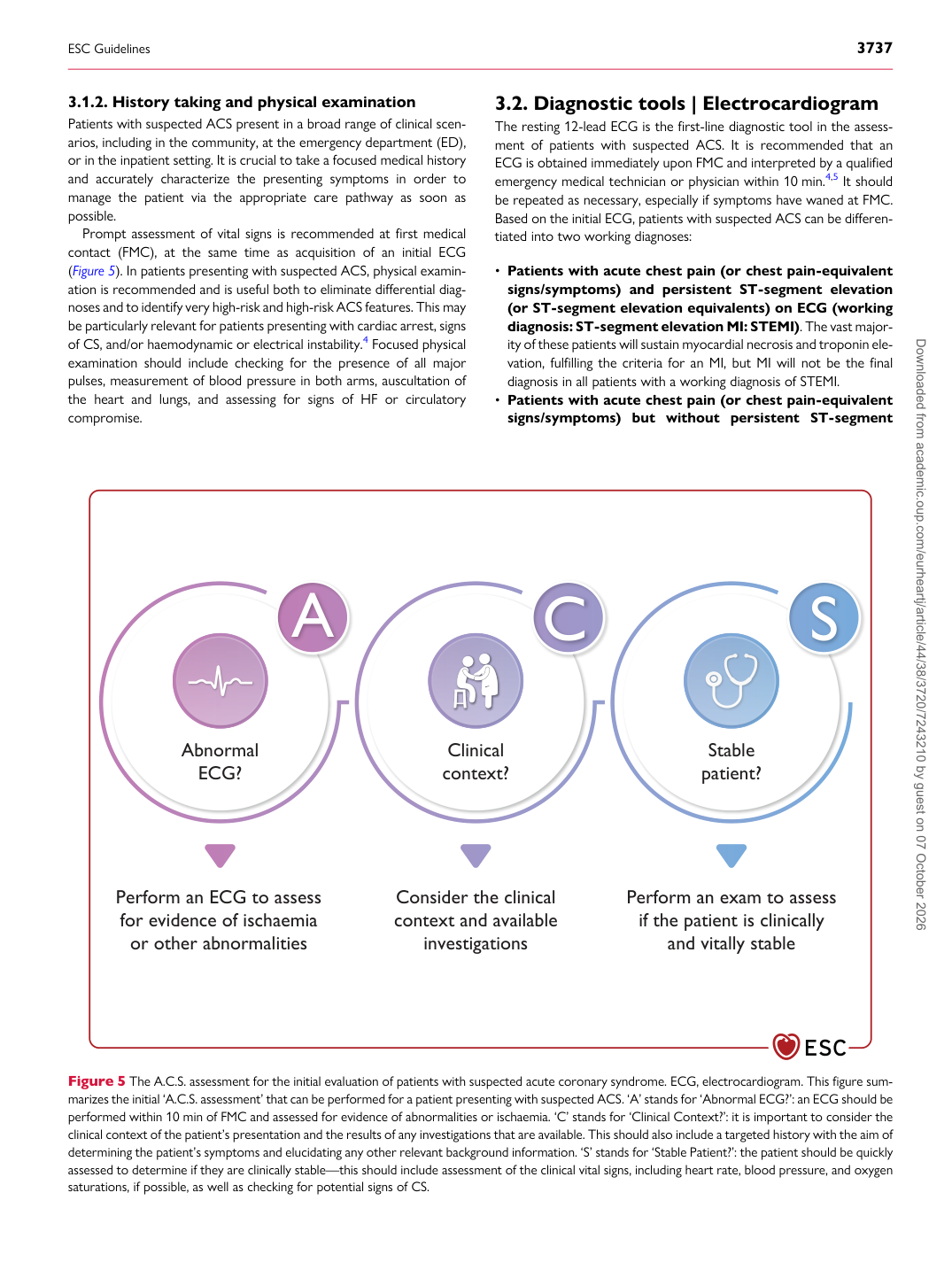
Patients with suspected ACS present in a broad range of clinical scenarios, including in the community, at the emergency department (ED), or in the inpatient setting. It is crucial to take a focused medical history and accurately characterize the presenting symptoms in order to manage the patient via the appropriate care pathway as soon as possible. Prompt assessment of vital signs is recommended at first medical contact (FMC), at the same time as acquisition of an initial ECG (Figure 5). In patients presenting with suspected ACS, physical examination is recommended and is useful both to eliminate differential diagnoses and to identify very high-risk and high-risk ACS features. This may be particularly relevant for patients presenting with cardiac arrest, signs of CS, and/or haemodynamic or electrical instability.4 Focused physical examination should include checking for the presence of all major pulses, measurement of blood pressure in both arms, auscultation of the heart and lungs, and assessing for signs of HF or circulatory compromise. 3.2 Diagnostic tools | Electrocardiogram

The resting 12-lead ECG is the first-line diagnostic tool in the assessment of patients with suspected ACS. It is recommended that an ECG is obtained immediately upon FMC and interpreted by a qualified emergency medical technician or physician within 10 min.4,5 It should be repeated as necessary, especially if symptoms have waned at FMC. Based on the initial ECG, patients with suspected ACS can be differentiated into two working diagnoses:

• Patients with acute chest pain (or chest pain-equivalent signs/symptoms) and persistent ST-segment elevation (or ST-segment elevation equivalents) on ECG (working diagnosis: ST-segment elevation MI: STEMI). The vast majority of these patients will sustain myocardial necrosis and troponin elevation, fulfilling the criteria for an MI, but MI will not be the final diagnosis in all patients with a working diagnosis of STEMI. • Patients with acute chest pain (or chest pain-equivalent signs/symptoms) but without persistent ST-segment

A C S

Abnormal

ECG? Clinical context? Stable patient?

Perform an ECG to assess

for evidence of ischaemia

or other abnormalities Consider the clinical context and available

investigations Perform an exam to assess

if the patient is clinically

and vitally stable

Figure 5 The A.C.S. assessment for the initial evaluation of patients with suspected acute coronary syndrome. ECG, electrocardiogram. This figure summarizes the initial ‘A.C.S. assessment’ that can be performed for a patient presenting with suspected ACS. ‘A’ stands for ‘Abnormal ECG?’: an ECG should be performed within 10 min of FMC and assessed for evidence of abnormalities or ischaemia. ‘C’ stands for ‘Clinical Context?’: it is important to consider the clinical context of the patient’s presentation and the results of any investigations that are available. This should also include a targeted history with the aim of determining the patient’s symptoms and elucidating any other relevant background information. ‘S’ stands for ‘Stable Patient?’: the patient should be quickly assessed to determine if they are clinically stable—this should include assessment of the clinical vital signs, including heart rate, blood pressure, and oxygen saturations, if possible, as well as checking for potential signs of CS.

ESC Guidelines                                                                                                                                                                                          3737

Downloaded from academic.oup.com/eurheartj/article/44/38/3720/7243210 by guest on 07 October 2026