p.16 抽出テキスト
New/revised concepts • ACS should be considered a spectrum, which encompasses both non-ST-elevation (NSTE)-ACS and ST-elevation MI (STEMI). • A section on the management of ACS in patients with cancer is provided. • A section on patient perspectives is provided.

3 Triage and diagnosis

3.1 Clinical presentation and physical

examination 3.1.1. Clinical presentation Acute chest discomfort—which may be described as pain, pressure, tightness, heaviness, or burning—is the leading presenting symptom prompting consideration of the clinical diagnosis of ACS and the initiation of testing aligned with specific diagnostic algorithms (Figure 4).

Chest pain descriptors should be classified as cardiac, possibly cardiac, and likely non-cardiac. Further information on the suggested use of these terms is provided in the Supplementary data online. The use of the descriptor ‘atypical’ should be avoided. Chest pain-equivalent symptoms include dyspnoea, epigastric pain, and pain in the left or right arm or neck/jaw. Misdiagnosis or delayed diagnosis is sometimes due to an incomplete history or difficulty in eliciting symptoms from the patient. In order to understand the complexity of ACS-related symptomatology, careful history taking and comprehensive interaction with the patient are crucial and may help to facilitate an early and accurate diagnosis. Further information is provided in the Supplementary data online, including Figure S1, which outlines some of the most common symptoms of ACS in women and men.

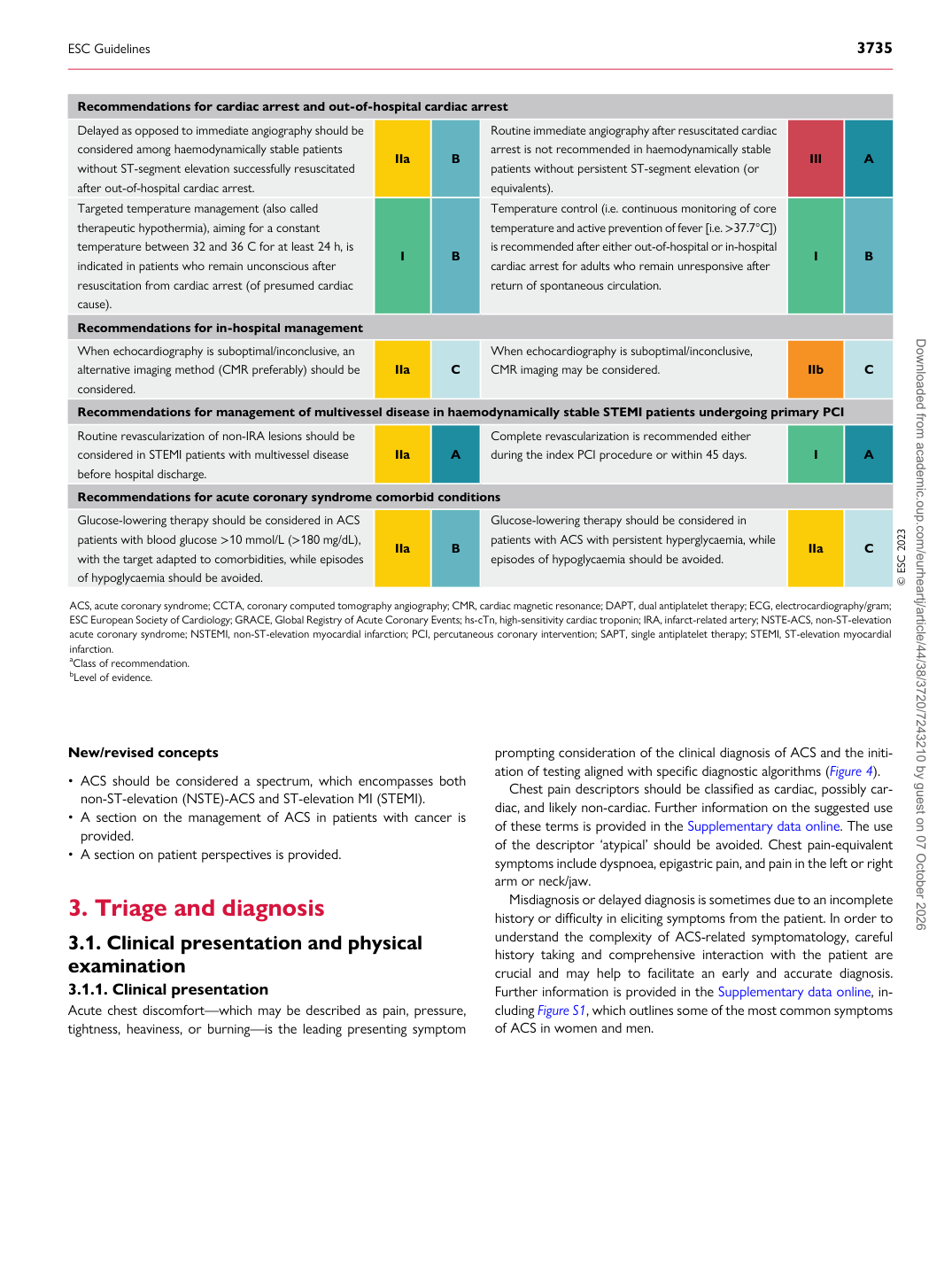
Recommendations for cardiac arrest and out-of-hospital cardiac arrest Delayed as opposed to immediate angiography should be considered among haemodynamically stable patients without ST-segment elevation successfully resuscitated after out-of-hospital cardiac arrest. IIa B Routine immediate angiography after resuscitated cardiac arrest is not recommended in haemodynamically stable

patients without persistent ST-segment elevation (or equivalents). III A

Targeted temperature management (also called therapeutic hypothermia), aiming for a constant temperature between 32 and 36 C for at least 24 h, is indicated in patients who remain unconscious after resuscitation from cardiac arrest (of presumed cardiac cause). I B Temperature control (i.e. continuous monitoring of core

temperature and active prevention of fever [i.e. >37.7°C]) is recommended after either out-of-hospital or in-hospital cardiac arrest for adults who remain unresponsive after return of spontaneous circulation. I B

Recommendations for in-hospital management When echocardiography is suboptimal/inconclusive, an alternative imaging method (CMR preferably) should be considered. IIa C When echocardiography is suboptimal/inconclusive, CMR imaging may be considered. IIb C Recommendations for management of multivessel disease in haemodynamically stable STEMI patients undergoing primary PCI Routine revascularization of non-IRA lesions should be considered in STEMI patients with multivessel disease before hospital discharge. IIa A Complete revascularization is recommended either during the index PCI procedure or within 45 days. I A Recommendations for acute coronary syndrome comorbid conditions Glucose-lowering therapy should be considered in ACS patients with blood glucose >10 mmol/L (>180 mg/dL), with the target adapted to comorbidities, while episodes of hypoglycaemia should be avoided. IIa B Glucose-lowering therapy should be considered in patients with ACS with persistent hyperglycaemia, while

episodes of hypoglycaemia should be avoided. IIa C © ESC 2023

ACS, acute coronary syndrome; CCTA, coronary computed tomography angiography; CMR, cardiac magnetic resonance; DAPT, dual antiplatelet therapy; ECG, electrocardiography/gram; ESC European Society of Cardiology; GRACE, Global Registry of Acute Coronary Events; hs-cTn, high-sensitivity cardiac troponin; IRA, infarct-related artery; NSTE-ACS, non-ST-elevation acute coronary syndrome; NSTEMI, non-ST-elevation myocardial infarction; PCI, percutaneous coronary intervention; SAPT, single antiplatelet therapy; STEMI, ST-elevation myocardial infarction. aClass of recommendation. bLevel of evidence.

ESC Guidelines                                                                                                                                                                                          3735

Downloaded from academic.oup.com/eurheartj/article/44/38/3720/7243210 by guest on 07 October 2026