p.15 抽出テキスト
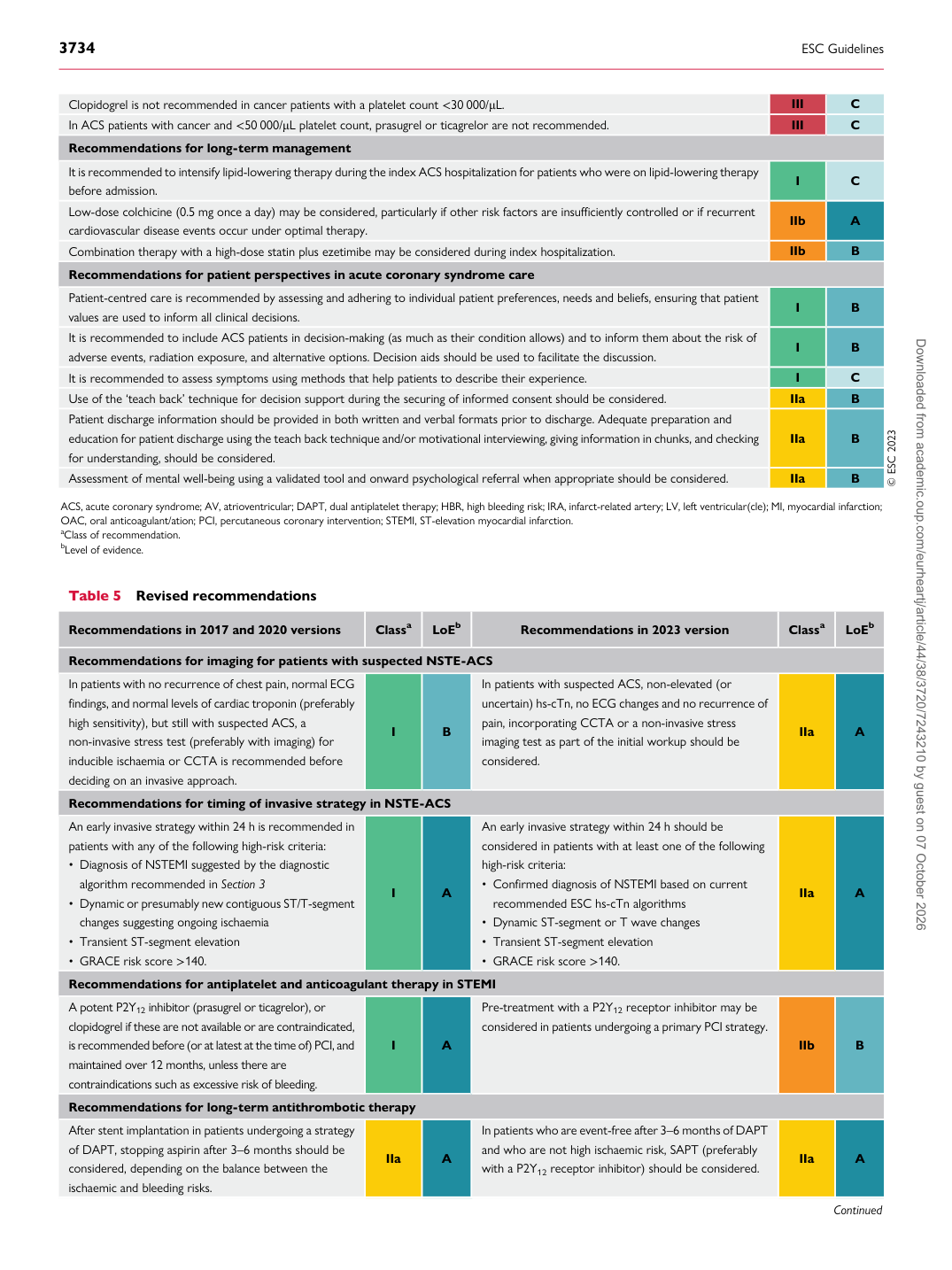
Clopidogrel is not recommended in cancer patients with a platelet count <30 000/μL. III C In ACS patients with cancer and <50 000/μL platelet count, prasugrel or ticagrelor are not recommended. III C Recommendations for long-term management It is recommended to intensify lipid-lowering therapy during the index ACS hospitalization for patients who were on lipid-lowering therapy before admission. I C Low-dose colchicine (0.5 mg once a day) may be considered, particularly if other risk factors are insufficiently controlled or if recurrent cardiovascular disease events occur under optimal therapy. IIb A Combination therapy with a high-dose statin plus ezetimibe may be considered during index hospitalization. IIb B Recommendations for patient perspectives in acute coronary syndrome care Patient-centred care is recommended by assessing and adhering to individual patient preferences, needs and beliefs, ensuring that patient values are used to inform all clinical decisions. I B It is recommended to include ACS patients in decision-making (as much as their condition allows) and to inform them about the risk of adverse events, radiation exposure, and alternative options. Decision aids should be used to facilitate the discussion. I B It is recommended to assess symptoms using methods that help patients to describe their experience. I C Use of the ‘teach back’ technique for decision support during the securing of informed consent should be considered. IIa B Patient discharge information should be provided in both written and verbal formats prior to discharge. Adequate preparation and education for patient discharge using the teach back technique and/or motivational interviewing, giving information in chunks, and checking for understanding, should be considered. IIa B Assessment of mental well-being using a validated tool and onward psychological referral when appropriate should be considered. IIa B © ESC 2023

ACS, acute coronary syndrome; AV, atrioventricular; DAPT, dual antiplatelet therapy; HBR, high bleeding risk; IRA, infarct-related artery; LV, left ventricular(cle); MI, myocardial infarction; OAC, oral anticoagulant/ation; PCI, percutaneous coronary intervention; STEMI, ST-elevation myocardial infarction. aClass of recommendation. bLevel of evidence.

Table 5 Revised recommendations

Recommendations in 2017 and 2020 versions Classa LoEb Recommendations in 2023 version Classa LoEb

Recommendations for imaging for patients with suspected NSTE-ACS In patients with no recurrence of chest pain, normal ECG findings, and normal levels of cardiac troponin (preferably high sensitivity), but still with suspected ACS, a non-invasive stress test (preferably with imaging) for inducible ischaemia or CCTA is recommended before deciding on an invasive approach. I B In patients with suspected ACS, non-elevated (or

uncertain) hs-cTn, no ECG changes and no recurrence of pain, incorporating CCTA or a non-invasive stress imaging test as part of the initial workup should be considered. IIa A

Recommendations for timing of invasive strategy in NSTE-ACS An early invasive strategy within 24 h is recommended in patients with any of the following high-risk criteria: • Diagnosis of NSTEMI suggested by the diagnostic algorithm recommended in Section 3 • Dynamic or presumably new contiguous ST/T-segment

changes suggesting ongoing ischaemia • Transient ST-segment elevation • GRACE risk score >140. I A An early invasive strategy within 24 h should be considered in patients with at least one of the following

high-risk criteria: • Confirmed diagnosis of NSTEMI based on current recommended ESC hs-cTn algorithms • Dynamic ST-segment or T wave changes • Transient ST-segment elevation • GRACE risk score >140. IIa A

Recommendations for antiplatelet and anticoagulant therapy in STEMI A potent P2Y12 inhibitor (prasugrel or ticagrelor), or clopidogrel if these are not available or are contraindicated, is recommended before (or at latest at the time of) PCI, and maintained over 12 months, unless there are contraindications such as excessive risk of bleeding. I A Pre-treatment with a P2Y12 receptor inhibitor may be

considered in patients undergoing a primary PCI strategy.

IIb B

Recommendations for long-term antithrombotic therapy After stent implantation in patients undergoing a strategy of DAPT, stopping aspirin after 3–6 months should be considered, depending on the balance between the ischaemic and bleeding risks. IIa A In patients who are event-free after 3–6 months of DAPT

and who are not high ischaemic risk, SAPT (preferably with a P2Y12 receptor inhibitor) should be considered. IIa A

Continued Downloaded from academic.oup.com/eurheartj/article/44/38/3720/7243210 by guest on 07 October 2026