p.14 抽出テキスト
2.4 What is new

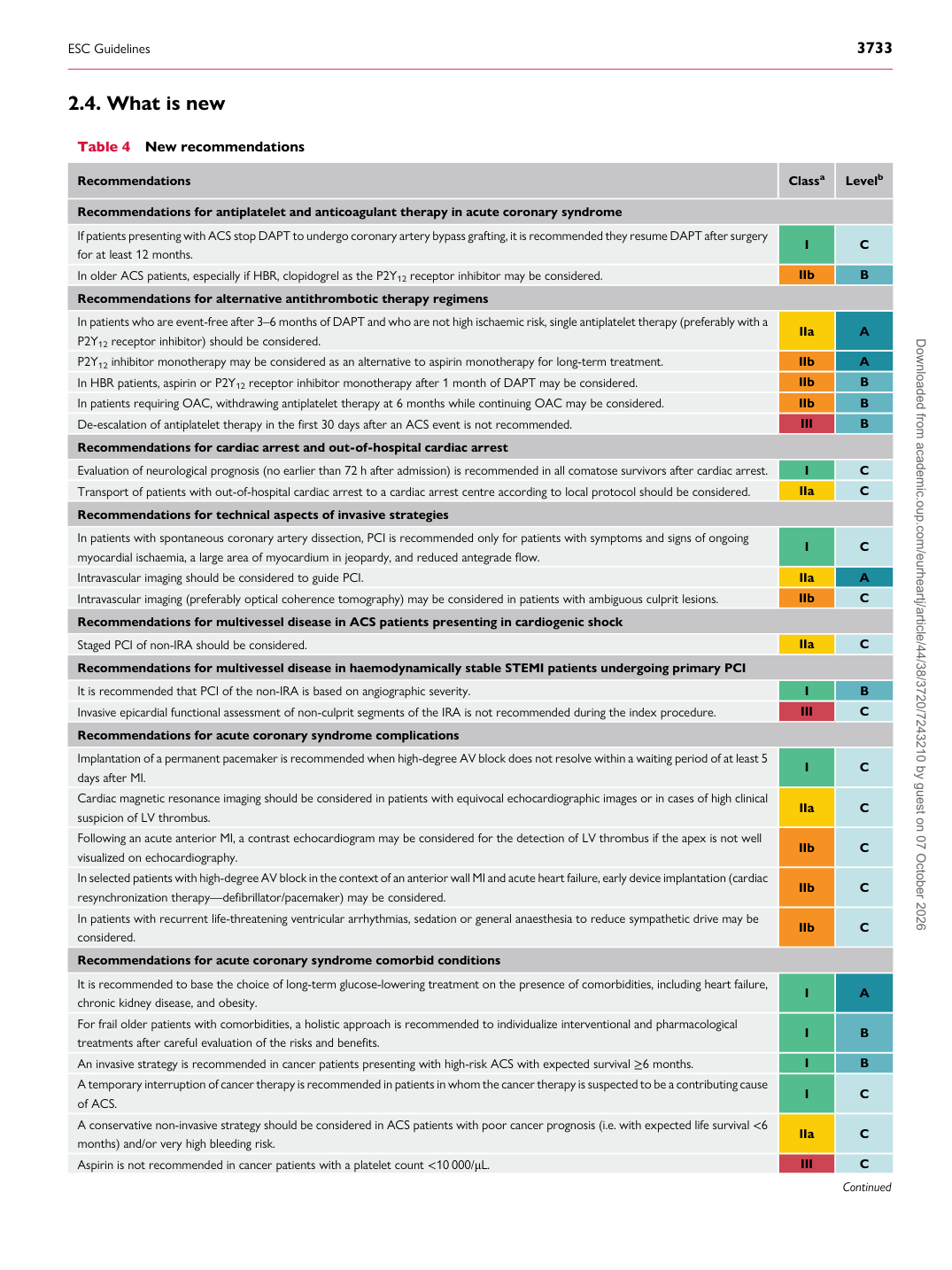
Table 4 New recommendations

Recommendations Classa Levelb

Recommendations for antiplatelet and anticoagulant therapy in acute coronary syndrome If patients presenting with ACS stop DAPT to undergo coronary artery bypass grafting, it is recommended they resume DAPT after surgery for at least 12 months. I C In older ACS patients, especially if HBR, clopidogrel as the P2Y12 receptor inhibitor may be considered. IIb B Recommendations for alternative antithrombotic therapy regimens In patients who are event-free after 3–6 months of DAPT and who are not high ischaemic risk, single antiplatelet therapy (preferably with a P2Y12 receptor inhibitor) should be considered. IIa A P2Y12 inhibitor monotherapy may be considered as an alternative to aspirin monotherapy for long-term treatment. IIb A In HBR patients, aspirin or P2Y12 receptor inhibitor monotherapy after 1 month of DAPT may be considered. IIb B In patients requiring OAC, withdrawing antiplatelet therapy at 6 months while continuing OAC may be considered. IIb B De-escalation of antiplatelet therapy in the first 30 days after an ACS event is not recommended. III B Recommendations for cardiac arrest and out-of-hospital cardiac arrest Evaluation of neurological prognosis (no earlier than 72 h after admission) is recommended in all comatose survivors after cardiac arrest. I C Transport of patients with out-of-hospital cardiac arrest to a cardiac arrest centre according to local protocol should be considered. IIa C Recommendations for technical aspects of invasive strategies In patients with spontaneous coronary artery dissection, PCI is recommended only for patients with symptoms and signs of ongoing myocardial ischaemia, a large area of myocardium in jeopardy, and reduced antegrade flow. I C Intravascular imaging should be considered to guide PCI. IIa A Intravascular imaging (preferably optical coherence tomography) may be considered in patients with ambiguous culprit lesions. IIb C Recommendations for multivessel disease in ACS patients presenting in cardiogenic shock Staged PCI of non-IRA should be considered. IIa C Recommendations for multivessel disease in haemodynamically stable STEMI patients undergoing primary PCI It is recommended that PCI of the non-IRA is based on angiographic severity. I B Invasive epicardial functional assessment of non-culprit segments of the IRA is not recommended during the index procedure. III C Recommendations for acute coronary syndrome complications Implantation of a permanent pacemaker is recommended when high-degree AV block does not resolve within a waiting period of at least 5 days after MI. I C Cardiac magnetic resonance imaging should be considered in patients with equivocal echocardiographic images or in cases of high clinical suspicion of LV thrombus. IIa C Following an acute anterior MI, a contrast echocardiogram may be considered for the detection of LV thrombus if the apex is not well visualized on echocardiography. IIb C In selected patients with high-degree AV block in the context of an anterior wall MI and acute heart failure, early device implantation (cardiac resynchronization therapy—defibrillator/pacemaker) may be considered. IIb C In patients with recurrent life-threatening ventricular arrhythmias, sedation or general anaesthesia to reduce sympathetic drive may be considered. IIb C Recommendations for acute coronary syndrome comorbid conditions It is recommended to base the choice of long-term glucose-lowering treatment on the presence of comorbidities, including heart failure, chronic kidney disease, and obesity. I A For frail older patients with comorbidities, a holistic approach is recommended to individualize interventional and pharmacological treatments after careful evaluation of the risks and benefits. I B An invasive strategy is recommended in cancer patients presenting with high-risk ACS with expected survival ≥6 months. I B A temporary interruption of cancer therapy is recommended in patients in whom the cancer therapy is suspected to be a contributing cause of ACS. I C A conservative non-invasive strategy should be considered in ACS patients with poor cancer prognosis (i.e. with expected life survival <6 months) and/or very high bleeding risk. IIa C Aspirin is not recommended in cancer patients with a platelet count <10 000/μL. III C

Continued

ESC Guidelines                                                                                                                                                                                          3733

Downloaded from academic.oup.com/eurheartj/article/44/38/3720/7243210 by guest on 07 October 2026