p.13 抽出テキスト
2.2 Epidemiology of acute coronary

syndromes Cardiovascular disease (CVD) is the most common cause of mortality and morbidity worldwide, with a substantial portion of this burden borne by low- and middle-income countries.2,3 ACS is often the first clinical manifestation of CVD. In 2019, there were an estimated 5.8 million new cases of ischaemic heart disease in the 57 ESC member countries.3 The median age-standardized incidence estimate per 100 000 people was 293.3 (interquartile ratio 195.8–529.5). CVD remains the most common cause of death within ESC member countries, accounting for just under 2.2 million deaths in females and just over 1.9 million deaths in males in the most recent year of available data. Ischaemic heart disease is the most common cause of CVD death, accounting for 38% of all CVD deaths in females and 44% in males.3

2.3 Number and breakdown of classes of

recommendations The total number of recommendations in this guideline is 193. A summary of the recommendations according to Class of Recommendation and Level of Evidence (LoE) is also provided. As per Class of Recommendation, there were 106 Class I, 70 Class II, and 17 Class III recommendations. As per LoE, there were 56 LoE A, 64 LoE B, and 73 LoE C recommendations.

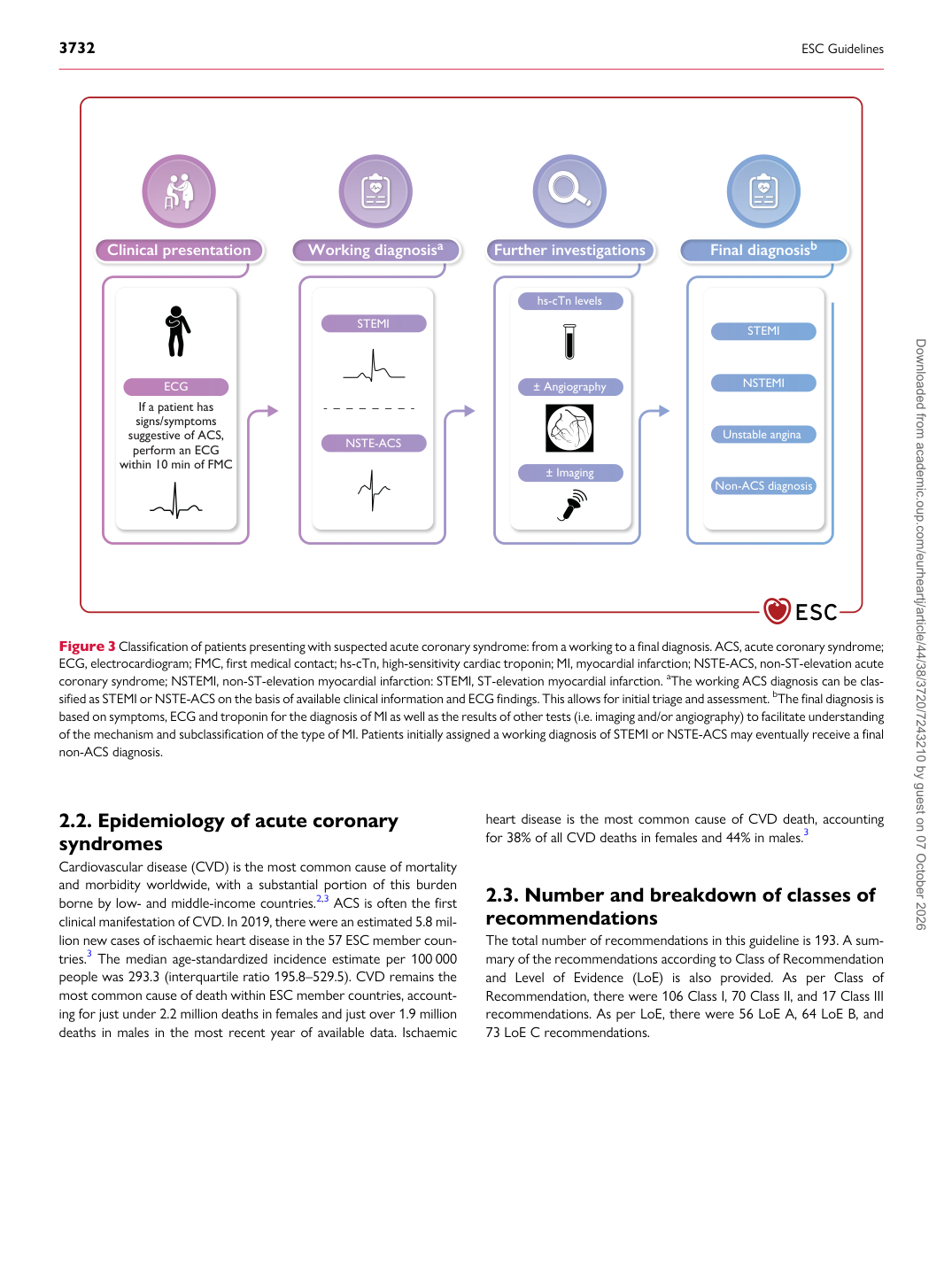
STEMI

NSTE-ACS STEMI

NSTEMI

Unstable angina

Non-ACS diagnosis

hs-cTn levels

± Angiography

± Imaging

Final diagnosisb Working diagnosisa Further investigations

Clinical presentation

If a patient has signs/symptoms suggestive of ACS, perform an ECG within 10 min of FMC

ECG

Figure 3 Classification of patients presenting with suspected acute coronary syndrome: from a working to a final diagnosis. ACS, acute coronary syndrome; ECG, electrocardiogram; FMC, first medical contact; hs-cTn, high-sensitivity cardiac troponin; MI, myocardial infarction; NSTE-ACS, non-ST-elevation acute coronary syndrome; NSTEMI, non-ST-elevation myocardial infarction: STEMI, ST-elevation myocardial infarction. aThe working ACS diagnosis can be classified as STEMI or NSTE-ACS on the basis of available clinical information and ECG findings. This allows for initial triage and assessment. bThe final diagnosis is based on symptoms, ECG and troponin for the diagnosis of MI as well as the results of other tests (i.e. imaging and/or angiography) to facilitate understanding of the mechanism and subclassification of the type of MI. Patients initially assigned a working diagnosis of STEMI or NSTE-ACS may eventually receive a final non-ACS diagnosis. Downloaded from academic.oup.com/eurheartj/article/44/38/3720/7243210 by guest on 07 October 2026