p.97 抽出テキスト
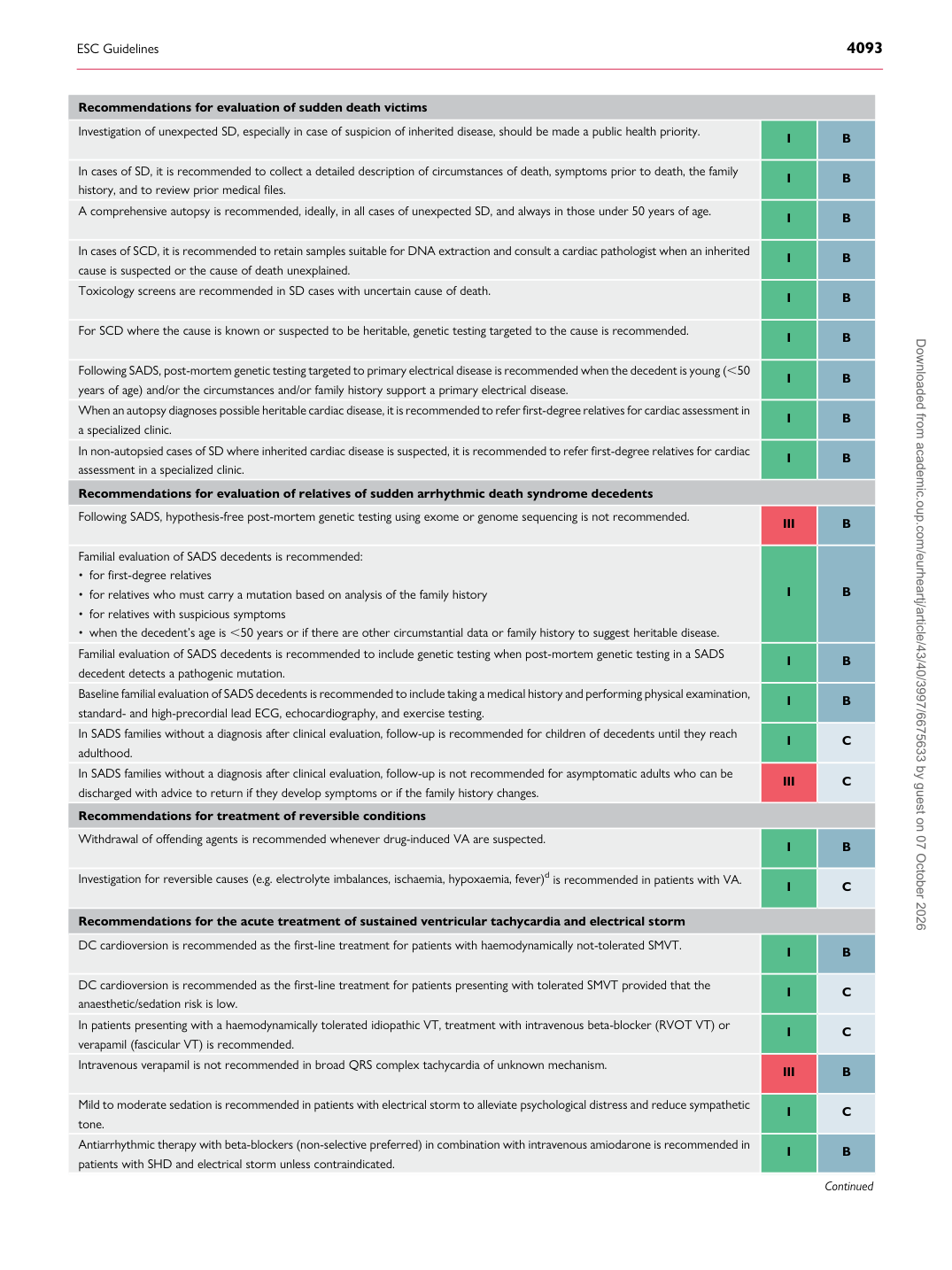
Recommendations for evaluation of sudden death victims Investigation of unexpected SD, especially in case of suspicion of inherited disease, should be made a public health priority. I B

In cases of SD, it is recommended to collect a detailed description of circumstances of death, symptoms prior to death, the family history, and to review prior medical files. I B A comprehensive autopsy is recommended, ideally, in all cases of unexpected SD, and always in those under 50 years of age. I B

In cases of SCD, it is recommended to retain samples suitable for DNA extraction and consult a cardiac pathologist when an inherited cause is suspected or the cause of death unexplained. I B Toxicology screens are recommended in SD cases with uncertain cause of death. I B

For SCD where the cause is known or suspected to be heritable, genetic testing targeted to the cause is recommended. I B

Following SADS, post-mortem genetic testing targeted to primary electrical disease is recommended when the decedent is young (,50 years of age) and/or the circumstances and/or family history support a primary electrical disease. I B When an autopsy diagnoses possible heritable cardiac disease, it is recommended to refer first-degree relatives for cardiac assessment in a specialized clinic. I B In non-autopsied cases of SD where inherited cardiac disease is suspected, it is recommended to refer first-degree relatives for cardiac assessment in a specialized clinic. I B Recommendations for evaluation of relatives of sudden arrhythmic death syndrome decedents Following SADS, hypothesis-free post-mortem genetic testing using exome or genome sequencing is not recommended. III B

Familial evaluation of SADS decedents is recommended: • for first-degree relatives • for relatives who must carry a mutation based on analysis of the family history • for relatives with suspicious symptoms • when the decedent’s age is ,50 years or if there are other circumstantial data or family history to suggest heritable disease. I B Familial evaluation of SADS decedents is recommended to include genetic testing when post-mortem genetic testing in a SADS decedent detects a pathogenic mutation. I B Baseline familial evaluation of SADS decedents is recommended to include taking a medical history and performing physical examination, standard- and high-precordial lead ECG, echocardiography, and exercise testing. I B In SADS families without a diagnosis after clinical evaluation, follow-up is recommended for children of decedents until they reach adulthood. I C In SADS families without a diagnosis after clinical evaluation, follow-up is not recommended for asymptomatic adults who can be discharged with advice to return if they develop symptoms or if the family history changes. III C Recommendations for treatment of reversible conditions Withdrawal of offending agents is recommended whenever drug-induced VA are suspected. I B

Investigation for reversible causes (e.g. electrolyte imbalances, ischaemia, hypoxaemia, fever)d is recommended in patients with VA. I C

Recommendations for the acute treatment of sustained ventricular tachycardia and electrical storm DC cardioversion is recommended as the first-line treatment for patients with haemodynamically not-tolerated SMVT. I B

DC cardioversion is recommended as the first-line treatment for patients presenting with tolerated SMVT provided that the anaesthetic/sedation risk is low. I C In patients presenting with a haemodynamically tolerated idiopathic VT, treatment with intravenous beta-blocker (RVOT VT) or verapamil (fascicular VT) is recommended. I C Intravenous verapamil is not recommended in broad QRS complex tachycardia of unknown mechanism. III B

Mild to moderate sedation is recommended in patients with electrical storm to alleviate psychological distress and reduce sympathetic tone. I C Antiarrhythmic therapy with beta-blockers (non-selective preferred) in combination with intravenous amiodarone is recommended in patients with SHD and electrical storm unless contraindicated. I B

Continued Downloaded from academic.oup.com/eurheartj/article/43/40/3997/6675633 by guest on 07 October 2026