p.96 抽出テキスト
• Improved diagnostic and risk stratification tools for asymptomatic Brugada patients and suspected early repolarization syndrome are needed. • The role of endo-epicardial mapping to identify localized structural alterations potentially related to IVF and targeted catheter ablation needs to be further studied. • Long-term data are required on the efficacy of the ICD vs. no ICD in CPVT survivors of cardiac arrest. • It is poorly understood why women are at low risk of sport-related SCD.

11 ‘What to do’ and ‘what not to do’ messages from the Guidelines

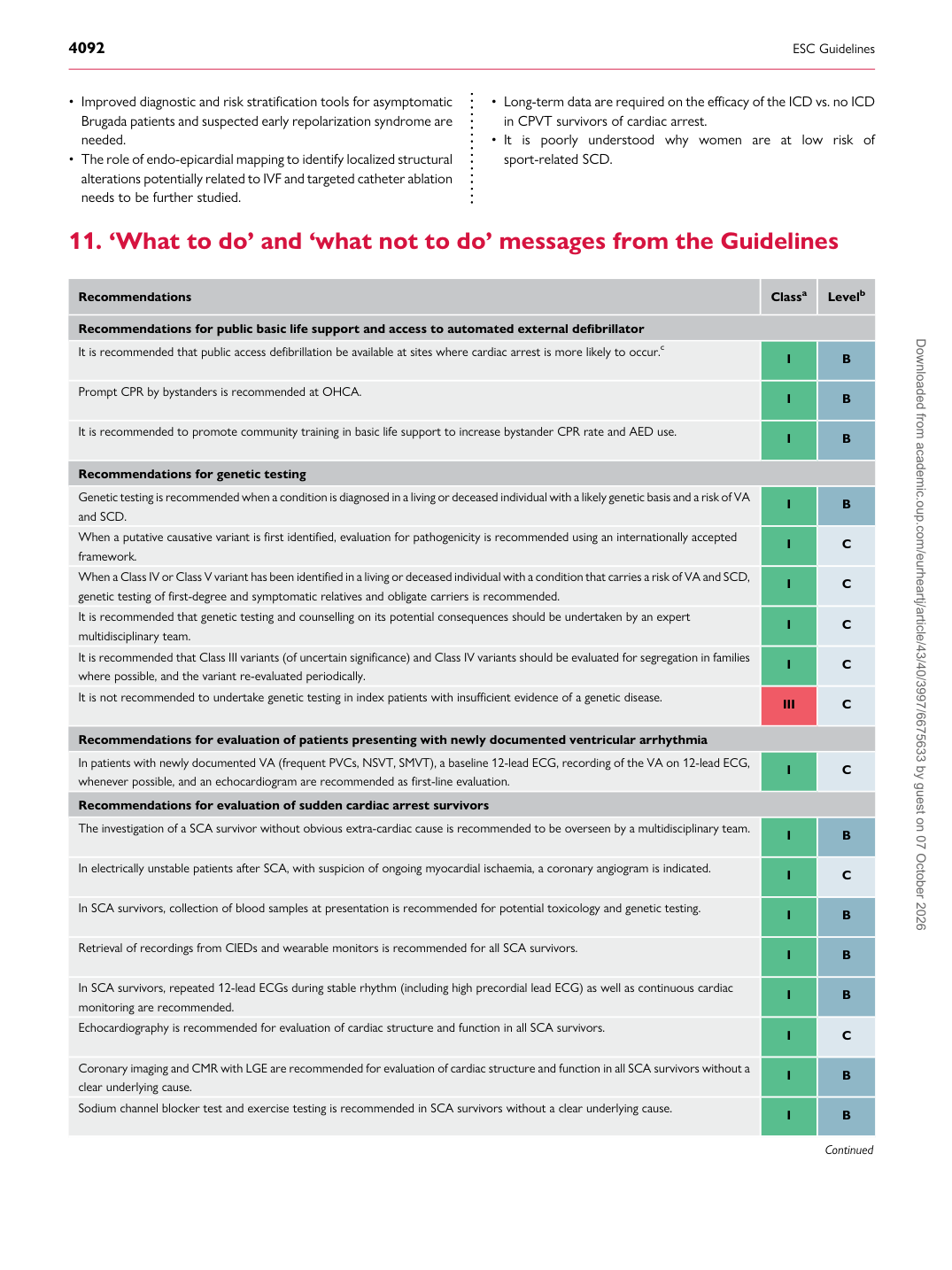
Recommendations Classa Levelb

Recommendations for public basic life support and access to automated external defibrillator It is recommended that public access defibrillation be available at sites where cardiac arrest is more likely to occur.c I B

Prompt CPR by bystanders is recommended at OHCA. I B

It is recommended to promote community training in basic life support to increase bystander CPR rate and AED use. I B

Recommendations for genetic testing Genetic testing is recommended when a condition is diagnosed in a living or deceased individual with a likely genetic basis and a risk of VA and SCD. I B When a putative causative variant is first identified, evaluation for pathogenicity is recommended using an internationally accepted framework. I C When a Class IV or Class V variant has been identified in a living or deceased individual with a condition that carries a risk of VA and SCD, genetic testing of first-degree and symptomatic relatives and obligate carriers is recommended. I C It is recommended that genetic testing and counselling on its potential consequences should be undertaken by an expert multidisciplinary team. I C It is recommended that Class III variants (of uncertain significance) and Class IV variants should be evaluated for segregation in families where possible, and the variant re-evaluated periodically. I C It is not recommended to undertake genetic testing in index patients with insufficient evidence of a genetic disease. III C

Recommendations for evaluation of patients presenting with newly documented ventricular arrhythmia In patients with newly documented VA (frequent PVCs, NSVT, SMVT), a baseline 12-lead ECG, recording of the VA on 12-lead ECG, whenever possible, and an echocardiogram are recommended as first-line evaluation. I C Recommendations for evaluation of sudden cardiac arrest survivors The investigation of a SCA survivor without obvious extra-cardiac cause is recommended to be overseen by a multidisciplinary team. I B

In electrically unstable patients after SCA, with suspicion of ongoing myocardial ischaemia, a coronary angiogram is indicated. I C

In SCA survivors, collection of blood samples at presentation is recommended for potential toxicology and genetic testing. I B

Retrieval of recordings from CIEDs and wearable monitors is recommended for all SCA survivors. I B

In SCA survivors, repeated 12-lead ECGs during stable rhythm (including high precordial lead ECG) as well as continuous cardiac monitoring are recommended. I B Echocardiography is recommended for evaluation of cardiac structure and function in all SCA survivors. I C

Coronary imaging and CMR with LGE are recommended for evaluation of cardiac structure and function in all SCA survivors without a clear underlying cause. I B Sodium channel blocker test and exercise testing is recommended in SCA survivors without a clear underlying cause. I B

Continued Downloaded from academic.oup.com/eurheartj/article/43/40/3997/6675633 by guest on 07 October 2026