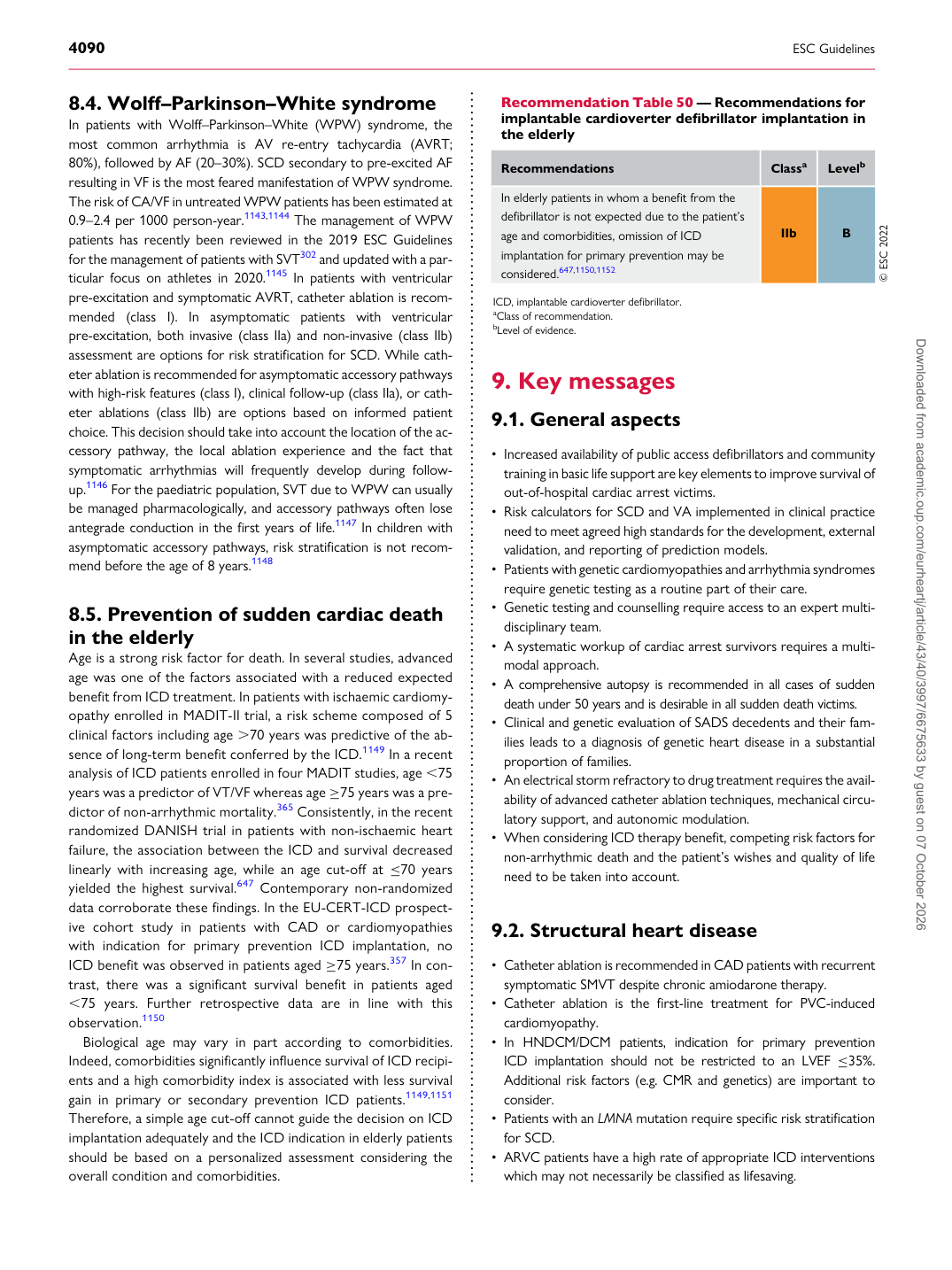
p.94 抽出テキスト
8.4 Wolff–Parkinson–White syndrome

In patients with Wolff–Parkinson–White (WPW) syndrome, the most common arrhythmia is AV re-entry tachycardia (AVRT; 80%), followed by AF (20–30%). SCD secondary to pre-excited AF resulting in VF is the most feared manifestation of WPW syndrome. The risk of CA/VF in untreated WPW patients has been estimated at 0.9–2.4 per 1000 person-year.1143,1144 The management of WPW patients has recently been reviewed in the 2019 ESC Guidelines for the management of patients with SVT302 and updated with a particular focus on athletes in 2020.1145 In patients with ventricular pre-excitation and symptomatic AVRT, catheter ablation is recommended (class I). In asymptomatic patients with ventricular pre-excitation, both invasive (class IIa) and non-invasive (class IIb) assessment are options for risk stratification for SCD. While catheter ablation is recommended for asymptomatic accessory pathways with high-risk features (class I), clinical follow-up (class IIa), or catheter ablations (class IIb) are options based on informed patient choice. This decision should take into account the location of the accessory pathway, the local ablation experience and the fact that symptomatic arrhythmias will frequently develop during followup.1146 For the paediatric population, SVT due to WPW can usually be managed pharmacologically, and accessory pathways often lose antegrade conduction in the first years of life.1147 In children with asymptomatic accessory pathways, risk stratification is not recommend before the age of 8 years.1148

8.5 Prevention of sudden cardiac death

in the elderly Age is a strong risk factor for death. In several studies, advanced age was one of the factors associated with a reduced expected benefit from ICD treatment. In patients with ischaemic cardiomyopathy enrolled in MADIT-II trial, a risk scheme composed of 5 clinical factors including age .70 years was predictive of the absence of long-term benefit conferred by the ICD.1149 In a recent analysis of ICD patients enrolled in four MADIT studies, age ,75 years was a predictor of VT/VF whereas age ≥75 years was a predictor of non-arrhythmic mortality.365 Consistently, in the recent randomized DANISH trial in patients with non-ischaemic heart failure, the association between the ICD and survival decreased linearly with increasing age, while an age cut-off at ≤70 years yielded the highest survival.647 Contemporary non-randomized data corroborate these findings. In the EU-CERT-ICD prospective cohort study in patients with CAD or cardiomyopathies with indication for primary prevention ICD implantation, no ICD benefit was observed in patients aged ≥75 years.357 In contrast, there was a significant survival benefit in patients aged ,75 years. Further retrospective data are in line with this observation.1150 Biological age may vary in part according to comorbidities. Indeed, comorbidities significantly influence survival of ICD recipients and a high comorbidity index is associated with less survival gain in primary or secondary prevention ICD patients.1149,1151 Therefore, a simple age cut-off cannot guide the decision on ICD implantation adequately and the ICD indication in elderly patients should be based on a personalized assessment considering the overall condition and comorbidities. 9 Key messages

9.1 General aspects

• Increased availability of public access defibrillators and community training in basic life support are key elements to improve survival of out-of-hospital cardiac arrest victims. • Risk calculators for SCD and VA implemented in clinical practice need to meet agreed high standards for the development, external validation, and reporting of prediction models. • Patients with genetic cardiomyopathies and arrhythmia syndromes require genetic testing as a routine part of their care. • Genetic testing and counselling require access to an expert multidisciplinary team. • A systematic workup of cardiac arrest survivors requires a multimodal approach. • A comprehensive autopsy is recommended in all cases of sudden death under 50 years and is desirable in all sudden death victims. • Clinical and genetic evaluation of SADS decedents and their families leads to a diagnosis of genetic heart disease in a substantial proportion of families. • An electrical storm refractory to drug treatment requires the availability of advanced catheter ablation techniques, mechanical circulatory support, and autonomic modulation. • When considering ICD therapy benefit, competing risk factors for non-arrhythmic death and the patient’s wishes and quality of life need to be taken into account.

9.2 Structural heart disease

• Catheter ablation is recommended in CAD patients with recurrent symptomatic SMVT despite chronic amiodarone therapy. • Catheter ablation is the first-line treatment for PVC-induced cardiomyopathy. • In HNDCM/DCM patients, indication for primary prevention ICD implantation should not be restricted to an LVEF ≤35%. Additional risk factors (e.g. CMR and genetics) are important to consider. • Patients with an LMNA mutation require specific risk stratification for SCD. • ARVC patients have a high rate of appropriate ICD interventions which may not necessarily be classified as lifesaving.

Recommendation Table 50 — Recommendations for implantable cardioverter defibrillator implantation in the elderly

Recommendations Classa Levelb

In elderly patients in whom a benefit from the defibrillator is not expected due to the patient’s age and comorbidities, omission of ICD implantation for primary prevention may be considered.647,1150,1152 IIb B © ESC 2022

ICD, implantable cardioverter defibrillator. aClass of recommendation. bLevel of evidence.

Downloaded from academic.oup.com/eurheartj/article/43/40/3997/6675633 by guest on 07 October 2026