p.93 抽出テキスト
8.2 Heart transplantation

Patients listed for HTX are exposed to an SCD risk and have a high incidence of VA. Data from large registries suggest a survival benefit from ICDs.1108–1111 The only randomized study including patients listed for HTX was prematurely stopped because of low enrolment.1112 There are no data regarding the role of WCD in patients listed for HTX. The median expected time on the waiting list, 8–16 months, needs to be considered.1108,1110 However, this panel shares the opinion that a WCD may be an alternative for an ICD in selected patients waiting for HTX.371,1113 In post-HTX patients, SCD is responsible for around 10% of deaths.1114,1115 Transplant rejection and allograft vasculopathy are associated with SCD1114,1116,1117; therefore, ICD implantation may be appropriate in selected high-risk patients.1118

8.3 Sudden cardiac death in athletes

The incidence of SCD in athletes increases with age.4,1120 In apparently healthy athletes (.35 years), the estimated incidence of SCD ranges from 2 to 6.3 per 100 000 participant-years. In comparison, in young competitive athletes (≤35 years) the incidence of fatal events is significantly lower, 0.4–3 per 100 000 participantyears.46,47,1120 Women athletes are at low risk of SCD; on average, 1 in 14 SCD in athletes occurs in women.1121 Pre-participation cardiovascular evaluation offers the potential to identify athletes at-risk for cardiovascular disease before onset of symptoms.1122–1126 The evaluation protocol needs to be adapted to the age of the athlete to account for age-specific cardiovascular disease.1125 Pre-participation evaluation, including medical history, physical examination, and ECG, appears effective in identifying cardiovascular disease in young athletes (≤35 years of age) by identification of relevant symptoms (e.g. exertional syncope) or ECG abnormalities consistent with inheritable cardiomyopathies or channelopathies.1127–1130 Although echocardiography can increase the sensitivity of screening for SHD, it is unfeasible as a routine test in mass screening. More cardiovascular diseases are identified by serial (annual) evaluations of adolescent athletes.1129,1131 The prevalence of false-positive results strongly depends on the criteria used to define an ECG as ‘abnormal’.1132,1133 Additional tests, such as echocardiography, 24-hour Holter monitoring, stress testing, and CMR, are requested for athletes who had positive findings at the initial evaluation. Athletes diagnosed with clinically relevant cardiovascular disease are managed according to available ESC Guidelines.4,1134–1136

In middle-aged/senior athletes, the most common cause of SCD is CAD.1125,1137 Before engaging in a vigorous physical activity, asymptomatic middle-aged/senior athletes should be evaluated using risk score systems such as the ESC SCORE2.4,65 Excellent rates of survival with favourable neurological outcome after CA has been reported in sports centres equipped with AED.1137,1138 This justifies the efforts for implementing emergency programs for SCD prevention, with distribution of AED in sports arenas and training of coaches and staff to perform CPR and defibrillation.1139

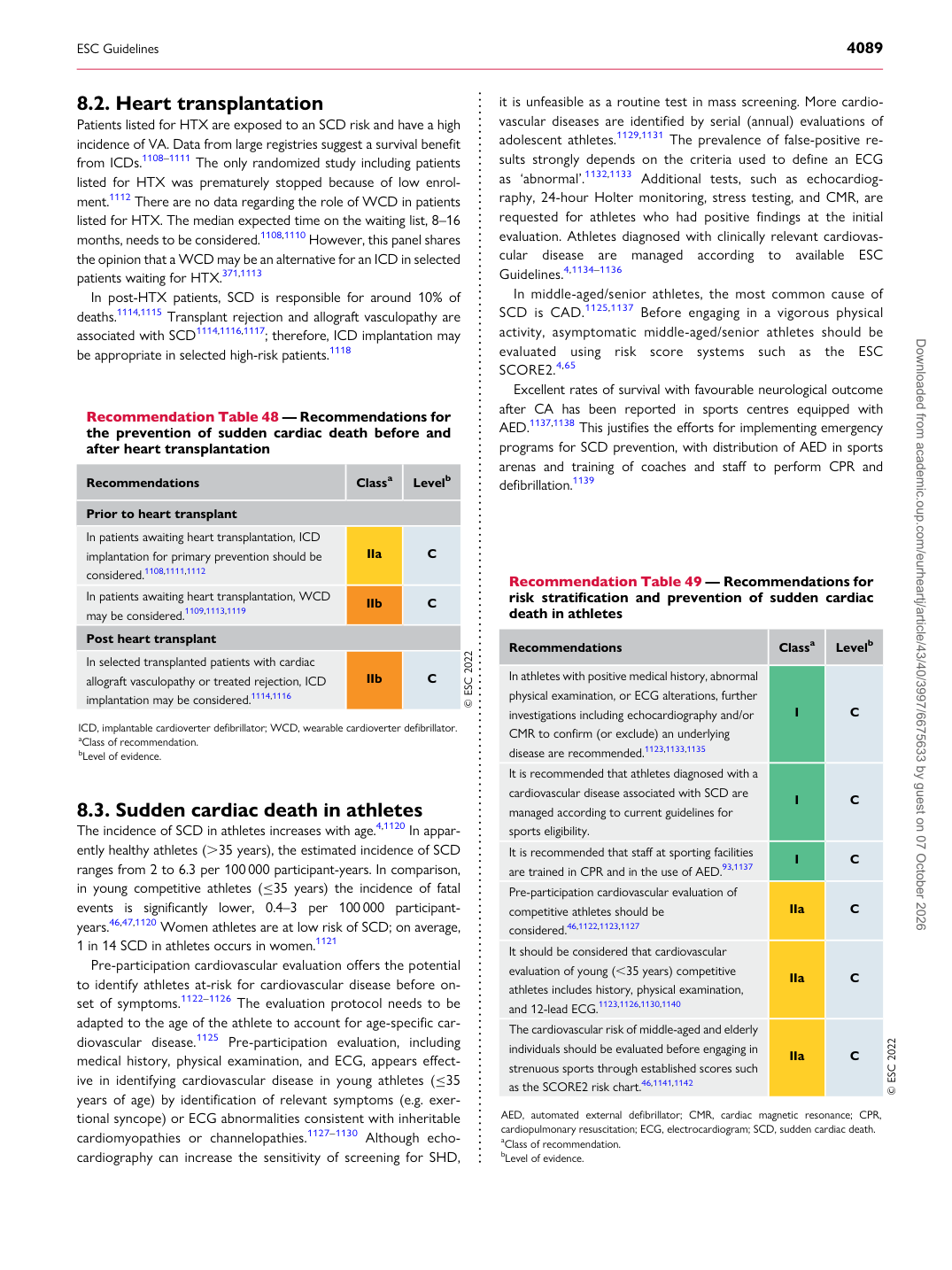
Recommendation Table 48 — Recommendations for the prevention of sudden cardiac death before and after heart transplantation

Recommendations Classa Levelb

Prior to heart transplant In patients awaiting heart transplantation, ICD implantation for primary prevention should be considered.1108,1111,1112 IIa C In patients awaiting heart transplantation, WCD may be considered.1109,1113,1119 IIb C Post heart transplant In selected transplanted patients with cardiac allograft vasculopathy or treated rejection, ICD implantation may be considered.1114,1116 IIb C © ESC 2022

ICD, implantable cardioverter defibrillator; WCD, wearable cardioverter defibrillator. aClass of recommendation. bLevel of evidence. Recommendation Table 49 — Recommendations for risk stratification and prevention of sudden cardiac death in athletes

Recommendations Classa Levelb

In athletes with positive medical history, abnormal physical examination, or ECG alterations, further investigations including echocardiography and/or CMR to confirm (or exclude) an underlying disease are recommended.1123,1133,1135 I C It is recommended that athletes diagnosed with a cardiovascular disease associated with SCD are managed according to current guidelines for sports eligibility. I C It is recommended that staff at sporting facilities are trained in CPR and in the use of AED.93,1137 I C Pre-participation cardiovascular evaluation of competitive athletes should be considered.46,1122,1123,1127 IIa C It should be considered that cardiovascular evaluation of young (,35 years) competitive athletes includes history, physical examination, and 12-lead ECG.1123,1126,1130,1140 IIa C The cardiovascular risk of middle-aged and elderly individuals should be evaluated before engaging in strenuous sports through established scores such as the SCORE2 risk chart.46,1141,1142 IIa C © ESC 2022

AED, automated external defibrillator; CMR, cardiac magnetic resonance; CPR, cardiopulmonary resuscitation; ECG, electrocardiogram; SCD, sudden cardiac death. aClass of recommendation. bLevel of evidence. Downloaded from academic.oup.com/eurheartj/article/43/40/3997/6675633 by guest on 07 October 2026