p.92 抽出テキスト
8 Special aspects in selected

populations

8.1 Pregnant patients and peri-partum

cardiomyopathy Pregnancy and the post-partum period contribute a significant risk in women with arrhythmic heart disease and is covered in the 2018 ESC Guidelines for the management of cardiovascular diseases during pregnancy.1076–1080 New-onset VT may present during pregnancy and risk of recurrent VT is higher in patients with previous VT and SHD.1081 Peri-partum cardiomyopathy (PPCM) should be ruled out in the case of new-onset VT during the last 6 weeks of pregnancy or in the early post-partum period.1082 A genetic contribution may be present in up to 20% of patients with PPCM (in particular titin-truncating variants)1083 and future studies should reveal if genetic testing plays a role in PPCM patients with a positive family history.

8.1.1 Electrocardioversion and implantable

cardioverter defibrillator therapy in pregnancy Cardioversion seems safe in all phases of pregnancy and case reports show neither compromise in fetal blood flow nor initiation of preterm labour.1084 Foetal heart rate should be routinely controlled after cardioversion.1085 If an ICD is indicated, ICD implantation should be performed beyond 8 weeks of gestation with radiation protection by experienced operator teams.1086 Echocardiographic guidance or a 3D mapping system may be helpful in ICD implantation to avoid radiation.1087,1088 In pregnant patients with existing ICD, routine ICD interrogation is recommended prior to delivery. In patients with PPCM, thresholds for early ICD implantations are higher than in other conditions because of a high rate of spontaneous recovery after delivery.1089 WCD have been suggested to temporarily prevent SCD during the first 3–6 months after diagnosis of PPCM with LVEF ≤35%, while awaiting recovery.1090,1091

8.1.2 Pharmacological treatment

Pharmacological treatment of arrhythmias and heart failure in pregnant women should follow treatment in non-pregnant patients with avoidance of drugs contraindicated in pregnancy, such as ACE inhibitors, ARB inhibitors/ARNI and renin inhibitors.1080,1082,1092,1093 The first trimester is associated with the greatest teratogenic risk. Start of pharmacological therapy is advised to begin at the latest possible point in the pregnancy and with the lowest effective dose. Drug exposure in the second and third trimestera may confer adverse effects on foetal growth and development as well as increasing the risk of pro-arrhythmia. It is recommended to check drugs and safety data before initiation of a new drug during pregnancy, according to the 2018 ESC Guidelines for the management of cardiovascular diseases during pregnancy.1080 From this list, AADs can be summarized as followed: • Well tolerated: sotalol, oral verapamil • Use only if potential benefit outweighs potential risk: bisoprolol, carvedilol, digoxin, diltiazem (possible teratogenic effects), disopyramide (uterine contractions), flecainide, lidocaine, metoprolol, nadolol, propranolol, verapamil IV, quinidine • Inadequate data: Ivabradine, mexiletine, proprafenone, vernakalant • Contraindicated: amiodarone, atenolol, dronedarone. In LQTS (LQT2 in particular), risk of cardiac events increases substantially in the post-partum period (up to one year after delivery).1094 Therefore, it is important to continue beta-blocker therapy throughout pregnancy and post-partum.955,1094,1095

Continuation of beta-blocker treatment is recommended in LQTS and CPVT1096 and should be considered in ARVC.1097–1099 No additional risk by pregnancy is known in women with BrS1100,1101 ( ESC CardioMed chapter 53.6).1102 In patients with PPCM, use of bromocriptine as disease-specific therapy in addition to standard heart failure therapy has shown promising results in two clinical trials.1103,1104

8.1.3 Catheter ablation

In planned pregnancies, symptomatic tachyarrhythmia should be treated by catheter ablation before pregnancy. If catheter ablation is indicated in a pregnant patient, one should avoid the procedure in the first trimester, and electroanatomical mapping-guided procedures should be preferred.1105,1106

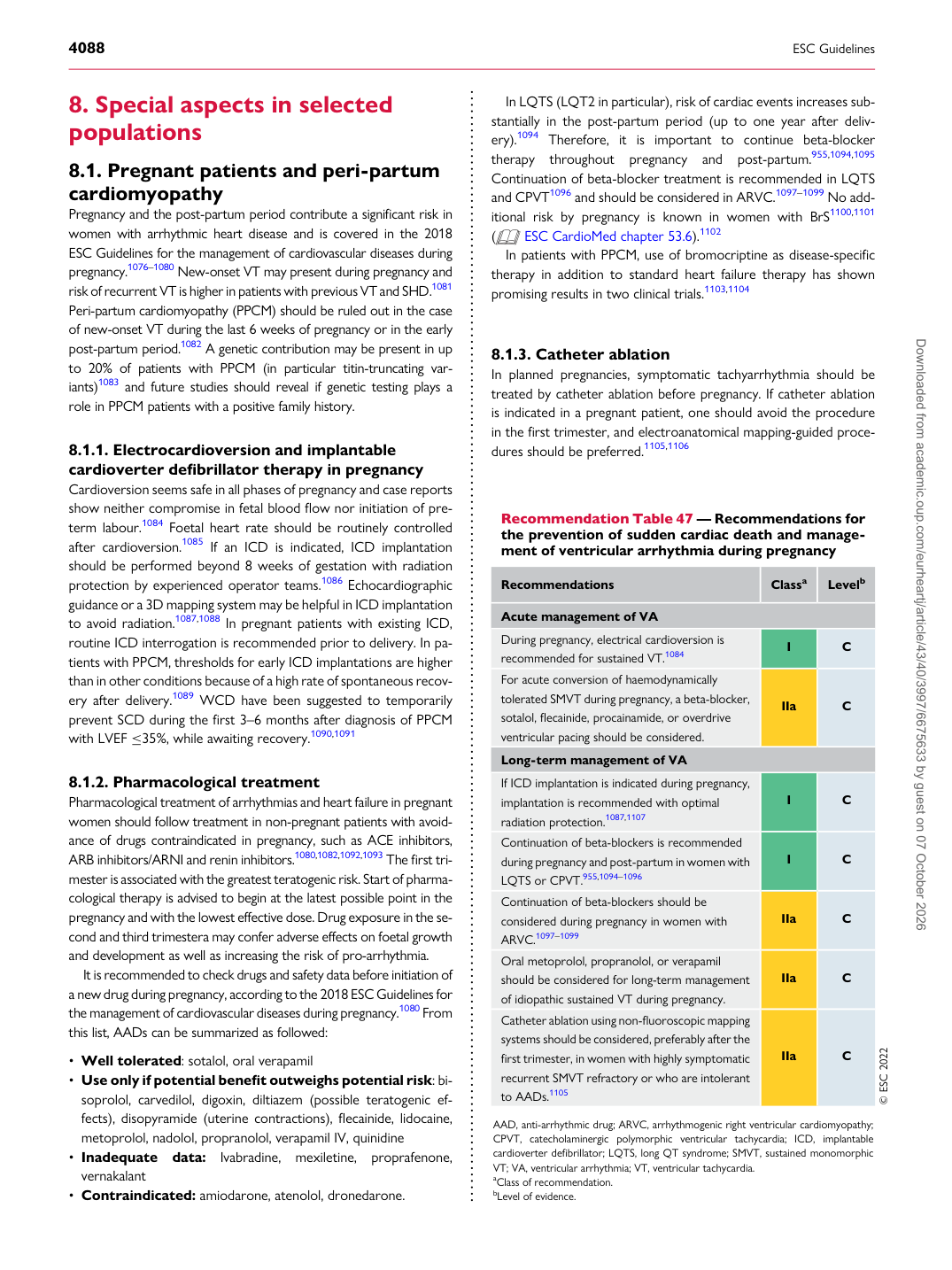
Recommendation Table 47 — Recommendations for the prevention of sudden cardiac death and management of ventricular arrhythmia during pregnancy

Recommendations Classa Levelb

Acute management of VA During pregnancy, electrical cardioversion is recommended for sustained VT.1084 I C For acute conversion of haemodynamically tolerated SMVT during pregnancy, a beta-blocker, sotalol, flecainide, procainamide, or overdrive ventricular pacing should be considered. IIa C Long-term management of VA If ICD implantation is indicated during pregnancy, implantation is recommended with optimal radiation protection.1087,1107 I C Continuation of beta-blockers is recommended during pregnancy and post-partum in women with LQTS or CPVT.955,1094–1096 I C Continuation of beta-blockers should be considered during pregnancy in women with ARVC.1097–1099 IIa C Oral metoprolol, propranolol, or verapamil should be considered for long-term management of idiopathic sustained VT during pregnancy. IIa C Catheter ablation using non-fluoroscopic mapping systems should be considered, preferably after the first trimester, in women with highly symptomatic recurrent SMVT refractory or who are intolerant to AADs.1105 IIa C © ESC 2022

AAD, anti-arrhythmic drug; ARVC, arrhythmogenic right ventricular cardiomyopathy; CPVT, catecholaminergic polymorphic ventricular tachycardia; ICD, implantable cardioverter defibrillator; LQTS, long QT syndrome; SMVT, sustained monomorphic VT; VA, ventricular arrhythmia; VT, ventricular tachycardia. aClass of recommendation. bLevel of evidence. Downloaded from academic.oup.com/eurheartj/article/43/40/3997/6675633 by guest on 07 October 2026