p.90 抽出テキスト
7.2.7 Short QT syndrome

Short QT syndrome (SQTS) is a rare genetic disorder characterised by a short QT interval, premature AF and VF in the context of a structurally normal heart.1061 It has been associated with gain of function mutations in KCNH2, KCNQ1 and loss of

Recommendation Table 45 — Recommendations for the management of patients with catecholaminergic polymorphic ventricular tachycardia

Recommendations Classa Levelb

Diagnosis It is recommended that CPVT is diagnosed in the presence of a structurally normal heart, normal ECG, and exercise- or emotion-induced bidirectional, or PVT. I C It is recommended that CPVT is diagnosed in patients who are carriers of a mutation in disease-causing genes. I C Genetic testing and genetic counselling are indicated in patients with clinical suspicion or clinical diagnosis of CPVT. I C Epinephrine or isoproterenol challenge may be considered for the diagnosis of CPVT when an exercise test is not possible. IIb C General recommendations Avoidance of competitive sports, strenuous exercise, and exposure to stressful environments is recommended in all patients with CPVT. I C Therapeutic interventions Beta-blockers, ideally non-selective (nadolol or propranolol) are recommended in all patients with a clinical diagnosis of CPVT.1045,1048,1059 I C ICD implantation combined with beta-blockers and flecainide is recommended in CPVT patients after aborted CA.1045,1047,1060 I C

Continued Therapy with beta-blockers should be considered for genetically positive CPVT patients without

phenotype.1047,1050 IIa C LCSD should be considered in patients with diagnosis of CPVT when the combination of beta-blockers and flecainide at therapeutic dosage are either not effective, not tolerated, or contraindicated.1056 IIa C ICD implantation should be considered in patients with CPVT who experience arrhythmogenic syncope and/or documented bidirectional/PVT while on highest tolerated beta-blocker dose and on flecainide.1047,1050 IIa C Flecainide should be considered in patients with CPVT who experience recurrent syncope, polymorphic/bidirectional VT, or persistent exertional PVCs, while on beta-blockers at the highest tolerated dose.1052,1053,1060 IIa C PES is not recommended for stratification of SCD risk. III C © ESC 2022

CA, cardiac arrest; CPVT, catecholaminergic ventricular tachycardia; ECG, electrocardiogram; ICD, implantable cardioverter defibrillator; LCSD, left cardiac sympathetic denervation; PVT, polymorphic ventricular tachycardia; VT, ventricular tachycardia. aClass of recommendation. bLevel of evidence.

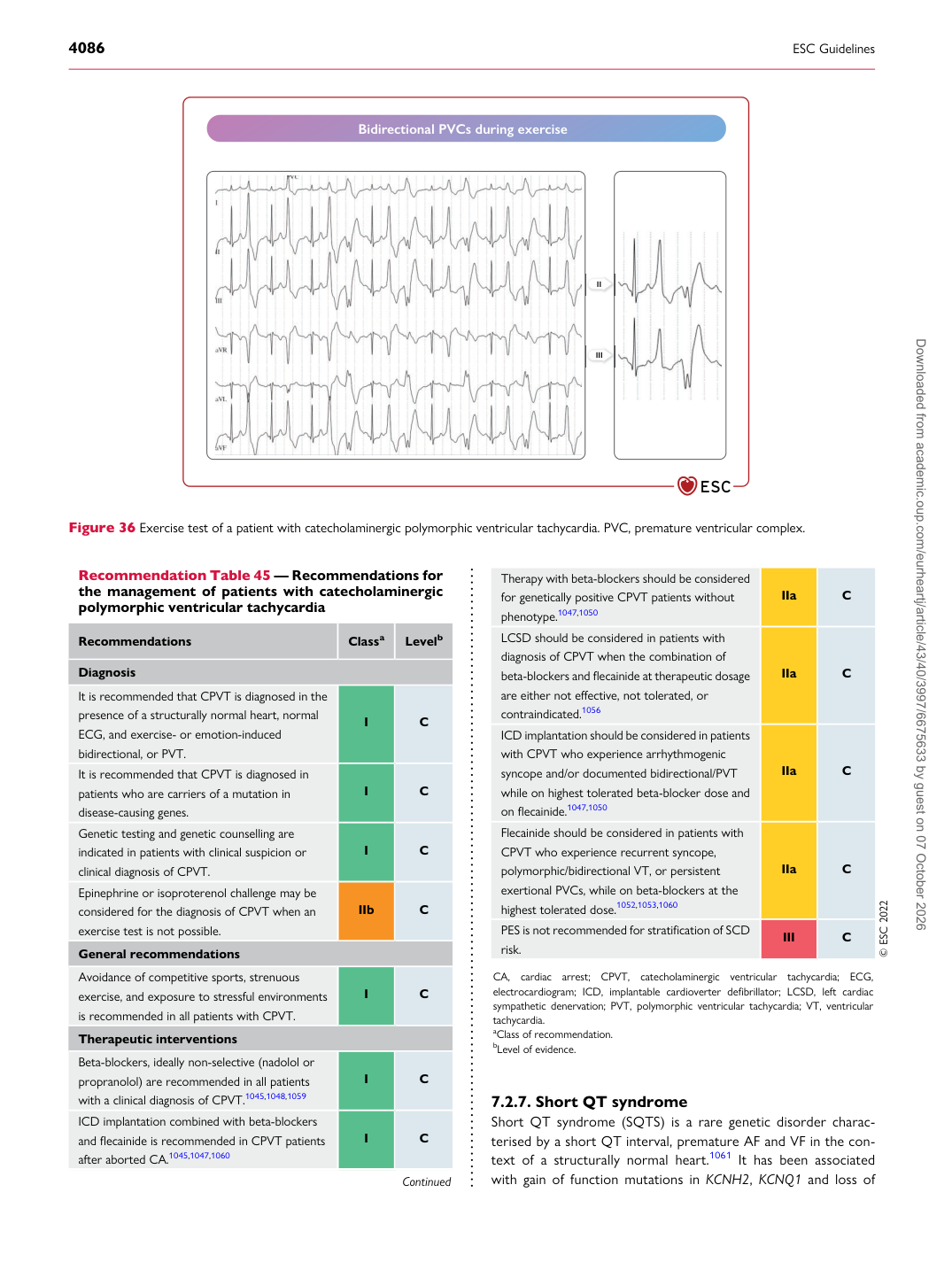
Bidirectional PVCs during exercise

II

III

Figure 36 Exercise test of a patient with catecholaminergic polymorphic ventricular tachycardia. PVC, premature ventricular complex. Downloaded from academic.oup.com/eurheartj/article/43/40/3997/6675633 by guest on 07 October 2026