p.9 抽出テキスト
label use of medication should be limited to situations where it is in the patient’s interest to do so, with regard to the quality, safety, and efficacy of care, and only after the patient has been informed and has provided consent; (2) country-specific health regulations, indications by governmental

drug regulatory agencies, and the ethical rules to which health professionals are subject, where applicable.

2 Introduction

This document presents an update of the 2015 ESC Guidelines for the management of patients with ventricular arrhythmias (VA) and the prevention of sudden cardiac death (SCD). New insights into the epidemiology of SCD, new evidence on genetics, imaging, and clinical findings for risk stratification for VA and SCD, and advances in diagnostic evaluation and therapeutic strategies made this revision necessary. The committee was composed of 25 members including 23 expert physicians, one methodologist, and one patient representative. Experts were selected to cover all areas of VA and SCD as well as subspecialties of cardiology with the assistance of related ESC working groups. All 25 members of the task force committee approved the guideline recommendations after an anonymous voting process. Ninety-nine peer reviewers reviewed the document. A systematic literature survey was conducted, after instructions by the methodologist in the group, that led to the incorporation of 1155 references, of which 485 were selected to support the recommendations and further specified in the table of evidence (Supplementary data).

2.1 What is new

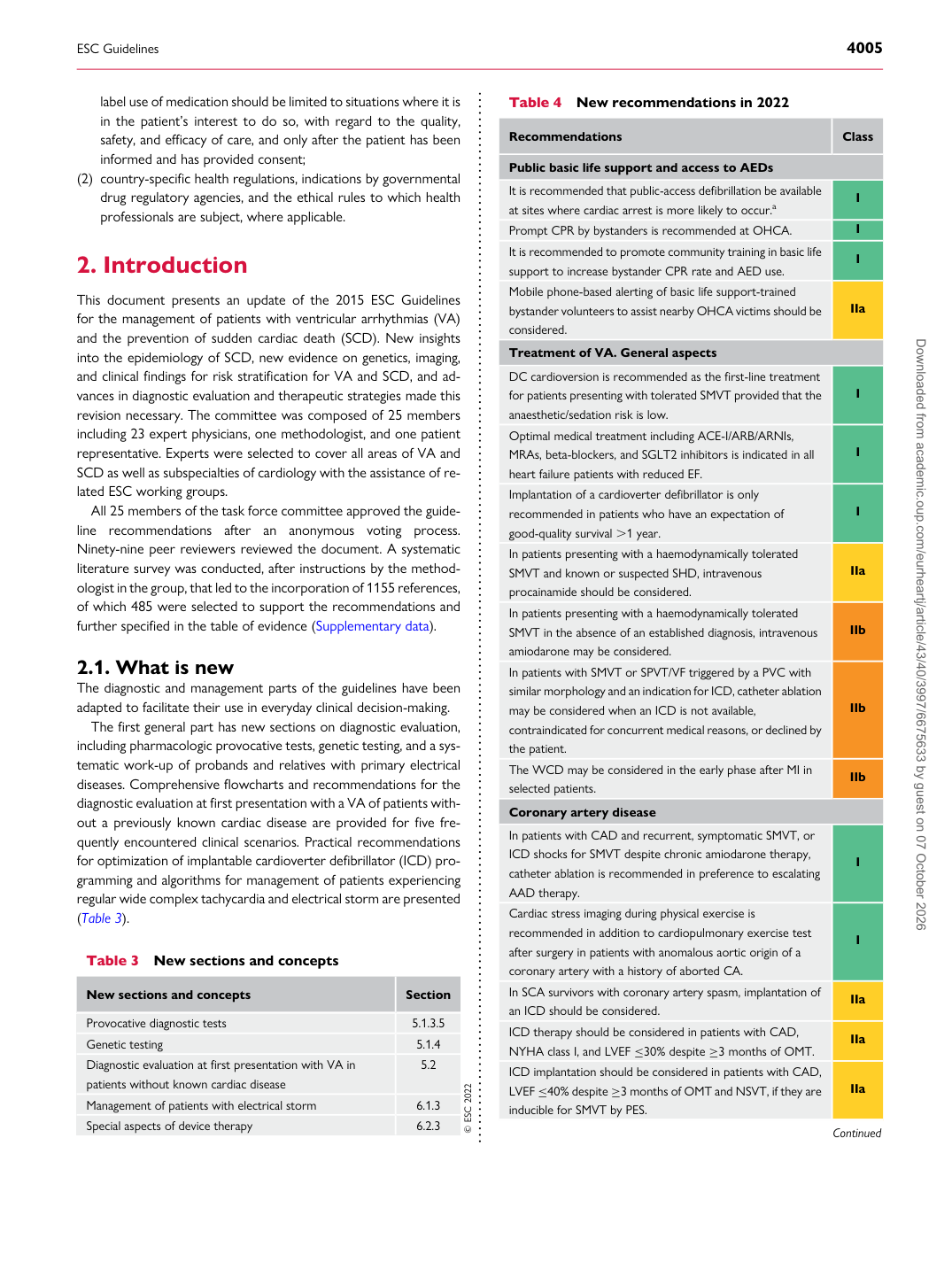
The diagnostic and management parts of the guidelines have been adapted to facilitate their use in everyday clinical decision-making. The first general part has new sections on diagnostic evaluation, including pharmacologic provocative tests, genetic testing, and a systematic work-up of probands and relatives with primary electrical diseases. Comprehensive flowcharts and recommendations for the diagnostic evaluation at first presentation with a VA of patients without a previously known cardiac disease are provided for five frequently encountered clinical scenarios. Practical recommendations for optimization of implantable cardioverter defibrillator (ICD) programming and algorithms for management of patients experiencing regular wide complex tachycardia and electrical storm are presented (Table 3).

Table 3 New sections and concepts

New sections and concepts Section

Provocative diagnostic tests 5.1.3.5 Genetic testing 5.1.4 Diagnostic evaluation at first presentation with VA in patients without known cardiac disease

5.2 Management of patients with electrical storm 6.1.3 Special aspects of device therapy 6.2.3 © ESC 2022 Table 4 New recommendations in 2022

Recommendations Class

Public basic life support and access to AEDs It is recommended that public-access defibrillation be available at sites where cardiac arrest is more likely to occur.a I Prompt CPR by bystanders is recommended at OHCA. I It is recommended to promote community training in basic life support to increase bystander CPR rate and AED use. I Mobile phone-based alerting of basic life support-trained bystander volunteers to assist nearby OHCA victims should be considered. IIa Treatment of VA. General aspects DC cardioversion is recommended as the first-line treatment for patients presenting with tolerated SMVT provided that the anaesthetic/sedation risk is low. I Optimal medical treatment including ACE-I/ARB/ARNIs, MRAs, beta-blockers, and SGLT2 inhibitors is indicated in all heart failure patients with reduced EF. I Implantation of a cardioverter defibrillator is only recommended in patients who have an expectation of good-quality survival .1 year. I In patients presenting with a haemodynamically tolerated SMVT and known or suspected SHD, intravenous procainamide should be considered. IIa In patients presenting with a haemodynamically tolerated SMVT in the absence of an established diagnosis, intravenous amiodarone may be considered. IIb In patients with SMVT or SPVT/VF triggered by a PVC with similar morphology and an indication for ICD, catheter ablation may be considered when an ICD is not available, contraindicated for concurrent medical reasons, or declined by the patient. IIb The WCD may be considered in the early phase after MI in selected patients. IIb Coronary artery disease In patients with CAD and recurrent, symptomatic SMVT, or ICD shocks for SMVT despite chronic amiodarone therapy, catheter ablation is recommended in preference to escalating AAD therapy. I Cardiac stress imaging during physical exercise is recommended in addition to cardiopulmonary exercise test after surgery in patients with anomalous aortic origin of a coronary artery with a history of aborted CA. I In SCA survivors with coronary artery spasm, implantation of an ICD should be considered. IIa ICD therapy should be considered in patients with CAD, NYHA class I, and LVEF ≤30% despite ≥3 months of OMT. IIa ICD implantation should be considered in patients with CAD, LVEF ≤40% despite ≥3 months of OMT and NSVT, if they are inducible for SMVT by PES. IIa

Continued Downloaded from academic.oup.com/eurheartj/article/43/40/3997/6675633 by guest on 07 October 2026