p.88 抽出テキスト
7.2.6 Catecholaminergic polymorphic ventricular

tachycardia CPVT is a heritable disorder characterized by catecholamineinduced bidirectional VT and PVT in the absence of SHD or ischaemia. The disease has an estimated prevalence of 1 in 10000 (Figure 35).135 There are two main genetic types: a dominant disorder due to mutations in the gene encoding for the cardiac ryanodine receptor (RYR2) and a recessive disorder caused by mutations in the cardiac calsequestrin gene (CASQ2).135,178 Mutations in TRDN and CALM1-3 have been identified in patients with atypical forms of catecholaminergic VAs.1042 At the present time, however, it is unclear whether they are distinct arrhythmic entities.1043 Patients with KCNJ2 mutations causing Andersen–Tawil syndrome type 1 may sometimes exhibit bidirectional and PVT, but are distinguished by their syndromic associations.1044

ICD implantation or quinidine may be considered in asymptomatic individuals who demonstrate a high-risk ERPc in the presence of a family history of unexplained juvenile SD.1030,1033 IIb C ICD implantation is not recommended in asymptomatic patients with an isolated ERP.1034,1035,1040 III C © ESC 2022

CA, cardiac arrest; ECG, electrocardiogram; ERP, early repolarization pattern; ERS, early repolarization syndrome; ICD, implantable cardioverter defibrillator; ILR, implantable loop recorder; PVC, premature ventricular complexes; PVT, ventricular tachycardia; SCD, sudden cardiac death; SD, sudden death; VA, ventricular arrhythmia; VF, ventricular fibrillation. aClass of recommendation. bLevel of evidence. cERP high-risk features: J waves .2 mm, dynamic changes in J point and ST morphology.1020,1041 dHigh-risk ERP: family history of unexplained SD ,40 years, family history of ERS.

N

N

N Patient with ear l y r epolarization pattern

Y Y

Y

N Y Catheter ablation

of PVC triggers

(Class IIa)

Quinidine (Class IIa)

Recu r r ent ICD shocks

Electrical storm

A r r h ythmic syncope Abo r ted ca r diac a r r est

ILR (Class IIa) ICD implantation

(Class IIb) Quinidine (Class IIb) Isop r ote r enol

(Class IIa) Quinidine (Class IIa)

At least one risk facto r : ICD implantation

(Class I)

Recu r r ence

High risk ERP a Fami l y histo r y of ju v enile unexplained SD Fami l y histo r y of ERS

At least one risk facto r : High risk ERP a Fami l y histo r y of ju v enile unexplained SD Fami l y histo r y of ERS

ILR (Class IIa)

N Y

ILR (Class IIa) ICD implantation

(Class IIb) Quinidine (Class IIb) ILR

(Class IIa)

No fu r ther i n v estigation (Class III) High risk ERP a AND

Fami l y histo r y of ju v enile unexplained SD

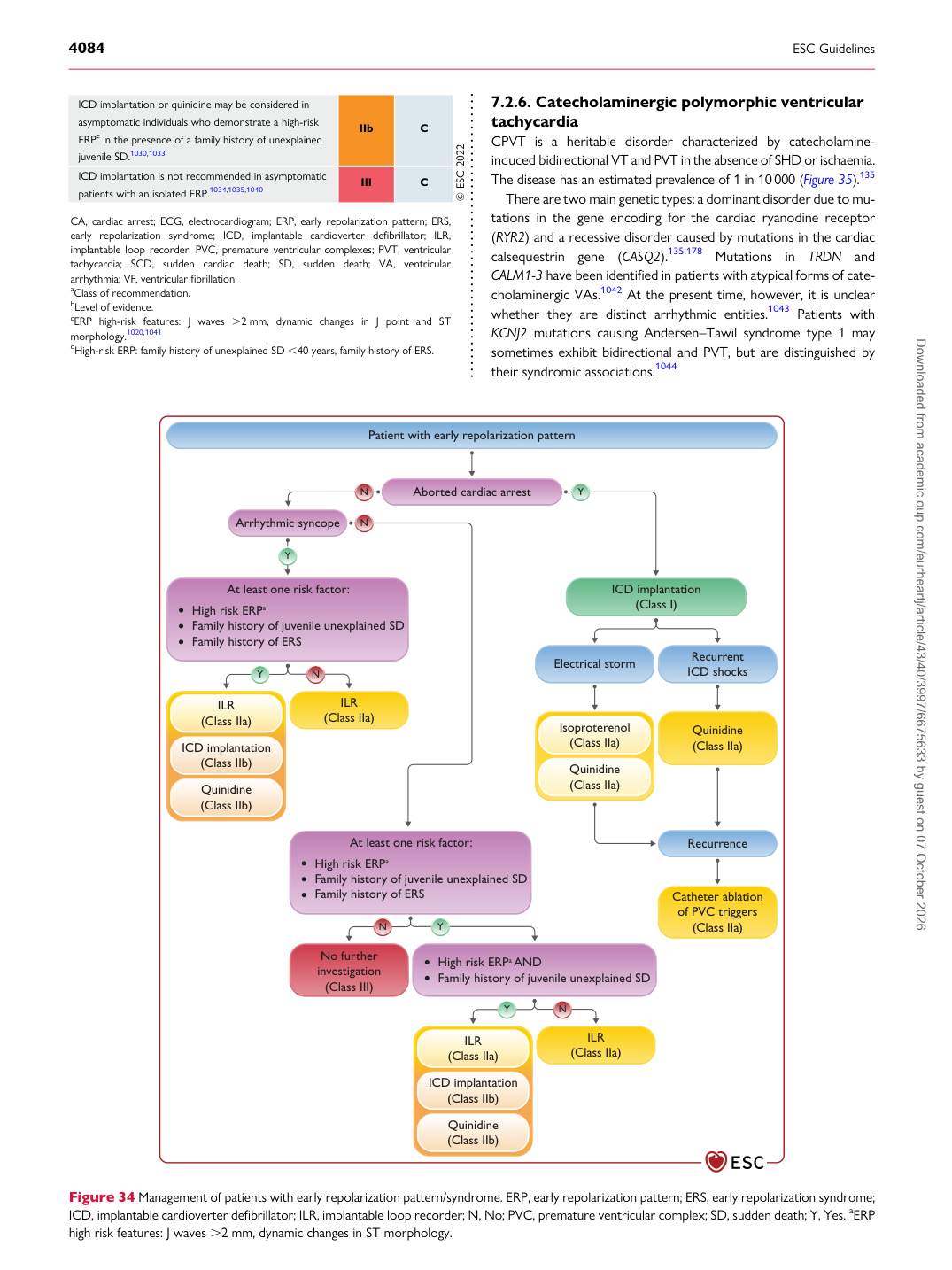
Figure 34 Management of patients with early repolarization pattern/syndrome. ERP, early repolarization pattern; ERS, early repolarization syndrome; ICD, implantable cardioverter defibrillator; ILR, implantable loop recorder; N, No; PVC, premature ventricular complex; SD, sudden death; Y, Yes. aERP high risk features: J waves .2 mm, dynamic changes in ST morphology. Downloaded from academic.oup.com/eurheartj/article/43/40/3997/6675633 by guest on 07 October 2026