p.85 抽出テキスト
7.2.5 Early repolarization syndromes

Early repolarization syndrome (ERS) is diagnosed in a patient resuscitated from PVT or VF without any heart disease and the early repolarization pattern (ERP); J-point elevation ≥1 mm in ≥2 adjacent inferior and/or lateral ECG leads (Figure 32).135,231,1017–1019 However, ERP is most often a benign finding and the prevalence of ERP has been reported as 5.8% in adults and is more common in young males and athletes.135,231,1017–1021 Nonetheless, ERP is over-represented in relatives of SADS cases282,1022 and of CA survivors.182,916 The diagnostic yield and utility of genetic testing is low.1023–1025 High-risk ECG features have been proposed to increase likelihood of ERS: prominent J-waves ≥2 mm, dynamic changes in J-point elevation (.0.1 mV) and J-waves associated with a horizontal or descending ST-segment (Figure 34).231,1026,1027 ERP with a horizontal ST-segment was associated with arrhythmic risk in an elderly and IVF population.1027 Nonetheless, ERS survivors and relatives of SADS cases also exhibit a higher prevalence of the ascending/upsloping ST segment than controls.282,1018 At least 40% of ERS patients with VF have subsequent episodes, with 27% suffering multiple episodes.231,1028,1029 Isoproterenol infusion is effective in acute suppression of recurrent ICD discharges and electrical storm.1030–1032 AADs that block the transient outward potassium current can prevent VF.922,1030,1033 A retrospective multicentre study showed a reduction of recurrent VF after initiation of quinidine.1030 Phosphodiesterase-3 inhibitors such as cilostazol and milrinone also reduced the recurrence of VF.1032 Ablation of a PVC trigger, usually from the Purkinje system, has an acute success rate of 87–100% and may be effective in preventing recurrence in patients with drug-refractory VF.1010,1017 Detailed electroanatomic mapping may reveal localized structural alterations in 39% of ERS patients.1010 Ablation of these areas successfully suppressed electrical storm and may be a therapeutic option in experienced centres. Whether catheter ablation improves long-term outcomes is currently unknown. Data for risk stratification of patients with suspected ERS without prior CA are unavailable. In individuals with ERP and unexplained syncope, this panel has recommended that follow-up with an ILR should be considered. As the prognosis of asymptomatic subjects with ERP is good, ICD therapy is usually not indicated.1034–1036 If, however, there is a high-risk ERP and a strong family history of unexplained juvenile SD, then ICD implantation or quinidine may be considered.

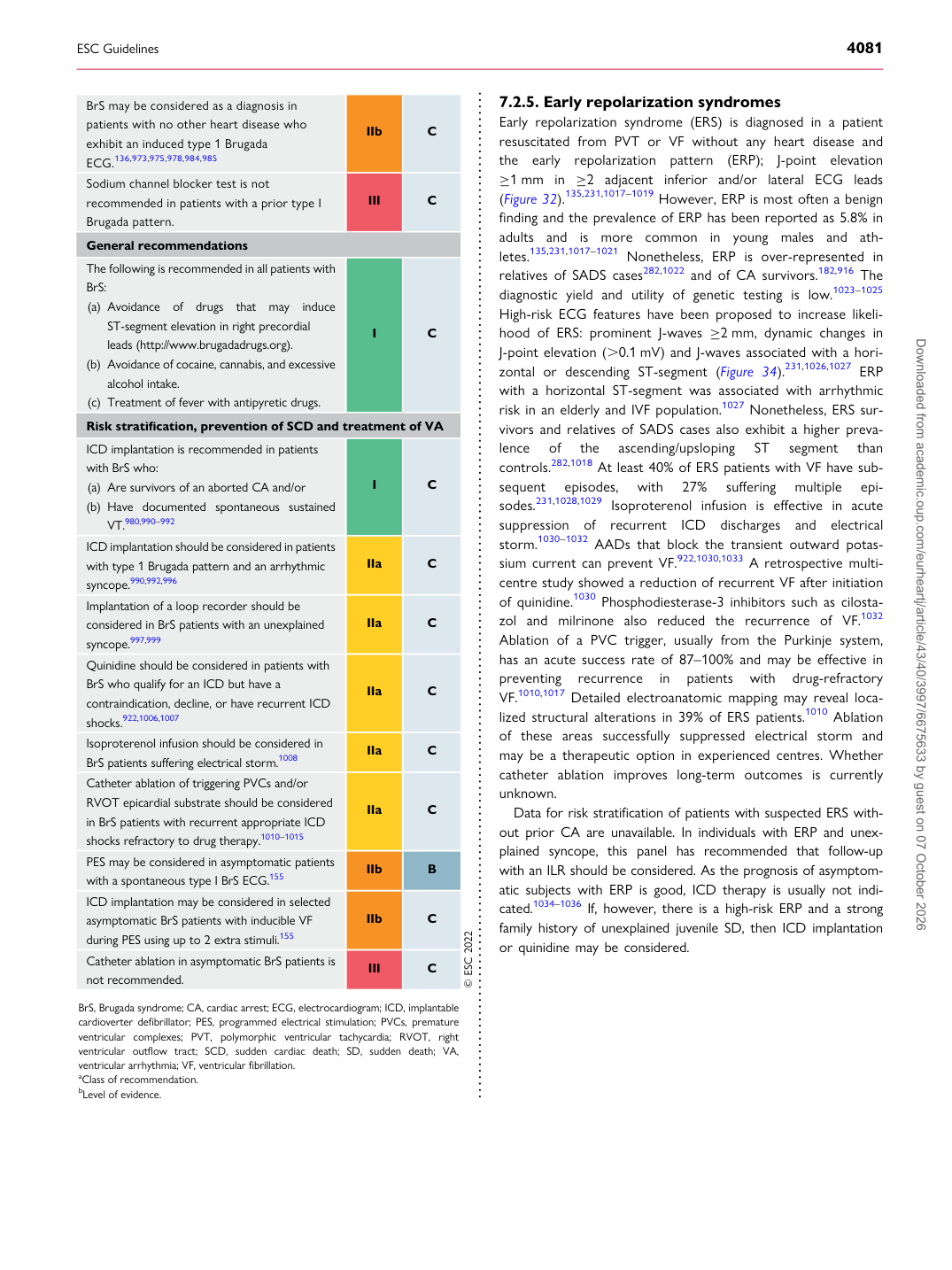
BrS may be considered as a diagnosis in patients with no other heart disease who exhibit an induced type 1 Brugada ECG.136,973,975,978,984,985 IIb C Sodium channel blocker test is not recommended in patients with a prior type I Brugada pattern. III C General recommendations The following is recommended in all patients with BrS: (a) Avoidance of drugs that may induce ST-segment elevation in right precordial

leads (http://www.brugadadrugs.org). (b) Avoidance of cocaine, cannabis, and excessive

alcohol intake. (c) Treatment of fever with antipyretic drugs. I C Risk stratification, prevention of SCD and treatment of VA ICD implantation is recommended in patients with BrS who: (a) Are survivors of an aborted CA and/or (b) Have documented spontaneous sustained

VT.980,990–992 I C ICD implantation should be considered in patients with type 1 Brugada pattern and an arrhythmic syncope.990,992,996 IIa C Implantation of a loop recorder should be considered in BrS patients with an unexplained syncope.997,999 IIa C Quinidine should be considered in patients with BrS who qualify for an ICD but have a contraindication, decline, or have recurrent ICD shocks.922,1006,1007 IIa C Isoproterenol infusion should be considered in BrS patients suffering electrical storm.1008 IIa C Catheter ablation of triggering PVCs and/or RVOT epicardial substrate should be considered in BrS patients with recurrent appropriate ICD shocks refractory to drug therapy.1010–1015 IIa C PES may be considered in asymptomatic patients with a spontaneous type I BrS ECG.155 IIb B ICD implantation may be considered in selected asymptomatic BrS patients with inducible VF during PES using up to 2 extra stimuli.155 IIb C Catheter ablation in asymptomatic BrS patients is not recommended. III C © ESC 2022

BrS, Brugada syndrome; CA, cardiac arrest; ECG, electrocardiogram; ICD, implantable cardioverter defibrillator; PES, programmed electrical stimulation; PVCs, premature ventricular complexes; PVT, polymorphic ventricular tachycardia; RVOT, right ventricular outflow tract; SCD, sudden cardiac death; SD, sudden death; VA, ventricular arrhythmia; VF, ventricular fibrillation. aClass of recommendation. bLevel of evidence. Downloaded from academic.oup.com/eurheartj/article/43/40/3997/6675633 by guest on 07 October 2026