p.80 抽出テキスト
when studied in vitro.949,950 Additionally, in the case of mutations that cause overlapping syndromes, mexiletine does not induce ST segment elevation, while flecainide has been reported to do so.951 Given the uncertain role of beta-blockers in LQT3, there are no indications on whether mexiletine should be administered as a stand-alone therapy or in combination with beta-blockers. Considering that some mutations may not respond to mexiletine, it is advisable to perform oral testing to verify that the QTc shortens 40 ms before prescribing chronic treatment.948

Survivors of a CA have a high risk of recurrences, even on betablockers (14% within 5 years on therapy), supporting the use of ICD in CA survivors.952 Moreover, ICD implantation is indicated when a patient experiences syncope and/or VA despite optimal pharmacological therapy, as syncopal events are associated with increased risk of CA.953,954 Women with LQTS, particularly LQT2, have an increased risk of arrhythmia both during pregnancy and especially first year post-partum.955 Silent carriers of mutations present a low, but not negligible, risk of cardiac events, and the use of beta-blockers should be considered in this group of patients.956 Left cardiac sympathetic denervation (LCSD) is recommended for symptomatic patients despite beta-blockers when ICD is contraindicated or declined, or for an ICD carrier who experiences multiple shocks while on beta-blockers. This is supported by the evidence that LCSD, especially when performed with a video-assisted technique, is safe and effective,957 well-tolerated by patients958 and does not have a negative impact on cardiovascular performance.959 However, because complications do occur and half of the patients experience breakthrough events after the procedure, LCSD is not an alternative to ICD for high-risk patients.960 Prophylactic ICD

Table 10 Modified long QT syndrome diagnostic score243

Findings Points

ECG QTc ≥480 ms 3.5

=460–479 ms 2 =450–459 ms (in males) 1 ≥480 ms during 4th minute of recovery from exercise stress test

1 Torsade de pointes 2 T wave alternans 1 Notched T wave in 3 leads 1 Low heart rate for age 0.5

Clinical history Syncope With stress 2

Without stress 1

Family history Family member(s) with definite LQTS 1

Unexplained SCD at age ,30 years in first-degree family

0.5 Genetic finding Pathogenic mutation 3.5 © ESC 2022

ECG, electrocardiogram; LQTS, long QT syndrome; SCD, sudden cardiac death. Diagnosis of LQTS with a score .3.

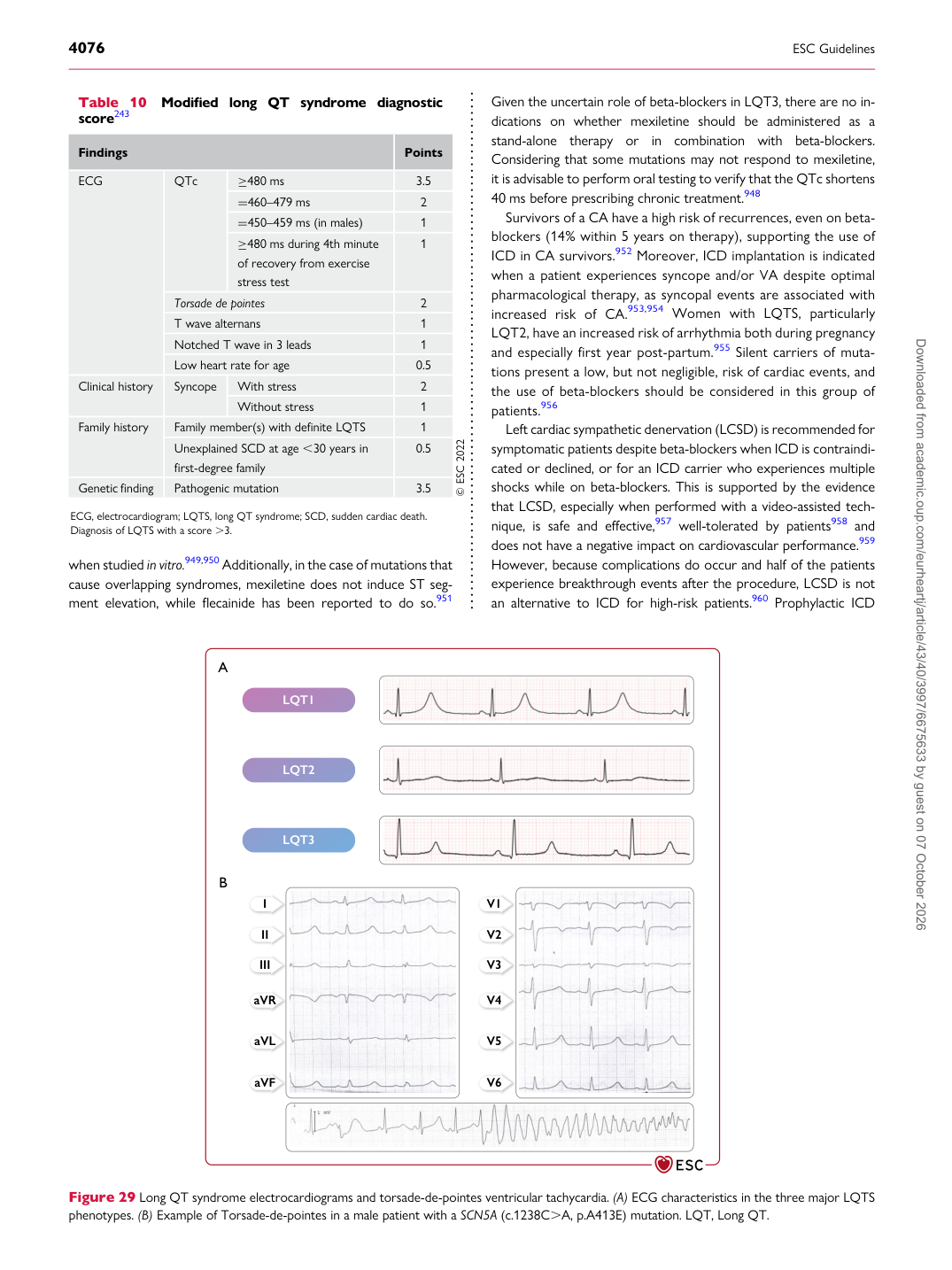
LQT1

LQT2

LQT3

A

B

I

II

III

aVR

aVL

aVF V1

V4

V5

V6

V2

V3

Figure 29 Long QT syndrome electrocardiograms and torsade-de-pointes ventricular tachycardia. (A) ECG characteristics in the three major LQTS phenotypes. (B) Example of Torsade-de-pointes in a male patient with a SCN5A (c.1238C.A, p.A413E) mutation. LQT, Long QT. Downloaded from academic.oup.com/eurheartj/article/43/40/3997/6675633 by guest on 07 October 2026