p.8 抽出テキスト
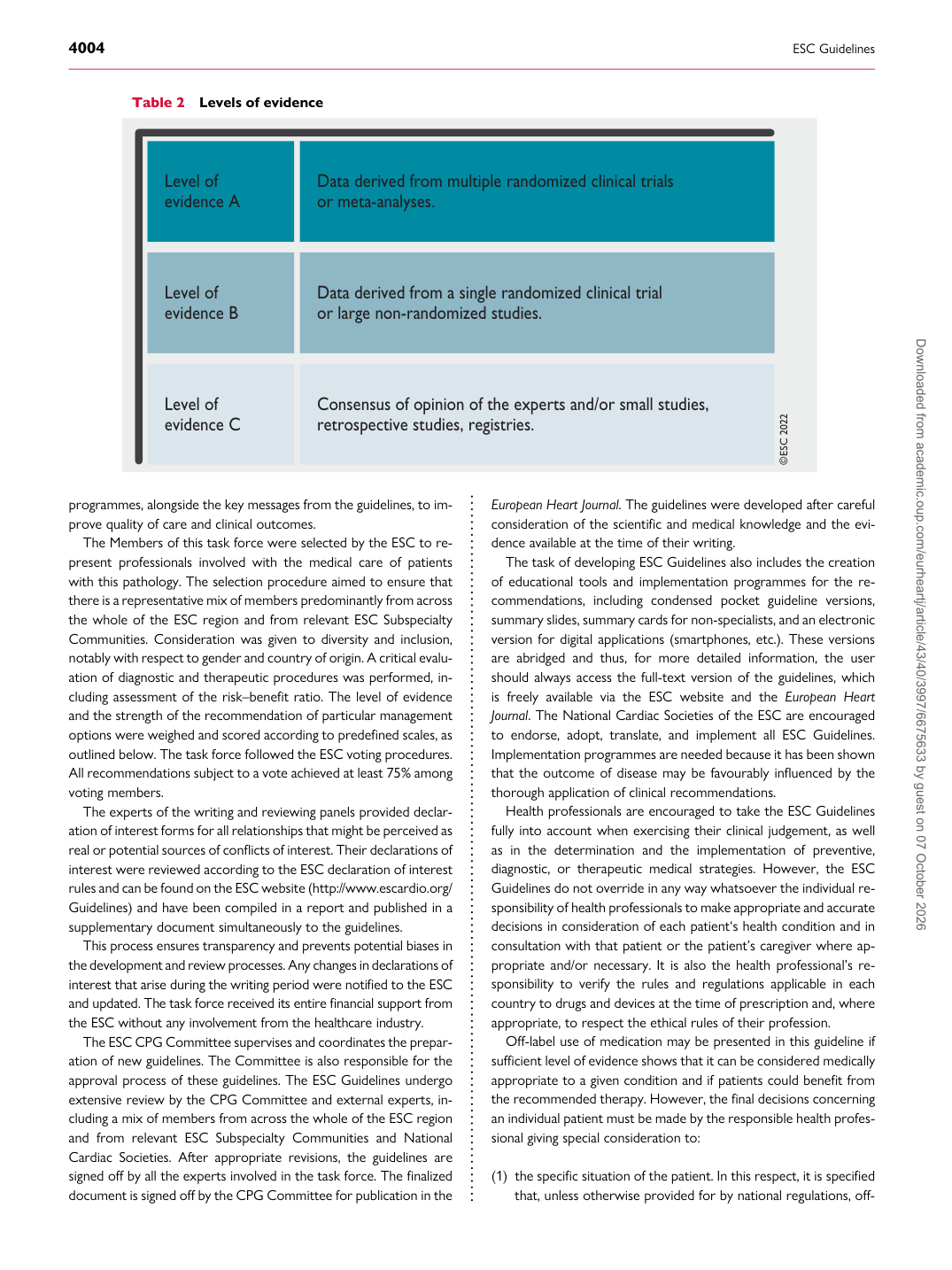
programmes, alongside the key messages from the guidelines, to improve quality of care and clinical outcomes. The Members of this task force were selected by the ESC to represent professionals involved with the medical care of patients with this pathology. The selection procedure aimed to ensure that there is a representative mix of members predominantly from across the whole of the ESC region and from relevant ESC Subspecialty Communities. Consideration was given to diversity and inclusion, notably with respect to gender and country of origin. A critical evaluation of diagnostic and therapeutic procedures was performed, including assessment of the risk–benefit ratio. The level of evidence and the strength of the recommendation of particular management options were weighed and scored according to predefined scales, as outlined below. The task force followed the ESC voting procedures. All recommendations subject to a vote achieved at least 75% among voting members. The experts of the writing and reviewing panels provided declaration of interest forms for all relationships that might be perceived as real or potential sources of conflicts of interest. Their declarations of interest were reviewed according to the ESC declaration of interest rules and can be found on the ESC website (http://www.escardio.org/ Guidelines) and have been compiled in a report and published in a supplementary document simultaneously to the guidelines. This process ensures transparency and prevents potential biases in the development and review processes. Any changes in declarations of interest that arise during the writing period were notified to the ESC and updated. The task force received its entire financial support from the ESC without any involvement from the healthcare industry. The ESC CPG Committee supervises and coordinates the preparation of new guidelines. The Committee is also responsible for the approval process of these guidelines. The ESC Guidelines undergo extensive review by the CPG Committee and external experts, including a mix of members from across the whole of the ESC region and from relevant ESC Subspecialty Communities and National Cardiac Societies. After appropriate revisions, the guidelines are signed off by all the experts involved in the task force. The finalized document is signed off by the CPG Committee for publication in the European Heart Journal. The guidelines were developed after careful consideration of the scientific and medical knowledge and the evidence available at the time of their writing.

The task of developing ESC Guidelines also includes the creation of educational tools and implementation programmes for the recommendations, including condensed pocket guideline versions, summary slides, summary cards for non-specialists, and an electronic version for digital applications (smartphones, etc.). These versions are abridged and thus, for more detailed information, the user should always access the full-text version of the guidelines, which is freely available via the ESC website and the European Heart Journal. The National Cardiac Societies of the ESC are encouraged to endorse, adopt, translate, and implement all ESC Guidelines. Implementation programmes are needed because it has been shown that the outcome of disease may be favourably influenced by the thorough application of clinical recommendations. Health professionals are encouraged to take the ESC Guidelines fully into account when exercising their clinical judgement, as well as in the determination and the implementation of preventive, diagnostic, or therapeutic medical strategies. However, the ESC Guidelines do not override in any way whatsoever the individual responsibility of health professionals to make appropriate and accurate decisions in consideration of each patient‘s health condition and in consultation with that patient or the patient’s caregiver where appropriate and/or necessary. It is also the health professional’s responsibility to verify the rules and regulations applicable in each country to drugs and devices at the time of prescription and, where appropriate, to respect the ethical rules of their profession. Off-label use of medication may be presented in this guideline if sufficient level of evidence shows that it can be considered medically appropriate to a given condition and if patients could benefit from the recommended therapy. However, the final decisions concerning an individual patient must be made by the responsible health professional giving special consideration to:

(1) the specific situation of the patient. In this respect, it is specified

that, unless otherwise provided for by national regulations, off-

Table 2 Levels of evidence

Level of evidence A

Level of evidence B

Level of evidence C Data derived from multiple randomized clinical trials or meta-analyses.

Data derived from a single randomized clinical trial or large non-randomized studies.

Consensus of opinion of the experts and/or small studies, retrospective studies, registries. ©ESC 2022 Downloaded from academic.oup.com/eurheartj/article/43/40/3997/6675633 by guest on 07 October 2026