p.77 抽出テキスト
7.2 Primary electrical disease

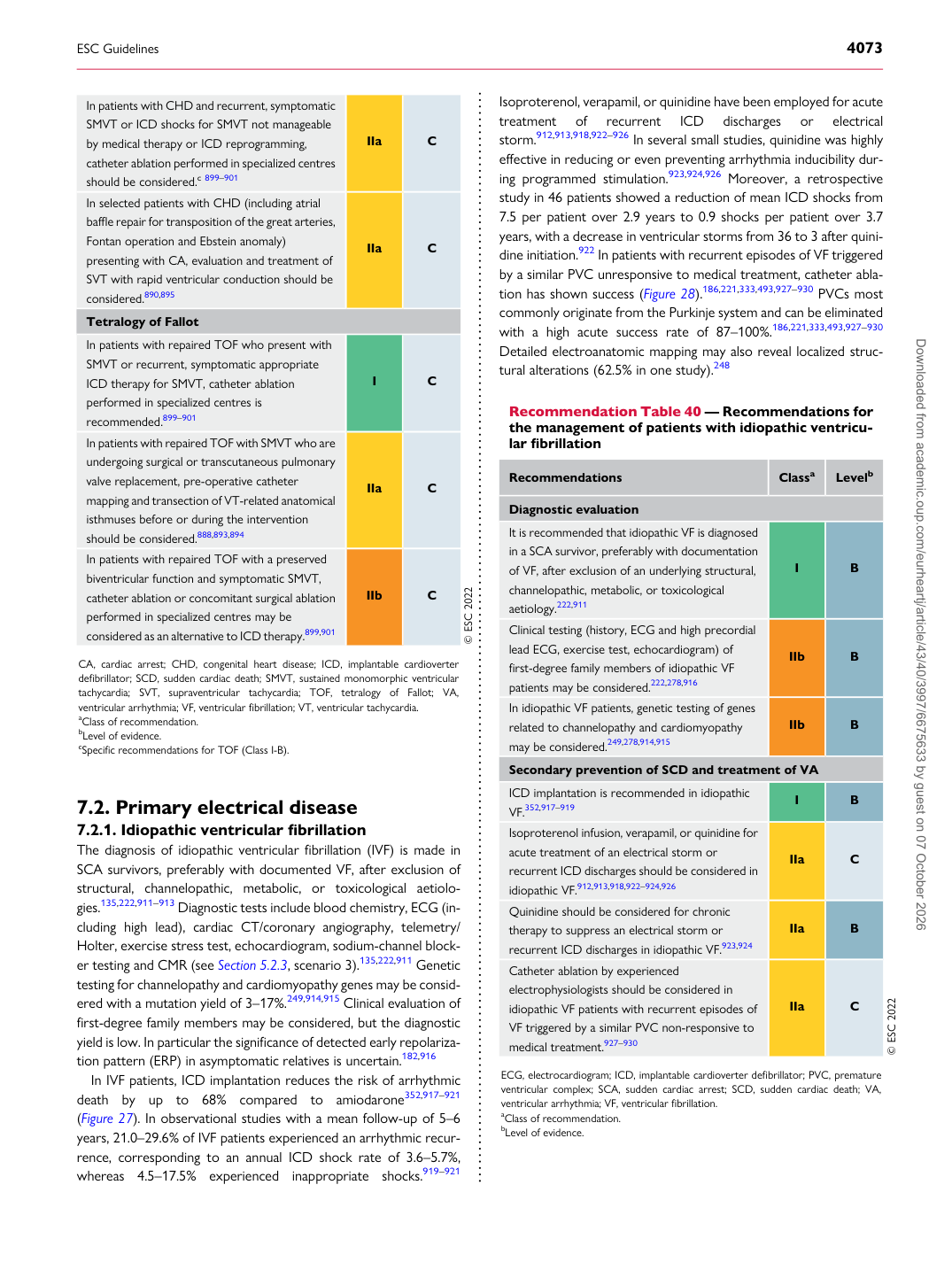
7.2.1. Idiopathic ventricular fibrillation The diagnosis of idiopathic ventricular fibrillation (IVF) is made in SCA survivors, preferably with documented VF, after exclusion of structural, channelopathic, metabolic, or toxicological aetiologies.135,222,911–913 Diagnostic tests include blood chemistry, ECG (including high lead), cardiac CT/coronary angiography, telemetry/ Holter, exercise stress test, echocardiogram, sodium-channel blocker testing and CMR (see Section 5.2.3, scenario 3).135,222,911 Genetic testing for channelopathy and cardiomyopathy genes may be considered with a mutation yield of 3–17%.249,914,915 Clinical evaluation of first-degree family members may be considered, but the diagnostic yield is low. In particular the significance of detected early repolarization pattern (ERP) in asymptomatic relatives is uncertain.182,916 In IVF patients, ICD implantation reduces the risk of arrhythmic death by up to 68% compared to amiodarone352,917–921 (Figure 27). In observational studies with a mean follow-up of 5–6 years, 21.0–29.6% of IVF patients experienced an arrhythmic recurrence, corresponding to an annual ICD shock rate of 3.6–5.7%, whereas 4.5–17.5% experienced inappropriate shocks.919–921 Isoproterenol, verapamil, or quinidine have been employed for acute treatment of recurrent ICD discharges or electrical storm.912,913,918,922–926 In several small studies, quinidine was highly effective in reducing or even preventing arrhythmia inducibility during programmed stimulation.923,924,926 Moreover, a retrospective study in 46 patients showed a reduction of mean ICD shocks from 7.5 per patient over 2.9 years to 0.9 shocks per patient over 3.7 years, with a decrease in ventricular storms from 36 to 3 after quinidine initiation.922 In patients with recurrent episodes of VF triggered by a similar PVC unresponsive to medical treatment, catheter ablation has shown success (Figure 28).186,221,333,493,927–930 PVCs most commonly originate from the Purkinje system and can be eliminated with a high acute success rate of 87–100%.186,221,333,493,927–930

Detailed electroanatomic mapping may also reveal localized structural alterations (62.5% in one study).248

In patients with CHD and recurrent, symptomatic SMVT or ICD shocks for SMVT not manageable by medical therapy or ICD reprogramming, catheter ablation performed in specialized centres should be considered.c 899–901 IIa C In selected patients with CHD (including atrial baffle repair for transposition of the great arteries, Fontan operation and Ebstein anomaly) presenting with CA, evaluation and treatment of SVT with rapid ventricular conduction should be considered.890,895 IIa C Tetralogy of Fallot In patients with repaired TOF who present with SMVT or recurrent, symptomatic appropriate ICD therapy for SMVT, catheter ablation performed in specialized centres is recommended.899–901 I C In patients with repaired TOF with SMVT who are undergoing surgical or transcutaneous pulmonary valve replacement, pre-operative catheter mapping and transection of VT-related anatomical isthmuses before or during the intervention should be considered.888,893,894 IIa C In patients with repaired TOF with a preserved biventricular function and symptomatic SMVT, catheter ablation or concomitant surgical ablation performed in specialized centres may be considered as an alternative to ICD therapy.899,901 IIb C © ESC 2022

CA, cardiac arrest; CHD, congenital heart disease; ICD, implantable cardioverter defibrillator; SCD, sudden cardiac death; SMVT, sustained monomorphic ventricular tachycardia; SVT, supraventricular tachycardia; TOF, tetralogy of Fallot; VA, ventricular arrhythmia; VF, ventricular fibrillation; VT, ventricular tachycardia. aClass of recommendation. bLevel of evidence. cSpecific recommendations for TOF (Class I-B). Recommendation Table 40 — Recommendations for the management of patients with idiopathic ventricular fibrillation

Recommendations Classa Levelb

Diagnostic evaluation It is recommended that idiopathic VF is diagnosed in a SCA survivor, preferably with documentation of VF, after exclusion of an underlying structural, channelopathic, metabolic, or toxicological aetiology.222,911 I B Clinical testing (history, ECG and high precordial lead ECG, exercise test, echocardiogram) of first-degree family members of idiopathic VF patients may be considered.222,278,916 IIb B In idiopathic VF patients, genetic testing of genes related to channelopathy and cardiomyopathy may be considered.249,278,914,915 IIb B Secondary prevention of SCD and treatment of VA ICD implantation is recommended in idiopathic VF.352,917–919 I B Isoproterenol infusion, verapamil, or quinidine for acute treatment of an electrical storm or recurrent ICD discharges should be considered in idiopathic VF.912,913,918,922–924,926 IIa C Quinidine should be considered for chronic therapy to suppress an electrical storm or recurrent ICD discharges in idiopathic VF.923,924 IIa B Catheter ablation by experienced electrophysiologists should be considered in idiopathic VF patients with recurrent episodes of VF triggered by a similar PVC non-responsive to medical treatment.927–930 IIa C © ESC 2022

ECG, electrocardiogram; ICD, implantable cardioverter defibrillator; PVC, premature ventricular complex; SCA, sudden cardiac arrest; SCD, sudden cardiac death; VA, ventricular arrhythmia; VF, ventricular fibrillation. aClass of recommendation. bLevel of evidence. Downloaded from academic.oup.com/eurheartj/article/43/40/3997/6675633 by guest on 07 October 2026