p.76 抽出テキスト
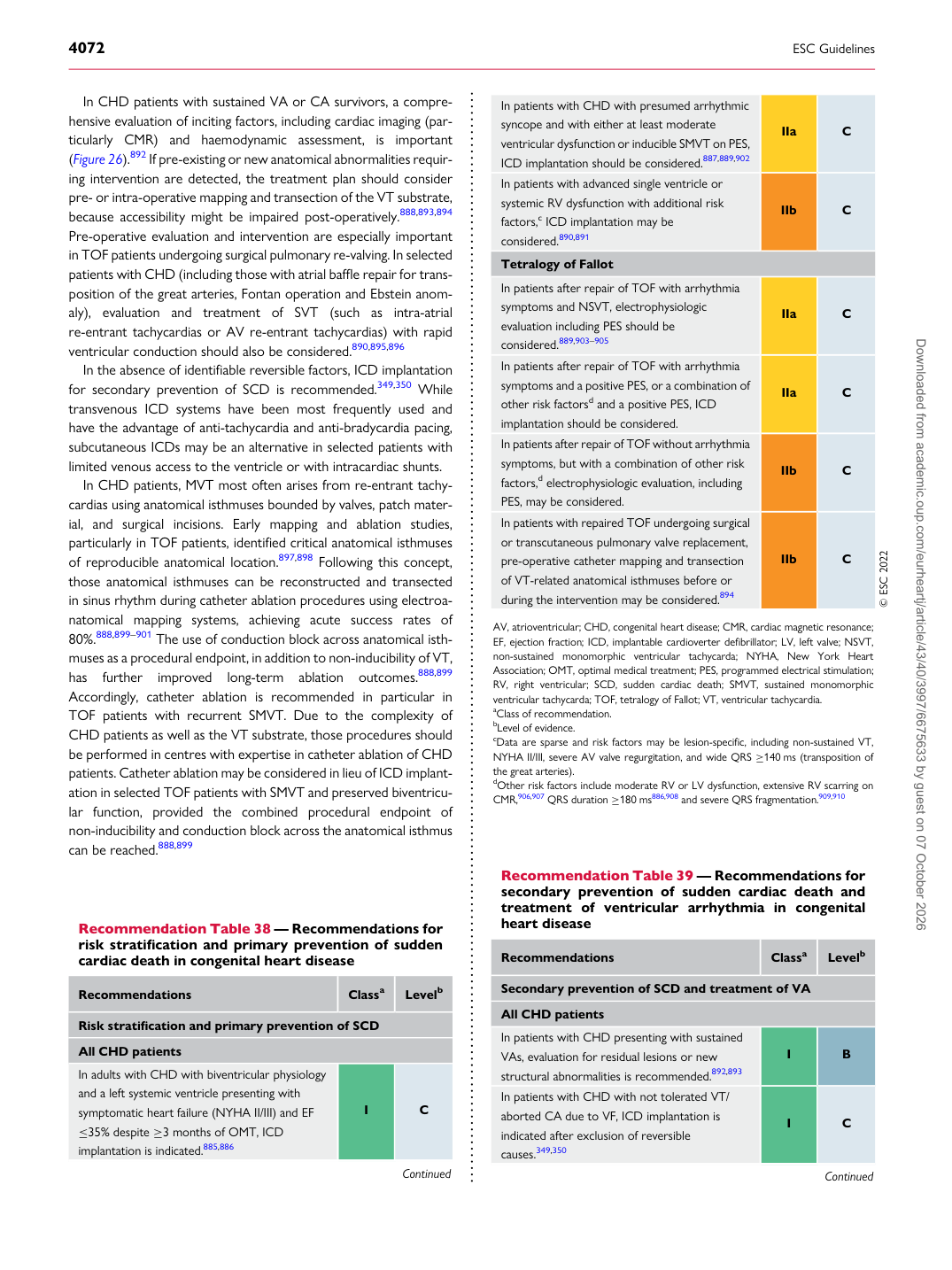
In CHD patients with sustained VA or CA survivors, a comprehensive evaluation of inciting factors, including cardiac imaging (particularly CMR) and haemodynamic assessment, is important (Figure 26).892 If pre-existing or new anatomical abnormalities requiring intervention are detected, the treatment plan should consider pre- or intra-operative mapping and transection of the VT substrate, because accessibility might be impaired post-operatively.888,893,894 Pre-operative evaluation and intervention are especially important in TOF patients undergoing surgical pulmonary re-valving. In selected patients with CHD (including those with atrial baffle repair for transposition of the great arteries, Fontan operation and Ebstein anomaly), evaluation and treatment of SVT (such as intra-atrial re-entrant tachycardias or AV re-entrant tachycardias) with rapid ventricular conduction should also be considered.890,895,896 In the absence of identifiable reversible factors, ICD implantation for secondary prevention of SCD is recommended.349,350 While transvenous ICD systems have been most frequently used and have the advantage of anti-tachycardia and anti-bradycardia pacing, subcutaneous ICDs may be an alternative in selected patients with limited venous access to the ventricle or with intracardiac shunts. In CHD patients, MVT most often arises from re-entrant tachycardias using anatomical isthmuses bounded by valves, patch material, and surgical incisions. Early mapping and ablation studies, particularly in TOF patients, identified critical anatomical isthmuses of reproducible anatomical location.897,898 Following this concept, those anatomical isthmuses can be reconstructed and transected in sinus rhythm during catheter ablation procedures using electroanatomical mapping systems, achieving acute success rates of 80%.888,899–901 The use of conduction block across anatomical isthmuses as a procedural endpoint, in addition to non-inducibility of VT, has further improved long-term ablation outcomes.888,899 Accordingly, catheter ablation is recommended in particular in TOF patients with recurrent SMVT. Due to the complexity of CHD patients as well as the VT substrate, those procedures should be performed in centres with expertise in catheter ablation of CHD patients. Catheter ablation may be considered in lieu of ICD implantation in selected TOF patients with SMVT and preserved biventricular function, provided the combined procedural endpoint of non-inducibility and conduction block across the anatomical isthmus can be reached.888,899

Recommendation Table 38 — Recommendations for risk stratification and primary prevention of sudden cardiac death in congenital heart disease

Recommendations Classa Levelb

Risk stratification and primary prevention of SCD All CHD patients In adults with CHD with biventricular physiology and a left systemic ventricle presenting with symptomatic heart failure (NYHA II/III) and EF ≤35% despite ≥3 months of OMT, ICD implantation is indicated.885,886 I C

Continued In patients with CHD with presumed arrhythmic

syncope and with either at least moderate ventricular dysfunction or inducible SMVT on PES, ICD implantation should be considered.887,889,902 IIa C In patients with advanced single ventricle or systemic RV dysfunction with additional risk factors,c ICD implantation may be considered.890,891 IIb C Tetralogy of Fallot In patients after repair of TOF with arrhythmia symptoms and NSVT, electrophysiologic evaluation including PES should be considered.889,903–905 IIa C In patients after repair of TOF with arrhythmia symptoms and a positive PES, or a combination of other risk factorsd and a positive PES, ICD implantation should be considered. IIa C In patients after repair of TOF without arrhythmia symptoms, but with a combination of other risk factors,d electrophysiologic evaluation, including PES, may be considered. IIb C In patients with repaired TOF undergoing surgical or transcutaneous pulmonary valve replacement, pre-operative catheter mapping and transection of VT-related anatomical isthmuses before or during the intervention may be considered.894 IIb C © ESC 2022

AV, atrioventricular; CHD, congenital heart disease; CMR, cardiac magnetic resonance; EF, ejection fraction; ICD, implantable cardioverter defibrillator; LV, left valve; NSVT, non-sustained monomorphic ventricular tachycarda; NYHA, New York Heart Association; OMT, optimal medical treatment; PES, programmed electrical stimulation; RV, right ventricular; SCD, sudden cardiac death; SMVT, sustained monomorphic ventricular tachycarda; TOF, tetralogy of Fallot; VT, ventricular tachycardia. aClass of recommendation. bLevel of evidence. cData are sparse and risk factors may be lesion-specific, including non-sustained VT, NYHA II/III, severe AV valve regurgitation, and wide QRS ≥140 ms (transposition of the great arteries). dOther risk factors include moderate RV or LV dysfunction, extensive RV scarring on CMR,906,907 QRS duration ≥180 ms886,908 and severe QRS fragmentation.909,910

Recommendation Table 39 — Recommendations for secondary prevention of sudden cardiac death and treatment of ventricular arrhythmia in congenital heart disease

Recommendations Classa Levelb

Secondary prevention of SCD and treatment of VA All CHD patients In patients with CHD presenting with sustained VAs, evaluation for residual lesions or new structural abnormalities is recommended.892,893 I B In patients with CHD with not tolerated VT/ aborted CA due to VF, ICD implantation is indicated after exclusion of reversible causes.349,350 I C

Continued Downloaded from academic.oup.com/eurheartj/article/43/40/3997/6675633 by guest on 07 October 2026