p.75 抽出テキスト
7.1.6 Congenital heart disease

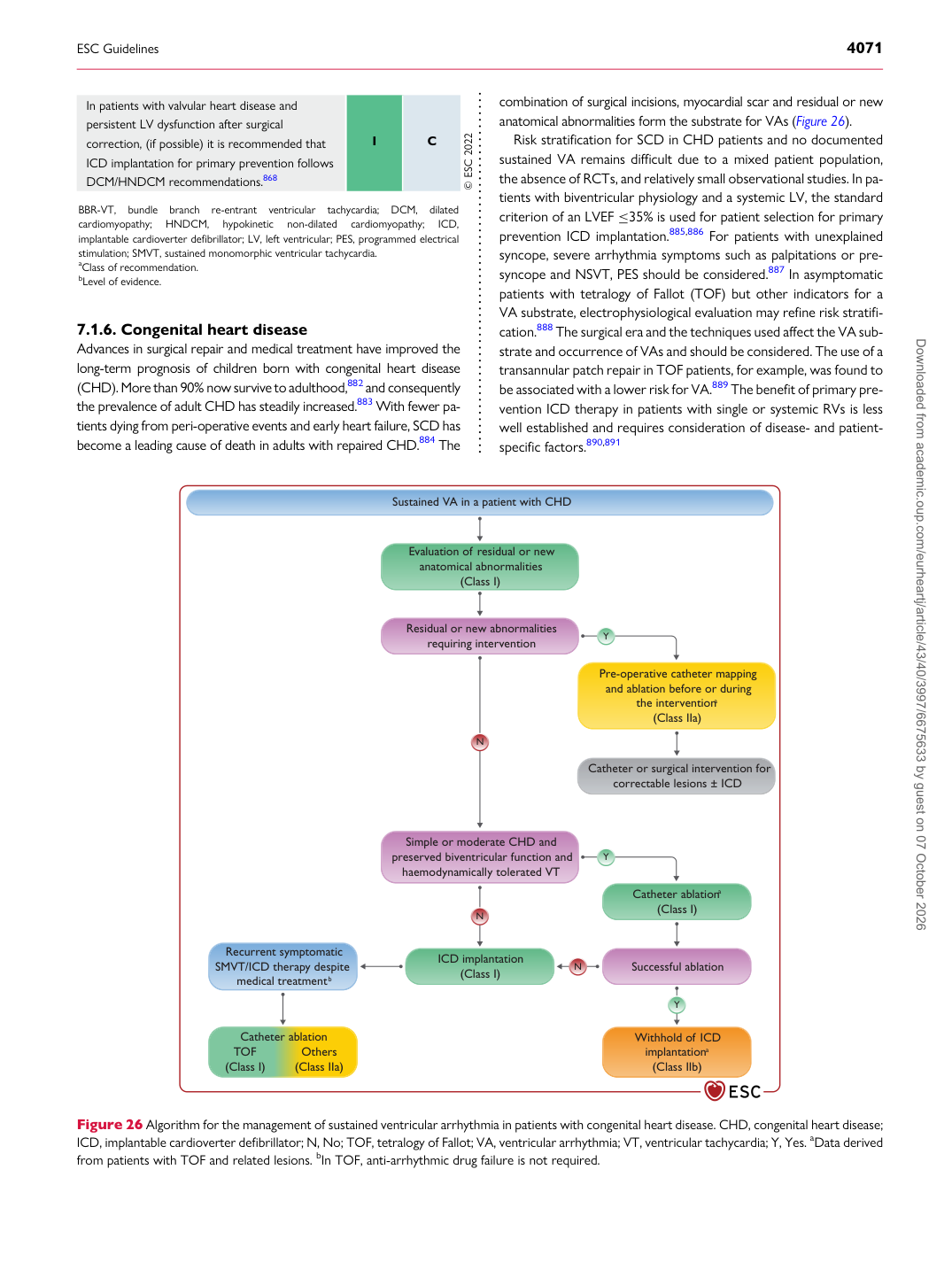
Advances in surgical repair and medical treatment have improved the long-term prognosis of children born with congenital heart disease (CHD). More than 90% now survive to adulthood,882 and consequently the prevalence of adult CHD has steadily increased.883 With fewer patients dying from peri-operative events and early heart failure, SCD has become a leading cause of death in adults with repaired CHD.884 The combination of surgical incisions, myocardial scar and residual or new anatomical abnormalities form the substrate for VAs (Figure 26).

Risk stratification for SCD in CHD patients and no documented sustained VA remains difficult due to a mixed patient population, the absence of RCTs, and relatively small observational studies. In patients with biventricular physiology and a systemic LV, the standard criterion of an LVEF ≤35% is used for patient selection for primary prevention ICD implantation.885,886 For patients with unexplained syncope, severe arrhythmia symptoms such as palpitations or presyncope and NSVT, PES should be considered.887 In asymptomatic patients with tetralogy of Fallot (TOF) but other indicators for a VA substrate, electrophysiological evaluation may refine risk stratification.888 The surgical era and the techniques used affect the VA substrate and occurrence of VAs and should be considered. The use of a transannular patch repair in TOF patients, for example, was found to be associated with a lower risk for VA.889 The benefit of primary prevention ICD therapy in patients with single or systemic RVs is less well established and requires consideration of disease- and patientspecific factors.890,891

Sustained VA in a patient with CHD

Simple or moderate CHD and preserved biventricular function and

haemodynamically tolerated VT Catheter or surgical intervention for

correctable lesions ± ICD

Pre-operative catheter mapping and ablation before or during

the interventiona

(Class IIa)

N

N

Residual or new abnormalities

requiring intervention

Evaluation of residual or new

anatomical abnormalities

(Class I)

N

Successful ablation

Withhold of ICD

implantationa (Class IIb)

Recurrent symptomatic SMVT/ICD therapy despite

medical treatmentb

Catheter ablation ICD implantation

(Class I) Catheter ablationa

(Class I)

TOF (Class I) Others (Class IIa) Y

Y Y

Figure 26 Algorithm for the management of sustained ventricular arrhythmia in patients with congenital heart disease. CHD, congenital heart disease; ICD, implantable cardioverter defibrillator; N, No; TOF, tetralogy of Fallot; VA, ventricular arrhythmia; VT, ventricular tachycardia; Y, Yes. aData derived from patients with TOF and related lesions. bIn TOF, anti-arrhythmic drug failure is not required.

In patients with valvular heart disease and persistent LV dysfunction after surgical correction, (if possible) it is recommended that ICD implantation for primary prevention follows DCM/HNDCM recommendations.868 I C © ESC 2022

BBR-VT, bundle branch re-entrant ventricular tachycardia; DCM, dilated cardiomyopathy; HNDCM, hypokinetic non-dilated cardiomyopathy; ICD, implantable cardioverter defibrillator; LV, left ventricular; PES, programmed electrical stimulation; SMVT, sustained monomorphic ventricular tachycardia. aClass of recommendation. bLevel of evidence.

Downloaded from academic.oup.com/eurheartj/article/43/40/3997/6675633 by guest on 07 October 2026