p.74 抽出テキスト
7.1.5 Valvular heart disease

Valvular heart diseases predispose to SCD both in the preoperative period and after valvular surgery. In old cohorts of symptomatic, non-operated patients with severe aortic stenosis or severe mitral regurgitation, the incidence of SCD was 50–60%. In these studies, the rate of SCD secondary to VA was not specified.861,862 Rates of SCD in patients with prosthetic valves range from 15% to 30%, with an estimated annual risk of 0.2–0.9%.863 In a large series of 1533 patients who underwent aortic or mitral valve replacement, 6% of deaths were caused by arrhythmias.864 A recent report of 3726 patients undergoing transcatheter aortic valve implantation (TAVI) showed 5.6% SCD during 22 months of followup, emphasizing the remaining SCD risk also after valve replacement.865 Small observational studies have shown that patients with residual LV dysfunction after valvular surgery who undergo ICD implantation have appropriate therapy and mortality rates similar to patients with ischaemic or dilated cardiomyopathy.866–868 ICD implantation in these patients should therefore follow DCM/HNDCM recommendations. In patients after TAVI, SCD has been associated with the presence of new-onset conduction disturbances (LBBB, QRS . 160 ms) and reduced LVEF ≤40%.865 SCD in these patients may be the consequence of advanced AV block, and permanent pacing indication should follow the 2021 ESC Guidelines on cardiac pacing and cardiac resynchronization therapy.2 The role of ICD implantation for prevention of SCD after TAVI is less clear. Two recent retrospective analyses including a total of 203 patients in whom the LVEF remained ≤35% did not show survival benefit from ICD implantation, probably related to the high competing risk of death from heart failure and relevant comorbidities in this population.869,870

In patients presenting with SMVT after aortic valve replacement, PES is indicated because of the high probability of BBR-VT as the underlying mechanism—an arrhythmia that is potentially curable with catheter ablation.871,872 SCD has been reported to occur in 0.2–0.4% of patients with MVP per year.873,874 However, the total number of patients dying suddenly with this condition is most likely underestimated, considering that it is a common valve variant with an estimated prevalence of 2–3% in the general population.875 Using rigorous criteria for morphologic diagnosis (i.e. myxomatous mitral valve) at post-mortem, MVP has been associated with 7% of all cases of juvenile SCD in the Registry of the Veneto region of Italy.228 Recent pathological and clinical studies on SCD victims with MVP or patients with MVP and major VAs have provided insights into the potential VA substrate.130,228,876–880 In particular, myocardial fibrosis affecting both the infero-basal LV free wall and the papillary muscles has been recognized in pathological and LGE-CMR studies.228 The scarring process has been related to mechanical stretch secondary to the excessive mobility of the mitral valve apparatus due to mitral valvular disjunction and posterior systolic curling.876 This indicates a promising role of CMR for arrhythmic risk stratification beyond traditional electrophysiological markers. Proposed criteria for an ‘arrhythmic MVP syndrome’ that have been associated with an increased risk for SCD include: young adults (most often women), QTc prolongation and/or negative T-wave in inferior ECG leads, mitral annular disjunction, bi-leaflet involvement on echocardiography, frequent PVCs, or nonsustained PVT on Holter monitoring and/or exercise testing.130,228,876–880 Reduced LVEF and/or myocardial fibrosis on CMR may add to the risk profile. These data are mainly derived from small retrospective series of SCD survivors and post-mortem studies. Therefore, identification of the small subgroup of patients at risk of SCD remains challenging.228,874 Robust data to support recommendations for risk stratification of SCD in patients with MVP are not available.

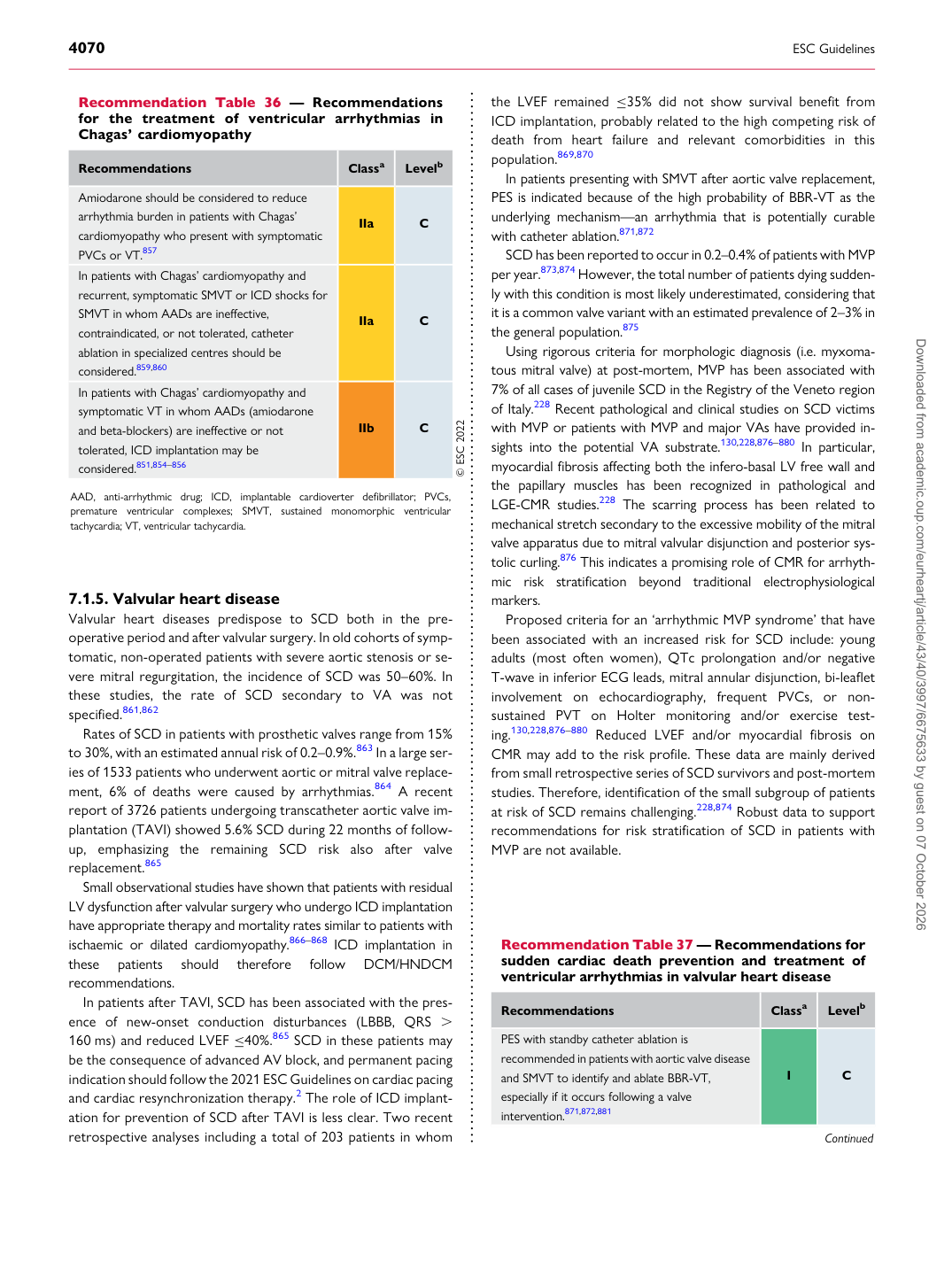
Recommendation Table 36 — Recommendations for the treatment of ventricular arrhythmias in Chagas’ cardiomyopathy

Recommendations Classa Levelb

Amiodarone should be considered to reduce arrhythmia burden in patients with Chagas’ cardiomyopathy who present with symptomatic PVCs or VT.857 IIa C In patients with Chagas’ cardiomyopathy and recurrent, symptomatic SMVT or ICD shocks for SMVT in whom AADs are ineffective, contraindicated, or not tolerated, catheter ablation in specialized centres should be considered.859,860 IIa C In patients with Chagas’ cardiomyopathy and symptomatic VT in whom AADs (amiodarone and beta-blockers) are ineffective or not tolerated, ICD implantation may be considered.851,854–856 IIb C © ESC 2022

AAD, anti-arrhythmic drug; ICD, implantable cardioverter defibrillator; PVCs, premature ventricular complexes; SMVT, sustained monomorphic ventricular tachycardia; VT, ventricular tachycardia.

Recommendation Table 37 — Recommendations for sudden cardiac death prevention and treatment of ventricular arrhythmias in valvular heart disease

Recommendations Classa Levelb

PES with standby catheter ablation is recommended in patients with aortic valve disease and SMVT to identify and ablate BBR-VT, especially if it occurs following a valve intervention.871,872,881 I C

Continued Downloaded from academic.oup.com/eurheartj/article/43/40/3997/6675633 by guest on 07 October 2026